

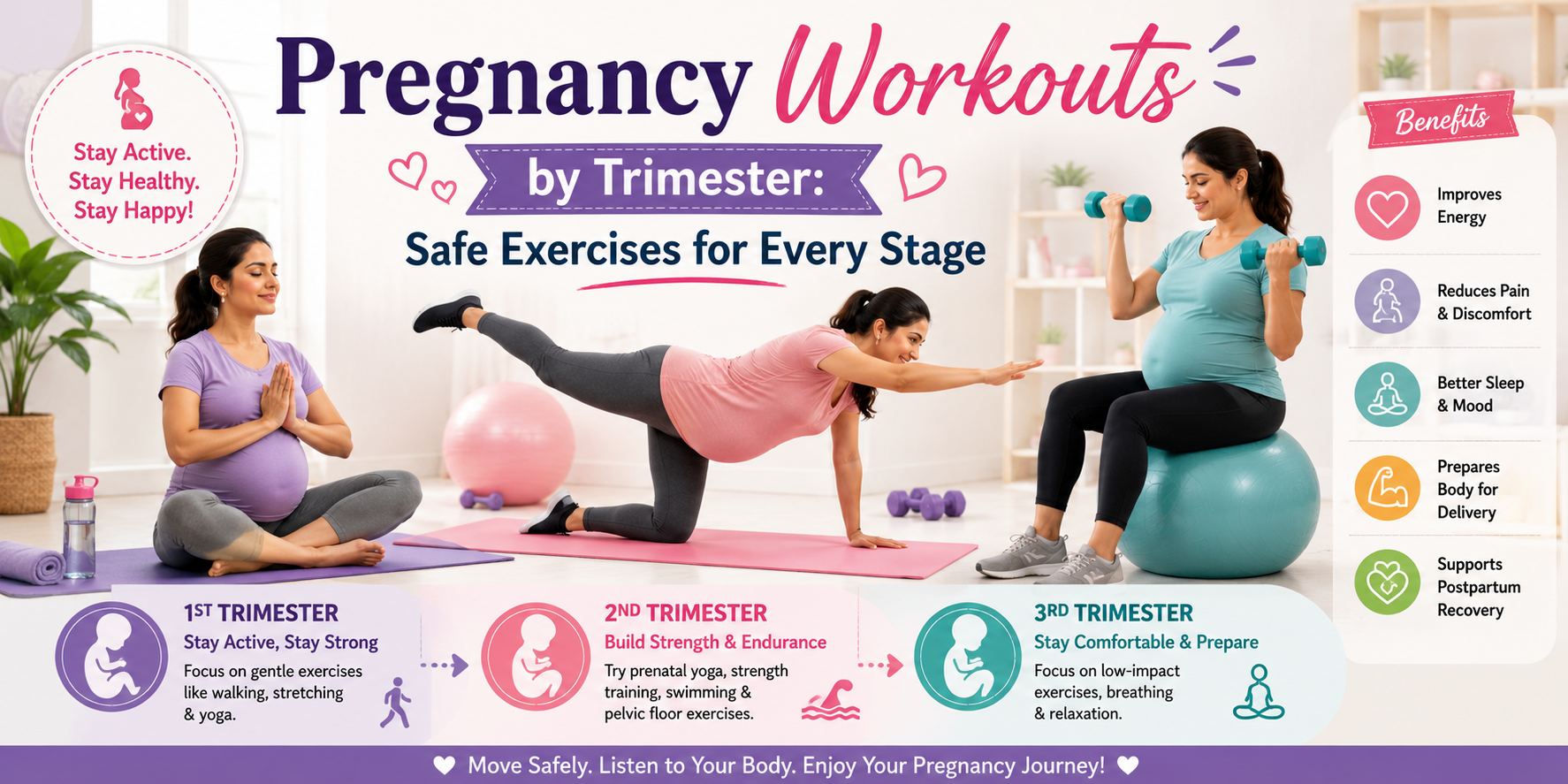
Meta Title: Safe Pregnancy Workouts by Trimester: Exercise Guide for Indian Mothers | FirstChoiceClubMeta Description: Which exercises are safe during pregnancy? Our trimester-by-trimester guide covers prenatal yoga, walking, swimming and pelvic floor exercises for Indian mothers.📢 Affiliate Disclosure: This post contains affiliate links through our Amazon India storefront. We may earn a small commission at no extra cost to you.Exercise during pregnancy is one of the most evidence-backed ways to support your own health and your baby's development. Regular moderate physical activity during an uncomplicated pregnancy reduces the risk of gestational diabetes, excessive weight gain, preeclampsia, back pain, and postpartum depression — and significantly improves sleep quality and energy levels.And yet, many Indian mothers are advised to "rest completely" during pregnancy — sometimes by well-meaning family members, sometimes even by older-school doctors. This guidance is outdated. The Indian Academy of Obstetrics and Gynaecology, the American College of Obstetricians and Gynecologists, and the WHO all recommend at least 150 minutes of moderate physical activity per week throughout an uncomplicated pregnancy.First Trimester (Weeks 1–12): Gentle FoundationsThe first trimester is often the hardest for exercise — not because activity is dangerous, but because exhaustion and nausea make it genuinely difficult. If you can manage only short walks and gentle stretching, that is sufficient and valuable.Safe exercises: Brisk walking, prenatal yoga, swimming, low-impact aerobics, light strength training with body weight or light weights.What to avoid: High-impact contact sports, exercises with fall risk, activities requiring lying flat on your back for extended periods (after week 12), and any activity that leaves you unable to hold a conversation (the "talk test").First trimester tip: Exercise in the morning before nausea peaks. Even 20 minutes of walking is meaningful. Ginger tea before exercise can reduce exercise-induced nausea.🛒 Recommended ProductNon-Slip Prenatal Yoga Mat — Extra ThickA thick, non-slip yoga mat provides the joint cushioning and stability you need as your centre of gravity shifts during pregnancy. Look for 6mm or thicker for comfortable floor exercises.Shop on Amazon India →Second Trimester (Weeks 13–26): The Active WindowThe second trimester is typically the best period for pregnancy exercise. Nausea has usually resolved, energy levels improve, and the bump is not yet large enough to significantly restrict movement. This is the time to build fitness habits that will serve you through the rest of pregnancy.Highly recommended activities:Prenatal yoga: Builds flexibility, pelvic floor strength, and breathing techniques directly useful in labour. Many Indian cities now have dedicated prenatal yoga classes.Swimming: One of the best pregnancy exercises — completely non-impact, supports the weight of your bump, and keeps you cool. Particularly beneficial in India's hot climate.Walking: Accessible, free, and appropriate at all fitness levels. Aim for 30 minutes most days.Pelvic floor exercises (Kegels): Not a workout per se, but essential from trimester one through postpartum recovery.What to avoid from 20 weeks: Exercises lying flat on your back (the growing uterus can compress the vena cava vein), contact sports, hot yoga or any exercise in intense heat, and heavy lifting above your head.🛒 Recommended ProductMaternity Support Belt / Pregnancy Belly BandA maternity support belt reduces the strain on your lower back and pelvis during walking and exercise from the second trimester onwards. Particularly useful if you experience pelvic girdle pain (PGP), which is very common in Indian mothers who spend time on their feet.Shop on Amazon India →Third Trimester (Weeks 27–40): Prepare and PreserveExercise in the third trimester requires modifications but remains beneficial and important. The goals shift: maintain fitness, manage discomfort, prepare your body for labour, and protect sleep quality.Reduce intensity — use the talk test to ensure you're not overexertingWalking remains excellent right up to your due date if comfortablePrenatal yoga classes often shift focus to labour preparation breathing and positionsAvoid lying on your back — use a left-side lying position or elevated propListen aggressively to your body — discomfort and pain are signals to stopIndian-Specific ConsiderationsSeveral cultural exercise questions come up repeatedly among Indian mothers:Is squatting safe in pregnancy? Yes — deep squatting is actually encouraged in late pregnancy as it opens the pelvis and can support optimal fetal positioning. Many midwives and doulas actively recommend squatting practice.Is yoga contraindicated in early pregnancy? No — gentle prenatal yoga is safe from early pregnancy. Avoid hot yoga, deep twists, and inversions (headstands, shoulder stands) throughout pregnancy.Warning Signs to Stop Exercise ImmediatelyVaginal bleeding or fluid leakingDizziness, faintness or shortness of breath at restChest pain or heart palpitationsPainful uterine contractionsSevere abdominal painIf you experience any of these, stop immediately and contact your doctor.Frequently Asked QuestionsIs it safe to exercise in the first trimester in India?Yes, for women with uncomplicated pregnancies. Gentle exercise in the first trimester is safe and beneficial. Always inform your doctor of your exercise plans.Can I do surya namaskar during pregnancy?Modified versions are generally acceptable in the first trimester. From the second trimester, full Surya Namaskar should be avoided and replaced with prenatal yoga sequences designed for pregnancy.Is walking enough exercise during pregnancy?Yes — 30 minutes of brisk walking most days of the week meets the recommended exercise guidelines for pregnancy and provides significant health benefits.Can I start exercising during pregnancy if I was not active before?Yes. Start with 10–15 minute gentle walks and gradually increase. Pregnancy is actually a motivating time to begin regular physical activity for many women.What exercises help with labour preparation?Squats, pelvic rocking, cat-cow yoga pose, and walking all encourage optimal fetal positioning and strengthen the muscles used during labour and pushing.Find certified prenatal yoga classes and maternity fitness centres near you at firstchoiceclub.in.
03 Jun
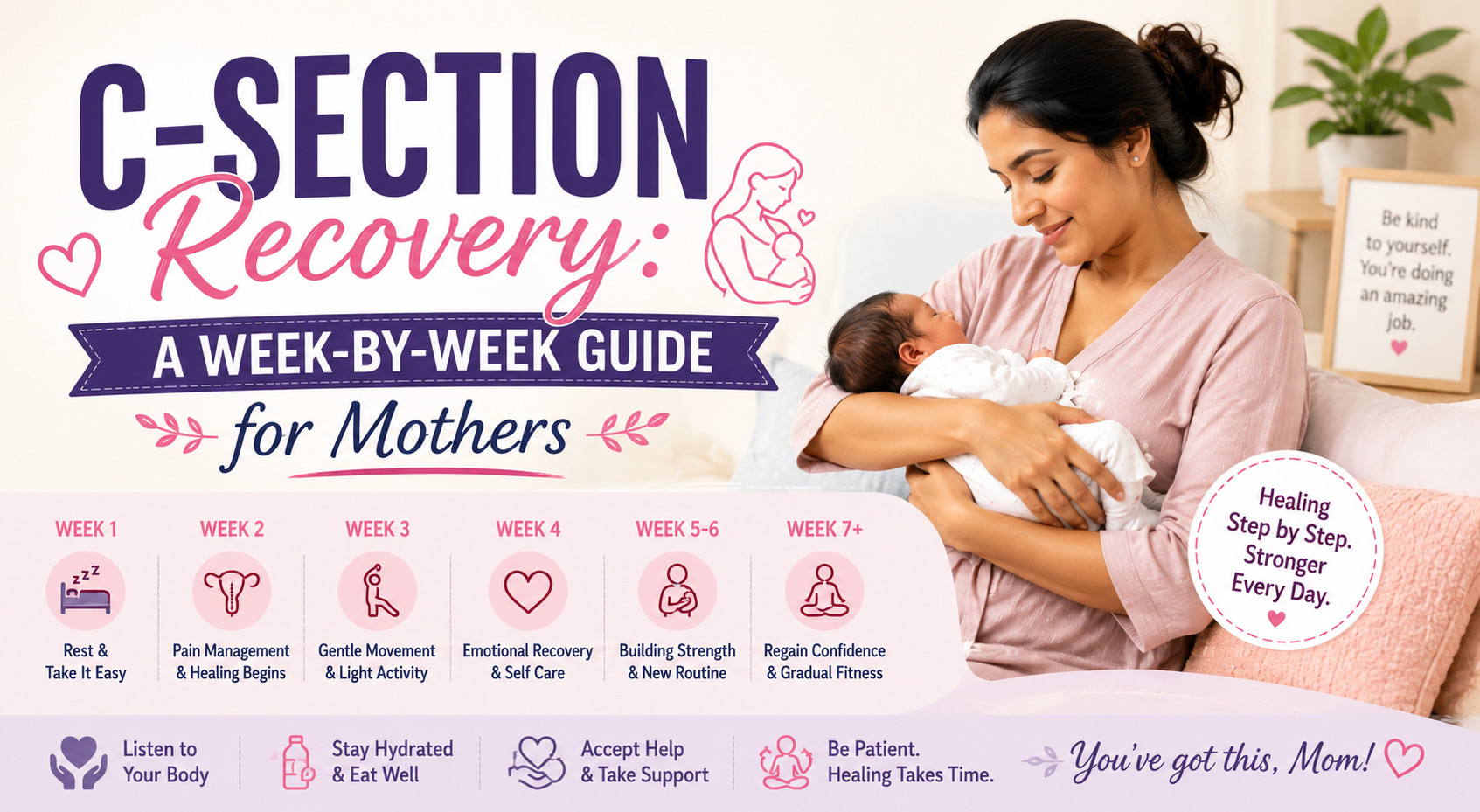
Meta Title: C-Section Recovery Week by Week: Complete Guide for Indian Mothers | FirstChoiceClubMeta Description: Recovering from a caesarean in India? Our week-by-week guide covers wound care, diet, Japa traditions, and when to resume normal activity after a C-section.📢 Affiliate Disclosure: This post contains affiliate links through our Amazon India storefront. We may earn a small commission at no extra cost to you.A caesarean section is major abdominal surgery — and yet many new mothers in India feel pressure to "bounce back" within days, particularly with household expectations and the demands of a newborn. Understanding the true timeline of C-section recovery is one of the most important things you can do for your long-term health and wellbeing.In India, approximately 17% of deliveries nationally (and over 40% in private hospitals in major cities) are caesarean births. If this was your birth experience, this guide is written for you.Week 1: The Hospital and Immediate RecoveryThe first 24–48 hours after a C-section are spent in hospital recovery. You will have a urinary catheter, IV fluids, and pain management medication. Most women begin to sit up and attempt short walks within 12–24 hours of surgery — early mobility is important to prevent blood clots and support healing, even though it is genuinely uncomfortable.Your wound will be covered with a dressing. Do not attempt to look at it until your doctor changes it. Wound pain is normal and manageable with the prescribed medications — do not try to manage without them in the first days. You need to be comfortable enough to breathe deeply and move, which is essential for recovery.Breastfeeding is possible after a C-section and should be started as soon as you and your baby are stable. A nursing pillow placed over the wound area protects the incision from your baby's weight during feeding.🛒 RECOMMENDED PRODUCTC-Section Recovery Belly Binder / Abdominal Support BeltAn abdominal binder worn from around day 3 post-surgery provides gentle compression that reduces pain with movement, supports the wound area, and helps with the feeling of internal instability many C-section mothers experience. Ask your doctor before use.Shop on Amazon India →Week 2: Home Recovery BeginsMost C-section mothers are discharged after 3–5 days. The second week at home is the most challenging — you are in a new environment without hospital support, managing a newborn while significantly limited in what you can do physically.You must not lift anything heavier than your baby for at least 6 weeksClimbing stairs should be minimised and done very slowlyDriving is not permitted for at least 6 weeksYour wound may itch, tighten, and feel numb — all are normalWatch for signs of infection: redness spreading beyond the incision, increased swelling, discharge, fever above 38°C, or wound that opensFamily support during this week is not optional — it is medically essential. This is the traditional period for Japa care in Indian families, and the wisdom of that tradition is well-supported by modern medicine.Weeks 3–4: Gradual ImprovementBy weeks 3 and 4, most women notice a significant improvement in pain levels and mobility. Short walks are encouraged and beneficial. You may begin to feel more like yourself, but the internal healing from major surgery continues long after the surface appears healed.The internal scar tissue takes 6–8 weeks to adequately heal and up to 12 months to fully remodel. This is why restrictions on lifting, sex, and strenuous exercise last 6 weeks minimum.🛒 RECOMMENDED PRODUCTSilicone Scar Sheets for C-SectionSilicone scar sheets, worn over the healed wound from about 6 weeks onwards, are one of the most evidence-supported methods for reducing the appearance of caesarean scars. Consistent daily use over 8–12 weeks produces the best results.Shop on Amazon India →Weeks 5–6: Approaching ClearanceYour 6-week postnatal check-up is a critical appointment. Your doctor will examine the wound, assess your recovery, and advise on resuming activities including exercise, sex, and driving. Do not skip this appointment even if you feel well — internal healing and pelvic floor assessment cannot be done without examination.C-Section Recovery Diet: Indian Foods That HelpNutrition is essential for tissue healing after surgery. Traditional Indian postnatal foods align well with this need:Ghee: Anti-inflammatory, rich in fat-soluble vitamins. Add to dals, khichdi and roti in moderation.Methi (fenugreek): Supports milk production and digestion. Used in ladoos and rotis in North Indian tradition.Ajwain (carom seeds): Supports digestion and reduces post-surgical gas — a significant discomfort after abdominal surgery.Dals and legumes: High-quality protein essential for wound healing.Drumstick leaves (moringa): Exceptionally iron-rich, important after surgical blood loss.Constipation is common after a C-section due to anaesthesia, pain medications, and reduced mobility. Eat fibre-rich foods, stay well hydrated, and do not strain during bowel movements — straining places pressure on the abdominal wound.🛒 RECOMMENDED PRODUCTPostnatal Vitamins for Breastfeeding MothersPostnatal multivitamins formulated for breastfeeding mothers cover the increased nutritional demands of recovery and milk production simultaneously — iron, vitamin D, calcium, and omega-3 are particularly important post-C-section.Shop on Amazon India →When to Call Your Doctor ImmediatelyContact your doctor without delay if you experience: fever above 38°C, wound that opens or has new discharge, heavy vaginal bleeding (soaking more than one pad per hour), severe abdominal pain that is worsening rather than improving, signs of blood clot (leg pain, swelling, shortness of breath), or any gut instinct that something is wrong. Trust yourself — you know your body.Frequently Asked QuestionsHow long does C-section recovery take in India?Most women feel significantly better by 6 weeks, but full internal healing takes 3–6 months. Heavy lifting restrictions apply for a minimum of 6 weeks.Can I sit on the floor after a C-section?Sitting on the floor is very difficult in the first 2–3 weeks and should be avoided. Most Indian homes benefit from a firm chair or bed during this period.When can I start exercising after C-section?Only after your 6-week postnatal clearance and with your doctor's explicit permission. Start with walking, then gentle pelvic floor exercises, then gradually increase intensity over months.Is Japa massage safe after C-section?Abdominal massage is not safe until the wound is fully healed — usually around 6–8 weeks. Traditional Japa body massage on limbs, back and legs is generally safe earlier. Always inform your Japa caregiver of your C-section.Can I get pregnant again after C-section?Yes, but most doctors in India recommend waiting at least 18–24 months before the next pregnancy to allow the uterine scar to heal adequately.Find trusted postnatal care services including Japa care providers near you at firstchoiceclub.in.
27 May

Meta Title: Hospital Bag Checklist India 2026: Complete Packing List for Delivery | FirstChoiceClubMeta Description: Don't forget a thing! Our complete hospital bag checklist for Indian mothers covers everything for mom, baby, and partner — for both government and private hospitals.📢 Affiliate Disclosure: This post contains affiliate links through our Amazon India storefront. We may earn a small commission at no extra cost to you when you purchase through these links.Packing your hospital bag is one of the most exciting — and anxiety-inducing — tasks of late pregnancy. Pack too early and you're using your toiletries from a bag in the corner. Pack too late and you're scrambling at 2am between contractions. The sweet spot is 35–36 weeks, and the trick is knowing exactly what you actually need versus what the internet will make you think you need.This guide is written specifically for Indian mothers — whether you're delivering at a private hospital in Mumbai, a government facility in Tamil Nadu, or a maternity home in any of India's smaller cities. The essentials differ slightly depending on your setting, and we've covered them all.For the Mother: Documents and AdminBefore anything else, gather your paperwork. Hospitals will ask for these repeatedly, and having them in one place saves enormous stress during labour.All antenatal reports, ultrasound scans, and blood test resultsYour doctor's consultation records and referral letter (if applicable)Aadhaar card or government ID for both parentsHealth insurance card and policy documentsPre-registration forms from your hospital (fill these in advance if possible)Emergency contact list written on paper — don't rely on your phone batteryFor the Mother: Clothing and ComfortPrivate hospitals typically provide gowns, but you'll want your own comfortable clothes for post-delivery and recovery. Government hospitals may provide nothing at all — pack accordingly.2–3 front-open or button-down nightgowns (essential for breastfeeding)Comfortable, loose-fitting salwar or pyjamas for recovery daysSupportive, well-fitted nursing bras (at least 2)Disposable maternity underwear — easier to discard than wash during recoveryComfortable slip-on slippers for hospital corridorsA light cardigan or shawl — hospitals are often heavily air-conditioned🛒 RECOMMENDED PRODUCTMaternity Nursing Nightgown — Front OpenA soft, front-open nightgown makes post-delivery skin-to-skin contact and breastfeeding much easier in those critical first hours. Look for cotton fabric that stays breathable in all seasons.Shop on Amazon India →For the Mother: Toiletries and HealthThick maternity pads (at least 2 full packs — bleeding is heavier than a period)Peri bottle for gentle post-delivery washingYour prescribed medications and any supplements your doctor has advisedNipple cream (lanolin-based) for the first days of breastfeedingMild, fragrance-free soap and shampooLip balm — hospitals are dry and labour is dehydratingHair ties and clips — you'll want hair away from your face during labourA reliable digital thermometer for monitoring your temperature post-delivery🛒 RECOMMENDED PRODUCTDisposable Maternity Pads — Heavy FlowPost-delivery bleeding (lochia) is significantly heavier than a normal period for the first few days. Dedicated maternity pads offer the length and absorbency needed for comfort and protection.Shop on Amazon India →For the Baby: Clothing and EssentialsYour newborn will need very little in the hospital, but what they need, they need immediately. Pack at least three complete outfits as newborns are messy from the very first hour.3–4 vests or onesies in newborn and 0–3 month sizes (bring both — you don't know the birth weight yet)2–3 sleepsuits or babygrowsSoft cotton hat (babies lose significant heat through their head)Receiving blankets — 2 thin muslin blankets for swaddlingNappies — at least one pack of newborn sizeBaby wipes, unscented and alcohol-freeA going-home outfit — something easy to put on and seasonally appropriate🛒 RECOMMENDED PRODUCTNewborn Essentials Starter KitA newborn starter kit typically includes vests, a sleepsuit, mittens, booties and a hat — everything your baby needs for the first days bundled in one convenient set.Shop on Amazon India →For the Baby: FeedingIf breastfeeding: a nursing pillow is worth fitting in your bag if space allowsIf formula feeding: pre-measured formula, bottles and sterilised teatsBurp cloths — at least 4, because they get saturated quicklyFor the PartnerLabour can last many hours and your partner will be with you for most or all of it. Pack them a separate small bag:Change of clothesSnacks and a refillable water bottlePhone charger and power bankCash in small denominations (for parking, food, hospital incidentals)A list of people to call/message after the birthWhat to Leave at HomeValuables like expensive jewellery, your laptop, and large amounts of cash have no place in a hospital bag. Leave your full toiletry collection at home too — you need travel-sized versions for a stay that is typically 2–4 days. Baby toys and books are not needed in hospital — save the nursery unpacking for home.Government Hospital vs Private Hospital: Key DifferencesAt a government hospital, pack more comprehensively — many facilities expect families to provide basic supplies including towels, cotton, and sometimes even surgical tape. At a private hospital, many items are provided but you'll still want your own comfort clothing and toiletries. Confirm your hospital's policy at your 36-week check-up.Frequently Asked QuestionsWhen should I pack my hospital bag in India?Pack your bag by 35–36 weeks of pregnancy. If you are carrying twins or have a high-risk pregnancy, have it ready by 32–33 weeks.How many maternity pads do I need for the hospital?Pack at least 2 full packets of thick maternity pads. Post-delivery bleeding is heavier than most women expect, particularly in the first 24–48 hours.Do Indian government hospitals provide baby clothes?No. Government hospitals typically provide a delivery gown for the mother but expect families to bring all clothing, nappies and feeding supplies for the baby.What size clothes should I pack for my newborn?Pack both newborn and 0–3 month sizes. Many Indian babies are born above 3kg and skip newborn sizing entirely.Can my husband stay in the hospital with me in India?It depends on the hospital. Most private hospitals allow a partner to stay. Government hospitals often have restricted visitor policies, particularly in labour wards.For trusted obstetricians and maternity hospitals in your city, visit firstchoiceclub.in— India's most comprehensive directory for pregnancy and newborn services.
26 May

Pregnancy Diet Month by Month: What to Eat at Each Stage of PregnancyNutrition during pregnancy is one of the most direct ways you can support your baby's development — from the very first days of conception through to birth. What you eat provides the raw materials your baby uses to build every organ, every bone, every brain cell. And yet pregnancy nutrition is surrounded by more conflicting advice, cultural myths and marketing messages than almost any other aspect of pregnancy.This guide cuts through the noise with clear, evidence-based guidance on what to prioritise at each stage of pregnancy, with specific focus on nutrients that matter for Indian women. Before Pregnancy: The FoundationIf you are planning to become pregnant, starting folic acid supplementation at least three months before conception significantly reduces the risk of neural tube defects. The recommended dose is 400 to 800 micrograms per day for most women, though women with certain risk factors (previous neural tube defect pregnancy, diabetes, certain medications) need higher doses. Speak to your doctor before conception if possible. First Trimester (Months 1–3): Building the FoundationMost Critical NutrientsFolic acid remains the most critical nutrient in the first trimester. It is essential for neural tube formation, which is complete by the end of week six — often before a woman even knows she is pregnant. If you are not already taking it, start immediately.Iron is needed from early pregnancy to support the significant increase in blood volume that begins in the first trimester. Indian women are at high risk of iron deficiency due to dietary patterns and high rates of pre-existing anaemia.Iodine is essential for fetal thyroid development and brain development. Iodine deficiency is common in India, particularly in areas far from the coast. Iodised salt and dairy products are the main dietary sources. 🛒 RECOMMENDED PRODUCTPrenatal Multivitamin Folic Acid IndiaA high-quality prenatal vitamin covering folic acid, iron and iodine is essential from the moment you know you are pregnant. Search for a prenatal multivitamin on Amazon — paste your affiliate link here.🔗 Amazon Link: Prenatal Multivitamin Folic Acid Managing First Trimester ChallengesFor most women, the first trimester is the hardest nutritionally because nausea and food aversions can make eating difficult. The priority in this trimester is not perfect nutrition — it is eating whatever you can tolerate. A prenatal vitamin covers your nutritional bases while you navigate the difficult period.Focus on: bland, easy-to-digest foods, small frequent meals, cold foods if hot food triggers nausea, and staying hydrated even if eating is difficult. Second Trimester (Months 4–6): Growth and DevelopmentThe second trimester is typically when nausea improves and appetite returns. This is the best time to focus on building excellent nutritional habits that will support the accelerated growth of the second and third trimesters.Calcium and Vitamin DYour baby's skeleton is mineralising rapidly in the second trimester. Calcium requirements increase significantly — aim for three to four servings of dairy or calcium-rich alternatives daily. Vitamin D is essential for calcium absorption and is very commonly deficient in Indian women due to limited sun exposure and skin pigmentation. Ask your doctor to check your vitamin D levels and supplement if needed.ProteinProtein requirements increase by approximately 25 grams per day during pregnancy compared to non-pregnancy. Good Indian protein sources include dals and legumes, paneer, curd, eggs, fish (choose low-mercury options), and chicken. Aim for a source of protein at every meal.DHA and Omega-3 Fatty AcidsDHA is the primary structural fat of the brain and retina. The fetal brain grows dramatically in the second and third trimesters, and adequate DHA is associated with better cognitive outcomes. The main dietary source is fatty fish — aim for two to three servings per week of low-mercury fish (salmon, sardines, tilapia). If fish consumption is low, a DHA supplement is worth considering. 🛒 RECOMMENDED PRODUCTDHA Omega 3 Pregnancy Supplement IndiaDHA supplementation during pregnancy supports fetal brain development. Search for a DHA omega-3 supplement for pregnancy on Amazon — paste your affiliate link here.🔗 Amazon Link:DHA Omega 3 Pregnancy Supplement India Third Trimester (Months 7–9): Preparing for BirthCaloric requirements increase most in the third trimester — approximately 400 to 500 additional calories per day compared to pre-pregnancy. But the quality of those additional calories matters as much as the quantity.Iron and HaemoglobinIron deficiency anaemia is very common in the third trimester as blood volume reaches its peak. Symptoms include fatigue, pallor, breathlessness and dizziness. Vitamin C significantly enhances iron absorption — take iron-rich foods with a source of vitamin C (lemon juice, tomatoes, amla). Avoid tea and coffee with iron-rich meals as they inhibit absorption.Foods to Prioritise in the Third Trimester• Green leafy vegetables — particularly spinach, methi and drumstick leaves for iron and folate• Whole grains — for sustained energy and B vitamins• Nuts and seeds — for healthy fats, protein and magnesium• Curd and dairy — for calcium, protein and probiotics• Dates — emerging research suggests consuming dates in the last four weeks may support cervical ripening and reduce labour duration 🛒 RECOMMENDED PRODUCTIndian Pregnancy Cookbook RecipesA pregnancy cookbook written for Indian diets makes trimester-specific meal planning significantly easier. Search for an Indian pregnancy diet cookbook on Amazon — paste your affiliate link here.🔗 Amazon Link: Indian Pregnancy Cookbook Recipes What to Avoid Throughout Pregnancy• Raw or undercooked meat, eggs and fish — risk of listeria, salmonella and toxoplasma• High-mercury fish — shark, swordfish, king mackerel, tilefish• Unpasteurised dairy and cheese — risk of listeria• Alcohol — no safe level has been established in pregnancy• Excess caffeine — limit to under 200mg per day (approximately two cups of filter coffee)• Raw sprouts — high bacterial contamination risk For trusted obstetricians, prenatal nutritionists and maternity services near you, visit firstchoiceclub.in — India's global directory for pregnancy and newborn services.
22 Mar

Morning Sickness Remedies That Actually Work: A Complete Guide for Pregnant WomenMorning sickness is a misleading name for a condition that, for many women, lasts all day and well into the evening. It affects approximately 70 to 80 percent of pregnant women, typically beginning around six weeks and peaking at eight to ten weeks. For most women it resolves by fourteen weeks, though for some it persists throughout pregnancy.This guide covers every evidence-based remedy for pregnancy nausea, from dietary adjustments and natural approaches to when medical treatment is appropriate. What Causes Morning Sickness?The exact cause of morning sickness is not fully understood, but it is strongly linked to rising levels of human chorionic gonadotropin (hCG) — the pregnancy hormone that begins to rise sharply in early pregnancy. Morning sickness tends to peak when hCG levels are highest, which is consistent with this theory.There is also an evolutionary hypothesis that morning sickness protects the developing embryo during the critical first trimester by causing the mother to avoid foods that might contain harmful substances. This may explain why many women develop aversions to alcohol, coffee, meat and strong-smelling foods — all of which can carry risk in early pregnancy. Dietary StrategiesEat Small, Frequent MealsAn empty stomach worsens nausea — stomach acid with nothing to work on is particularly irritating. Eating small amounts every one to two hours keeps the stomach from becoming empty. Keep dry crackers, plain biscuits or dry toast beside your bed to eat before getting up in the morning.Cold Foods Over HotHot foods release more aroma than cold foods, and strong smells are one of the most reliable nausea triggers in pregnancy. Cold or room-temperature foods — chilled fruit, cold rice, yoghurt — are often better tolerated than cooked hot meals.Separate Fluids and SolidsDrinking large amounts of fluid at mealtimes can worsen nausea. Try drinking fluids between meals rather than with food, in small sips throughout the day rather than large amounts at once.Protein at NightEating a small protein-rich snack before bed — a handful of nuts, a small portion of curd, a boiled egg — helps stabilise blood sugar overnight and can reduce morning nausea. Low blood sugar is a significant nausea trigger. Natural Remedies with EvidenceGingerGinger is the most extensively researched natural remedy for pregnancy nausea and has genuine evidence for efficacy. Multiple randomised controlled trials have found ginger to be significantly more effective than placebo for reducing nausea severity. It can be taken as ginger tea, fresh ginger in warm water with honey and lemon, ginger biscuits, or ginger supplements. 🛒 RECOMMENDED PRODUCTMorning Sickness Ginger Drops PregnancyPregnancy-safe ginger drops are a convenient on-the-go nausea relief option for Indian mothers. Search for morning sickness relief drops on Amazon — paste your affiliate link here.🔗 Amazon Link: Morning Sickness Ginger Drops Pregnancy Acupressure WristbandsAcupressure wristbands apply constant pressure to the P6 (Neiguan) point on the inner wrist, which has been used in traditional Chinese medicine for millennia to treat nausea. Multiple clinical trials have found P6 stimulation to be more effective than placebo for pregnancy nausea, with no side effects. 🛒 RECOMMENDED PRODUCTSea Band Morning Sickness WristbandThe Sea-Band Mama Wristband is drug-free, reusable and clinically tested for pregnancy nausea. Safe throughout pregnancy. Paste your Amazon affiliate link here.🔗 Amazon Link: Sea Band Morning Sickness Wristband Vitamin B6Vitamin B6 (pyridoxine) at doses of 10 to 25mg three times daily has reasonable evidence for reducing pregnancy nausea and is generally considered safe. It is one of the first-line pharmacological recommendations from most obstetric guidelines when dietary and natural approaches are insufficient. It is available over the counter in India.When to See Your DoctorSeek medical attention if you are unable to keep any food or fluids down for 24 hours, if you are losing weight, if your urine is very dark or you have not passed urine in eight hours, or if you feel faint or dizzy. These are signs of hyperemesis gravidarum — a severe form of pregnancy sickness that requires medical treatment including intravenous fluids.Effective prescription anti-nausea medication is available and safe in pregnancy — you do not need to suffer through severe nausea without help. For trusted obstetricians and maternity services, visit firstchoiceclub.in.
22 Mar

Postpartum Hair Fall: What Is Normal, What Helps, and What to IgnoreApproximately three to four months after giving birth, many new mothers notice a startling increase in hair shedding. Handfuls of hair in the shower, clumps on the pillow, hair everywhere. It can be alarming — particularly when you are already exhausted and stretched thin. But in the vast majority of cases, postpartum hair fall is a completely normal physiological process with a predictable timeline. Why Postpartum Hair Fall HappensDuring pregnancy, elevated oestrogen levels prolong the active growing phase of the hair cycle (anagen phase), keeping hairs in the growing phase longer than normal. This is why many women notice that their hair becomes thicker and more lustrous during pregnancy — they are simply losing less hair than usual.After birth, when oestrogen levels drop sharply, all those hairs that were held in the growing phase simultaneously enter the shedding phase (telogen phase). This is called telogen effluvium, and it typically peaks at three to four months postpartum.What Is NormalNormally, we shed approximately 50 to 100 hairs per day. During postpartum telogen effluvium, it can feel like much more than this. The shedding typically begins around three months after birth, peaks around four months, and resolves by six to twelve months postpartum. In most women, hair density returns to its pre-pregnancy level — or close to it — within twelve to eighteen months.What Actually HelpsNutritionIron deficiency is one of the most common causes of hair fall in postpartum women, and it is frequently underdiagnosed. Get your ferritin (stored iron) levels checked — not just haemoglobin. A ferritin level below 70 mcg/L is associated with significant hair fall, even when haemoglobin is normal. Iron supplementation, if indicated, can make a significant difference to hair recovery.Other nutritional factors that support hair recovery include adequate protein intake, vitamin D (very commonly deficient in Indian women), biotin, and zinc. 🛒 RECOMMENDED PRODUCTBiotin Tablets Hair Fall PostpartumBiotin supplements are commonly recommended for postpartum hair recovery. Always consult your doctor before starting any supplement while breastfeeding. Paste your Amazon affiliate link here.🔗 Amazon Link:Biotin Tablets Hair Fall Postpartum Gentle Hair CareDuring the postpartum shedding period, minimising additional hair stress helps retain the hairs that are not already in the shedding phase. Use a wide-tooth comb rather than a brush, particularly on wet hair. Avoid tight hairstyles that pull on the scalp. Reduce heat styling. Switch to a gentle, sulphate-free shampoo. 🛒 RECOMMENDED PRODUCTSulphate Free Shampoo Hair Fall IndiaSwitching to a sulphate-free, gentle shampoo reduces additional stress on already fragile postpartum hair. Search for a hair fall control shampoo on Amazon — paste your affiliate link here.🔗 Amazon Link: Sulphate Free Shampoo Hair Fall India Scalp MassageRegular scalp massage increases blood flow to the hair follicles and has some evidence for stimulating hair growth. Five minutes of gentle circular massage with fingertips daily can be done with or without oil. Rosemary oil has emerging research evidence as a topical treatment for hair loss — mix a few drops with a carrier oil and massage into the scalp.What Does Not HelpExpensive shampoos marketed specifically for postpartum hair loss are not supported by evidence and are generally a waste of money. Special hair supplements beyond addressing specific deficiencies (iron, vitamin D, biotin) have limited evidence. Stress reduction, while beneficial for general health, does not directly treat telogen effluvium.When to See a DoctorSee a doctor if your hair loss is severe (you can see the scalp clearly), if it has not improved at all by twelve months postpartum, if it is accompanied by other symptoms such as fatigue, weight gain or cold intolerance (which can indicate thyroid problems), or if the hair loss pattern is unusual (patchy or at the hairline rather than diffuse). For healthcare professionals in your area, visit firstchoiceclub.in.
22 Mar

Natural Ways to Calm Pregnancy Anxiety: What Actually WorksAnxiety during pregnancy is more common than most people acknowledge. Research suggests that up to 20 percent of pregnant women experience clinically significant anxiety — a higher prevalence than postpartum depression, though it receives considerably less attention. For many women, the experience of pregnancy brings a unique combination of joy and worry: anxiety about the baby's health, about labour, about becoming a parent, about the future.This guide covers the natural, evidence-based strategies that help most — and tells you when professional support is the right step. Why Pregnancy Can Trigger or Worsen AnxietyPregnancy involves a significant hormonal shift that directly affects the brain's anxiety circuitry. Progesterone levels rise dramatically and affect GABA receptors — the brain's natural calming system. The heightened sense of responsibility for another person's life, combined with the physical discomforts of pregnancy and the uncertainty of what lies ahead, creates conditions in which anxiety can escalate.For women who have experienced anxiety before pregnancy, symptoms often intensify. For others, pregnancy anxiety appears for the first time. In both cases, it is a normal human response to an extraordinary change — and it is manageable. Evidence-Based Strategies That HelpMindfulness and MeditationMindfulness-based stress reduction (MBSR) has strong evidence for reducing anxiety in pregnancy. Even brief daily practice — ten minutes of focused breathing or body-scan meditation — produces measurable reductions in anxiety over several weeks. Free guided meditation apps like Insight Timer have specific pregnancy meditations.Regular Gentle ExercisePrenatal yoga, walking and swimming are all associated with significant reductions in pregnancy anxiety. Exercise releases endorphins, improves sleep quality, and provides a sense of physical competence and control. Most obstetricians recommend 30 minutes of moderate exercise most days of the week throughout an uncomplicated pregnancy.SleepSleep and anxiety have a bidirectional relationship — anxiety disrupts sleep, and poor sleep worsens anxiety. Prioritising sleep during pregnancy is not a luxury but a genuine therapeutic intervention. A pregnancy pillow that provides proper support can significantly improve sleep quality from the second trimester onwards. 🛒 RECOMMENDED PRODUCTFull Body Pregnancy PillowA good pregnancy pillow dramatically improves sleep quality in the second and third trimester. It provides full-body support and reduces the discomfort that interrupts sleep. Paste your Amazon affiliate link here.🔗 Amazon Link: Full Body Pregnancy Pillow Information and EducationAnxiety often feeds on uncertainty. For many women, learning about what to expect at each stage of pregnancy, what labour involves, and what the early weeks of parenthood look like significantly reduces anxiety. Antenatal classes provide both information and the reassurance of being in a group of other parents in similar situations.Reducing CaffeineCaffeine is a stimulant that directly elevates anxiety and disrupts sleep. Reducing intake to under 200mg per day (the recommended maximum in pregnancy) — or eliminating it entirely if anxiety is significant — is a simple, effective step.Limiting News and Social MediaSocial media presents a highly curated version of pregnancy and parenting that can significantly worsen anxiety by comparison. Setting specific time limits on social media use, and choosing accounts that present honest rather than idealised images of motherhood, can make a meaningful difference. 🛒 RECOMMENDED PRODUCTPregnancy Safe Herbal Tea IndiaPregnancy-safe herbal teas support relaxation in the evenings. Always check with your doctor before using any herbal supplement during pregnancy. Search for pregnancy safe herbal tea on Amazon — paste your affiliate link here.🔗 Amazon Link:Pregnancy Safe Herbal Tea India When Professional Support Is the Right ChoiceNatural strategies are helpful for mild to moderate anxiety, but professional support is appropriate when anxiety is interfering with your ability to function, when it involves intrusive thoughts about harm to you or your baby, when it is accompanied by panic attacks, or when self-help strategies are not providing sufficient relief. Cognitive behavioural therapy (CBT) is highly effective for pregnancy anxiety and is available from psychologists and counsellors experienced in perinatal mental health.For mental health professionals and pregnancy wellness services in your area, visit firstchoiceclub.in.
22 Mar

Crib vs Bassinet vs Co-Sleeping: A Complete Guide to Choosing Your Baby's Sleep SetupWhere your baby sleeps is one of the first major decisions you will make as a parent — and one that is surrounded by more conflicting advice, cultural pressures and safety concerns than almost any other parenting choice. This guide gives you an honest, evidence-based comparison of the main options so you can make the decision that is right for your family. Option 1: Bassinet or Moses BasketA bassinet is a small, portable sleep space designed specifically for newborns, typically used from birth until your baby can push up or roll over — usually around four to six months. Moses baskets are the traditional woven version of the same concept.Advantages• Small size makes it easier to place beside your bed for room-sharing• Portability means you can move it between rooms during the day• Lower sides make middle-of-the-night feeding and resettling easier• Less overwhelming for a newborn than a full-size cribDisadvantages• Baby outgrows it quickly — usually by four to six months• More expensive per month of use than a full-size crib• Some models have limited weight limits 🛒 RECOMMENDED PRODUCTPortable Baby Bassinet FoldableThe Chicco Lullago Portable Bassinet folds flat for travel, has a breathable mesh base and can be used from birth up to around six months. Paste your Amazon affiliate link here.🔗 Amazon Link: Portable Baby Bassinet Foldable Option 2: Full-Size CribA standard crib or cot is designed to last from birth (or the transition from bassinet) through approximately three years, when most children move to a toddler bed. It is the most cost-effective long-term option.Advantages• Longer lifespan — many convert to toddler beds, extending value further• More space as the baby grows• Usually more sturdy than a bassinet• Wide range of price points available in IndiaDisadvantages• Larger footprint — may not fit comfortably beside your bed• Higher sides make middle-of-the-night resettling more physically demanding 🛒 RECOMMENDED PRODUCTLuvLap Baby Wooden Crib ConvertibleThe LuvLap Sunshine Wooden Crib converts to a toddler bed, making it genuinely long-term value. Paste your Amazon affiliate link here.🔗 Amazon Link: LuvLap Baby Wooden Crib Convertible Option 3: Bedside Bassinet (Sidecar Arrangement)A bedside bassinet attaches to the side of your adult bed, allowing your baby to sleep on a separate surface at the same height as your mattress. You can reach your baby without getting out of bed, making nighttime breastfeeding significantly easier, while maintaining a separate safe sleep surface.This arrangement has the best combination of safety and convenience for breastfeeding mothers and is widely recommended by breastfeeding advocates and pediatricians as an alternative to bed-sharing. The Mattress MattersRegardless of which sleep space you choose, the mattress is critical. It must be firm (your baby should not sink into it), properly fitted (no gaps at the edges that a baby could roll into), and breathable. Waterproof mattress covers are essential for practical reasons. 🛒 RECOMMENDED PRODUCTWaterproof Baby Crib MattressA firm, breathable and waterproof crib mattress is essential for safe infant sleep. This mattress meets safe sleep guidelines and is easy to clean. Paste your Amazon affiliate link here.🔗 Amazon Link:Waterproof Baby Crib Mattress Making the DecisionThe right sleep setup is the one that keeps your baby safest and is sustainable for your own rest. If room-sharing is your priority, a bassinet beside your bed is usually the most practical starting point. If budget and longevity matter most, start with a full-size crib. If you want the benefits of closeness without bed-sharing, a bedside bassinet is worth the investment. For all options, visit firstchoiceclub.in to find trusted baby gear suppliers in your area.
22 Mar

How to Calm a Crying Baby: Every Evidence-Based Technique That WorksA crying baby is one of the most stressful sounds a human being can hear — by evolutionary design. Your brain is literally wired to find that sound distressing, because historically, responding quickly to a baby's cry was a matter of survival. But when you are exhausted, have tried everything you can think of, and your baby is still screaming, that biological imperative quickly becomes overwhelming.This guide gives you every evidence-based technique for calming a crying baby, explains the science behind each one, and helps you understand why your baby might be crying in the first place. First: Understand Why Babies CryCrying is your baby's only means of communication. Before attempting any calming technique, run through a quick checklist: Is the baby hungry? (Most common cause in the first weeks) Is the nappy wet or dirty? Is the baby too hot or too cold? Is the baby overtired? Is the baby in pain (gas, reflux, illness)? Does the baby need closeness and stimulation?Addressing the underlying cause is always more effective than any calming technique. If you cannot identify a cause and the crying persists, proceed to the techniques below. The 5 S Method (Dr Harvey Karp)Pediatrician Dr Harvey Karp identified five techniques that mimic the womb environment and trigger what he calls the calming reflex in newborns. Used together, they are highly effective for most babies in the first three to four months.SwaddlingSnug wrapping in a muslin or cotton blanket recreates the snug containment of the womb and prevents the startle reflex (Moro reflex) from waking and distressing the baby. The arms should be wrapped firmly but not tightly, with the legs able to flex. If you find swaddling difficult to master consistently, a velcro swaddle makes it easier. 🛒 RECOMMENDED PRODUCTSwaddleMe Velcro Swaddle BabyThe SwaddleMe Original Swaddle uses velcro fastening to create a secure swaddle even for sleep-deprived parents at 3am. Paste your Amazon affiliate link here.🔗 Amazon Link: SwaddleMe Velcro Swaddle Baby Side or Stomach Position (While Held)Holding a crying baby on their side or stomach (across your forearm, face down, with their head at your elbow) activates the calming reflex more effectively than holding them upright on your shoulder. Note: this position is only for calming while awake and held — babies must always sleep on their backs.ShushingA loud, sustained shushing sound made directly near the baby's ear — louder than most people feel comfortable with — mimics the sound of blood flow in the womb. It needs to be approximately as loud as the baby's crying to be effective. Alternatively, white noise played at appropriate volume achieves the same effect.SwingingSmall, rapid, rhythmic movements — the head and neck always well supported — activate the calming reflex. This is different from the large, slow rocking movement most parents instinctively use. Think of the jiggling motion a parent uses when walking with a crying baby, not the gentle rocking of a traditional rocking chair. 🛒 RECOMMENDED PRODUCTFisher Price Baby SwingFor persistent crying, a baby swing can be genuinely life-changing in the early weeks. The Fisher-Price Snuga Swing provides the consistent rhythmic motion that activates the calming reflex in most newborns. Paste your Amazon affiliate link here.🔗 Amazon Link: Fisher Price Baby SwingSuckingNon-nutritive sucking — sucking for comfort rather than for food — is a powerful self-regulation tool for babies. The options are: breastfeeding for comfort, a clean finger, or a pacifier. Pacifiers are generally recommended after breastfeeding is well established (usually three to four weeks) to avoid nipple confusion. 🛒 RECOMMENDED PRODUCTPhilips Avent Pacifier OrthodonticThe Philips Avent Ultra Soft Orthodontic Pacifier is the most widely recommended option by Indian pediatricians. Paste your Amazon affiliate link here.🔗 Amazon Link:Philips Avent Pacifier Orthodontic Other Proven Calming TechniquesSkin-to-Skin ContactPlacing your baby directly on your chest, skin to skin, regulates their temperature, heart rate and breathing, and releases oxytocin in both baby and parent. It is one of the most powerful calming techniques available, particularly for newborns.Baby WearingCarrying your baby in a sling or carrier keeps them close to your heartbeat, body warmth and movement throughout the day, reducing the total amount of crying significantly. Studies show that babies who are carried for an extra three hours per day cry approximately 43 percent less.Fresh Air and Change of EnvironmentA change of scene is often surprisingly effective for an inconsolable baby. Taking your baby outside, even briefly, provides novel sensory input that can interrupt a crying cycle.When Crying May Indicate a ProblemSeek medical assessment if your baby: cries inconsolably for more than three hours despite your best efforts, has a cry that sounds different from their usual cry (especially high-pitched), has a fever, refuses feeds, or if you have any instinct that something is wrong. Trust your instincts. Visit firstchoiceclub.in to find trusted pediatricians in your area.
22 Mar

Postpartum Blues vs Postpartum Depression: What Every New Mother Needs to KnowBecoming a mother is one of the most significant psychological transitions of a woman's life. It is normal — expected, even — for the postpartum period to involve emotional turbulence. But there is a significant difference between the normal emotional adjustment of new motherhood and a clinical mood disorder that requires treatment. Understanding that difference is one of the most important things a new mother and her family can know. The Baby Blues: Normal and TemporaryThe baby blues affect the majority of new mothers — estimates range from 50 to 85 percent. They typically begin within the first two to three days after birth, peak around day four or five, and resolve completely by two weeks without any treatment.Symptoms include tearfulness that comes and goes without obvious reason, feeling emotionally fragile, anxiety about whether you are doing things right, irritability, difficulty sleeping even when the baby is sleeping, and a general sense of being overwhelmed.The baby blues are a physiological response to the dramatic hormonal changes that occur immediately after birth. They do not indicate that anything is wrong with you as a mother, and they do not predict postpartum depression. Postpartum Depression: More Than the BluesPostpartum depression (PPD) affects approximately 10 to 15 percent of new mothers, though many researchers believe the true figure is higher due to underreporting. Unlike the baby blues, PPD does not resolve on its own within two weeks. It is a clinical condition that requires assessment and often treatment.Symptoms of Postpartum Depression• Persistent sadness or emptiness that does not lift• Loss of interest or pleasure in activities you usually enjoy• Difficulty bonding with your baby — feeling disconnected or like your baby belongs to someone else• Inability to sleep even when your baby sleeps• Overwhelming fatigue that goes beyond normal new parent tiredness• Feelings of worthlessness, excessive guilt or shame• Difficulty concentrating or making decisions• Anxiety that is severe, persistent or accompanied by physical symptoms (racing heart, shortness of breath)• Thoughts of harming yourself or your baby When Does Postpartum Depression Start?PPD can begin anytime in the first year after birth — not only immediately postpartum. Many women develop PPD at around three to six months, sometimes triggered by a change in circumstances such as returning to work, weaning from breastfeeding, or a particularly difficult period with the baby. 🛒 RECOMMENDED PRODUCTGratitude Journal Self Care PostpartumJournaling is a simple evidence-supported tool for emotional processing. A structured gratitude journal takes less than five minutes a day. Search for a self-care journal on Amazon — paste your affiliate link here.🔗 Amazon Link: Gratitude Journal Self Care Postpartum Postpartum Anxiety: The Overlooked ConditionPostpartum anxiety is actually more common than postpartum depression, though it receives less attention. It involves persistent, excessive worry — often about the baby's safety and health — that is difficult to control, interferes with daily functioning, and may be accompanied by physical symptoms like racing heart, shortness of breath and restlessness.Getting Help: What Treatment Looks LikeThe most important step is speaking to your doctor honestly about how you are feeling. PPD and postpartum anxiety are both highly treatable. Treatment options include psychotherapy (particularly cognitive behavioural therapy), medication (antidepressants that are compatible with breastfeeding), and support groups.You are not a bad mother because you have PPD. PPD is a medical condition, not a character flaw. Getting treatment is not weakness — it is the most loving thing you can do for your baby, who needs you well.For mental health and postpartum support services in your area, visit firstchoiceclub.in.
22 Mar

Postpartum Is Hard — And That's Okay: What No One Tells You About Recovery After BirthNobody prepares you for how hard the postpartum period really is. The cultural narrative around new motherhood is dominated by images of glowing mothers holding peaceful sleeping babies, looking tired but radiantly happy. The reality for most mothers is more complicated, more uncomfortable, more isolating, and more beautiful than that — all at once.This guide is an honest account of what to expect in the weeks after birth — physically and emotionally — and what genuinely helps. Physical Recovery: What Is NormalThe First 24-48 HoursRegardless of how you delivered, the first two days after birth involve significant physical recovery. After a vaginal birth, perineal soreness, swelling and bruising are expected — particularly if you had a tear or episiotomy. Sitting can be uncomfortable for days to weeks. After a caesarean, you are recovering from major abdominal surgery — you will have wound pain, difficulty moving, and significant fatigue.LochiaLochia is the postpartum vaginal discharge that occurs as the uterus sheds its lining. It is heavier than a normal period for the first few days, gradually becoming lighter and changing from red to pink to brown to yellow-white over four to six weeks. Large clots larger than a 50-paise coin, a sudden increase in bleeding, or foul-smelling discharge warrant prompt medical assessment.AfterpainsUterine cramping — known as afterpains — occurs as the uterus contracts back to its pre-pregnancy size. These are typically stronger in subsequent pregnancies and can be intensified by breastfeeding. They generally resolve within the first week. 🛒 RECOMMENDED PRODUCTPostpartum Recovery Kit IndiaA postpartum recovery kit can make the first weeks significantly more comfortable. Search for a postpartum recovery kit on Amazon — paste your affiliate link here.🔗 Amazon Link: Postpartum Recovery Kit India Physical Recovery: What HelpsRest as much as possible in the first two weeks — this is not lazy, it is medically important. Accept help from family. Eat regularly and stay hydrated, particularly if breastfeeding. Take short walks once your doctor clears you — gentle movement helps recovery. Do not attempt any strenuous exercise until at least six weeks postpartum and after clearance from your healthcare provider.Perineal CareFor perineal recovery: use a peri bottle filled with warm water after every toilet visit, apply ice wrapped in a cloth for the first 24 hours, take sitz baths twice daily if recommended by your provider, wear clean cotton underwear, and change maternity pads frequently. 🛒 RECOMMENDED PRODUCTPostnatal Vitamins BreastfeedingNutritional deficiencies are common after childbirth and breastfeeding significantly increases nutritional demands. Postnatal vitamins formulated for breastfeeding mothers support recovery. Paste your Amazon affiliate link here.🔗 Amazon Link: Postnatal Vitamins Breastfeeding Emotional Recovery: What Is NormalThe postpartum period is one of the most emotionally intense of a woman's life. Hormones that were extremely elevated during pregnancy drop sharply within the first few days of birth — oestrogen levels fall by 90 to 95 percent in the first three days. This hormonal shift, combined with sleep deprivation, the demands of a newborn, and a completely changed identity, creates the conditions for significant emotional vulnerability.Baby BluesApproximately 70 to 80 percent of new mothers experience the baby blues in the first one to two weeks — tearfulness, emotional lability, anxiety, feeling overwhelmed, and self-doubt. The baby blues are a normal response to the hormonal shift of birth and typically resolve on their own within two weeks without treatment.What does not resolve within two weeks, what involves thoughts of harming yourself or your baby, or what significantly impairs your ability to care for yourself or your baby is not the baby blues — it may be postpartum depression or another postpartum mood disorder, which is common, treatable, and not your fault. Contact your healthcare provider.What Actually Helps in the Postpartum Period• Accept help unconditionally — food, laundry, holding the baby so you can sleep• Sleep when you can, not when the housework is done• Eat real meals, not just snacks• Stay connected with at least one adult daily — isolation makes everything harder• Lower your expectations of yourself radically and repeatedly• Remember that the hardest phase does not last forever — it only feels that way For postnatal support services, Japa care, lactation consultants and mental health professionals specialising in postpartum care, visit firstchoiceclub.in.
22 Mar

How to Choose a Pediatrician for Your Newborn: Questions to Ask Before You DecideChoosing a pediatrician for your newborn is one of the most important decisions you will make before your baby arrives — and one that many parents leave until after birth, when they are exhausted, overwhelmed and in no position to make careful comparisons. Ideally, you should choose your pediatrician in the third trimester, before your baby is born.This guide tells you what to look for, what to ask, and what the red flags are. Why Choosing Early MattersA pediatrician who is already familiar with your family and your expectations is in a much better position to support you through the newborn period. Many pediatricians offer prenatal consultations — a meeting before your baby is born to discuss their approach, your concerns and your expectations. This is an excellent opportunity to assess whether you will work well together. Where to LookThe best place to find a trusted pediatrician is through personal recommendations from other parents in your area, recommendations from your obstetrician or midwife, and online directories. First Choice Club maintains a verified directory of pediatricians across India and globally — visit firstchoiceclub.in to find options in your area. Questions to Ask at a Prenatal Visit or First AppointmentAbout Availability and Access• What are your consultation hours, and do you offer weekend appointments?• How do you handle after-hours concerns — is there a nurse line or emergency contact?• How long is the typical wait for a sick child appointment?• Do you offer telemedicine consultations for minor concerns?About Their Approach• What is your approach to breastfeeding support?• What is your vaccination schedule — do you follow the IAP recommended schedule?• How do you approach antibiotic prescriptions — do you follow a 'wait and see' approach for viral infections?• What developmental screening tools do you use, and at what ages?About Practical Matters• What is your fee structure, and which insurance panels are you on?• Do you have a separate waiting area for sick and well children?• How many pediatricians are in the practice, and who covers when you are unavailable? Red Flags to Watch ForBe cautious of a pediatrician who dismisses your questions or concerns, who pressures you on decisions without explaining the evidence, who takes an unusual stance on vaccination, who has very long waiting times for sick children, or whose communication style does not match your own. You will be consulting this person dozens of times in the first year alone — the relationship matters. 🛒 RECOMMENDED PRODUCTBaby Development Journal First YearA baby development journal helps you track milestones and note questions for your pediatrician. Search for a baby development journal on Amazon — paste your affiliate link here.🔗 Amazon Link:Baby Development Journal First Year After You Have ChosenOnce you have selected a pediatrician, confirm the process for the first newborn visit — most pediatricians recommend a check within the first three to five days of birth to assess weight, feeding, jaundice and overall health. Have your baby's birth information ready: birth weight, delivery method, whether breastfed or formula-fed, and any complications at birth. 🛒 RECOMMENDED PRODUCTPulse Oximeter Baby InfantA pulse oximeter is a useful home monitoring tool that measures your baby's oxygen levels and heart rate instantly. Many pediatricians recommend one for new parents. Paste your Amazon affiliate link here.🔗 Amazon Link:Pulse Oximeter Baby Infant
22 Mar

The Complete Newborn Vaccination Schedule India 2026: What Every Parent Needs to KnowVaccination is one of the single most effective things you can do to protect your baby's health. Vaccines have eliminated smallpox, dramatically reduced polio, and prevented millions of deaths from diseases like measles, diphtheria and whooping cough. Yet for many new parents, the vaccination schedule can feel overwhelming — a long list of unfamiliar names, multiple injections at each visit, and uncertainty about what to expect.This guide gives you the complete Indian Academy of Pediatrics recommended vaccination schedule, explains what each vaccine protects against, and tells you what to expect after each vaccination visit. Why Vaccinations Begin So EarlyBabies receive some immunity from their mothers during pregnancy — antibodies that pass through the placenta and, in breastfed babies, through breast milk. But this passive immunity is temporary and incomplete. Vaccines stimulate your baby's own immune system to build active immunity before they are exposed to potentially life-threatening infections. Starting early means your baby is protected during the most vulnerable period of their life. The IAP Recommended Vaccination ScheduleAt BirthBCG — protects against tuberculosis, particularly the severe forms that affect young children including TB meningitis. Given as a small injection into the skin of the left upper arm, leaving a small scar.Hepatitis B (first dose) — protects against hepatitis B infection, which can cause serious liver disease. Ideally given within 24 hours of birth.OPV 0 (oral polio vaccine) — protects against poliomyelitis. Given as drops in the mouth.At 6 WeeksDTwP or DTaP (first dose) — protects against diphtheria, tetanus and pertussis (whooping cough). One of the most important vaccines in the schedule — whooping cough can be life-threatening in young infants.Hepatitis B (second dose), OPV 1, Hib (first dose) — Hib protects against Haemophilus influenzae type b, a major cause of bacterial meningitis in young children.Rotavirus (first dose) — protects against rotavirus, the most common cause of severe diarrhoea in infants and young children.PCV (first dose) — pneumococcal vaccine, protects against pneumococcal bacteria which cause pneumonia, meningitis and ear infections.At 10 WeeksDTwP/DTaP (second dose), OPV 2, Hib (second dose), Rotavirus (second dose), PCV (second dose)At 14 WeeksDTwP/DTaP (third dose), OPV 3, Hib (third dose), Rotavirus (third dose — if applicable), PCV (third dose), IPV (first dose) — injectable polio vaccine.At 6 MonthsHepatitis B (third dose), OPV 4, Influenza (first dose) — flu vaccine is recommended annually for all children from 6 months onwards.At 9 MonthsMMR (first dose) — protects against measles, mumps and rubella. Measles remains a significant cause of childhood death in India.At 12 MonthsHepatitis A (first dose), Varicella (first dose) — protects against chickenpox.At 15 MonthsMMR (second dose), Varicella (second dose), PCV booster.At 16-18 MonthsDTwP/DTaP booster, OPV booster, Hib booster, IPV second dose. 🛒 RECOMMENDED PRODUCTBaby Vaccination Record BookKeeping an organised vaccination record makes it easy to stay on schedule and track your baby's health milestones. Search for a baby vaccination record book on Amazon — paste your affiliate link here.🔗 Amazon Link: Baby Vaccination Record Book What to Expect After VaccinationsMost babies experience some reaction after vaccination — this is completely normal and is a sign that the immune system is responding. Common reactions include soreness, redness or swelling at the injection site, mild fever (usually within 24 hours), increased fussiness, and extra sleepiness. These reactions typically resolve within 24 to 48 hours.A fever after vaccination in a baby under three months should always be assessed by a doctor, even if you believe it is vaccine-related. In older babies, a mild post-vaccination fever can generally be managed at home with appropriate infant paracetamol and extra feeds. 🛒 RECOMMENDED PRODUCTDr Trust Digital Thermometer BabyAlways have a reliable digital thermometer at home to monitor post-vaccination fever accurately. Paste your Amazon affiliate link here.🔗 Amazon Link: Dr Trust Digital Thermometer Baby Finding a Trusted Pediatrician for VaccinationsYour baby's vaccination schedule requires regular visits to a trusted pediatrician. Finding the right doctor before your baby is born is one of the best investments you can make in their health. Visit firstchoiceclub.in to find verified pediatricians in your area who can guide you through the complete vaccination schedule.
22 Mar

The Ultimate Baby Shopping List: What You Actually Need (And What You Don't)Walk into any baby store and you will find hundreds of products marketed as essential for your newborn. The reality is that babies need remarkably little in the first weeks of life — warmth, milk, closeness and a safe place to sleep. The rest is a combination of genuinely useful tools and an enormous amount of clever marketing.This guide separates the must-haves from the nice-to-haves from the complete wastes of money, based on what parents actually use and what ends up forgotten in a cupboard. Sleep Essentials — Must HaveSafe Sleep SpaceYour baby needs a firm, flat sleep surface with a well-fitting mattress. This can be a cot, a crib, a Moses basket, or a bassinet. The key requirements are firmness (no memory foam or overly soft surfaces), a properly fitted mattress with no gaps at the edges, and no loose bedding, pillows or bumpers. 🛒 RECOMMENDED PRODUCTLuvLap Baby Cot with MattressThe LuvLap Sunshine Baby Cot is a practical, well-priced option that includes a mattress and is sized for Indian homes. Search for a baby cot with mattress on Amazon — paste your affiliate link here.🔗 Amazon Link:LuvLap Baby Cot with Mattress Baby Sleep SacksSleep sacks replace loose blankets and keep your baby at the right temperature without any risk of covering their face. Much safer than blankets and used by most Indian pediatricians as the preferred sleep option. Feeding Essentials — Must HaveFor Breastfeeding MothersYou need: nursing bras (at least three), breast pads (reusable or disposable), nipple cream for the first weeks, and a nursing pillow to support comfortable positioning. A breast pump is helpful even if you plan to breastfeed exclusively — having the option to express occasionally gives you flexibility. 🛒 RECOMMENDED PRODUCTNursing Pillow Breastfeeding IndiaA nursing pillow makes breastfeeding significantly more comfortable and supports correct positioning from the beginning. Paste your Amazon affiliate link here.🔗 Amazon Link: Nursing Pillow Breastfeeding India For Bottle FeedingStart with four to six bottles in newborn size, slow-flow teats, a good bottle brush, and a steriliser. Bottles marketed as 'anti-colic' are worth considering if your baby shows signs of gas or reflux. 🛒 RECOMMENDED PRODUCTBaby Bottle SteriliserAn electric bottle steriliser saves significant time in the early weeks when you are sterilising bottles multiple times a day. Search for a baby bottle steriliser on Amazon — paste your affiliate link here.🔗 Amazon Link: Baby Bottle Steriliser Skincare and Bathing — Must HaveThe essentials are: a baby bath or bath support (or simply a clean sink), mild fragrance-free baby wash, an unscented moisturiser, zinc oxide nappy cream, and cotton wool or reusable cotton wipes for nappy changes. That is genuinely all you need. 🛒 RECOMMENDED PRODUCTMamaearth Newborn Baby Care KitThe Mamaearth Newborn Baby Care Kit includes shampoo, body wash, lotion, massage oil and face cream — all free from harmful chemicals and in travel-friendly sizes. Search on Amazon — paste your affiliate link here.🔗 Amazon Link: Mamaearth Newborn Baby Care Kit Clothing — Must Have (But Not Too Much)Newborns grow incredibly fast. Buy no more than six to eight outfits in newborn size — many babies skip newborn sizing entirely if they are born above 3.5kg. The most useful items are: vests (onesies), sleepsuits (babygrows), and one or two cardigans or jackets depending on the season. Avoid anything with complicated fastenings, strings or embellishments near the face.Travel and Outing — Must HaveA pram or stroller and a car seat are non-negotiable if you have a car. For parents without a car or who prefer to carry their baby, a good baby carrier or sling is an excellent alternative that promotes bonding and keeps your hands free. 🛒 RECOMMENDED PRODUCTBaby Stroller Lightweight IndiaA good pram makes outings with your newborn significantly easier. Search for a lightweight baby stroller on Amazon — paste your affiliate link here.🔗 Amazon Link:Baby Stroller Lightweight India What You Probably Do Not Need• Nappy bin (a regular bin with a lid works perfectly well)• Baby food processor (a regular hand blender does the same job when the time comes)• Wipe warmer (completely unnecessary)• Baby shoes before your baby is walking (decorative only)• More than one or two baby bath products — less is more for newborn skin
21 Mar

Baby Feeding Mistakes New Parents Make: What to Know and How to Fix ThemFeeding your newborn is one of the most fundamental and — for many new parents — one of the most anxiety-inducing aspects of early parenting. Whether breastfeeding, formula feeding, or combination feeding, the first weeks involve a steep learning curve for both parent and baby. Understanding the most common feeding mistakes helps you avoid them or correct them quickly if they occur. Mistake 1: Feeding on a Rigid ScheduleIn the early weeks, most newborns need to feed every one and a half to three hours — that is eight to twelve times in 24 hours. Many parents try to impose a fixed feeding schedule, waiting a set number of hours between feeds regardless of their baby's cues. This approach can lead to inadequate intake, poor weight gain, and in breastfed babies, reduced milk supply.Feeding on demand — responding to your baby's hunger cues rather than watching the clock — is the approach recommended by most lactation consultants and pediatricians for the first several weeks.Mistake 2: Not Recognising Early Hunger CuesCrying is a late hunger cue — by the time your baby is crying, they are already quite hungry, which makes it harder to achieve a good latch or calm feeding. Early hunger cues include rooting (turning the head and opening the mouth), sucking on hands, lip smacking, and increased alertness. Learning to respond to these early cues makes feeds calmer and more effective. Mistake 3: Using the Wrong Bottle Teat Flow RateFor bottle-fed babies, using a teat with a flow rate that is too fast for your baby's developmental stage is one of the most common and easily corrected feeding mistakes. A fast-flow teat delivers milk faster than the baby can comfortably swallow, forcing them to gulp, which leads to excessive air intake, gas, colic and frequent vomiting. Most newborns should use a slow-flow (size 1 or stage 1) teat for the first several months. 🛒 RECOMMENDED PRODUCTDr Browns Anti-Colic BottleThe Dr. Brown's Anti-Colic Options+ Bottle is specifically designed to reduce colic, gas and spit-up — one of the most extensively tested anti-colic bottles available in India. Paste your Amazon affiliate link here.🔗 Amazon Link:Dr Browns Anti-Colic Bottle Mistake 4: Poor Breastfeeding LatchA shallow latch — where the baby takes only the nipple into the mouth rather than a large portion of the areola — is painful for the mother and ineffective for the baby. Signs of a poor latch include pain beyond the initial latch (mild sensitivity in the first week is normal), clicking sounds during feeding, a baby who feeds for very long periods but does not seem satisfied, and poor weight gain.If you suspect a latch problem, contact a lactation consultant early. Latch issues resolve quickly with proper support but can escalate into supply problems if not addressed. 🛒 RECOMMENDED PRODUCTNursing Pillow BreastfeedingA good nursing pillow makes breastfeeding significantly more comfortable and helps position your baby correctly for a proper latch. Paste your Amazon affiliate link here.🔗 Amazon Link: Nursing Pillow Breastfeeding Mistake 5: Stopping Breastfeeding Too EarlyMany mothers stop breastfeeding in the first few weeks due to pain, perceived low supply, or difficulty — often at a point when the challenges could have been resolved with proper support. The first two to four weeks are the hardest period of breastfeeding for most mothers. Supply is still establishing, latch may still be improving, and nipple sensitivity is often at its peak.If you are struggling, reach out to a lactation consultant before giving up. Many women who receive proper support at this stage go on to breastfeed successfully for many months.Mistake 6: Overfeeding with FormulaFormula-fed babies are at higher risk of overfeeding because parents can see exactly how much milk is in the bottle and may encourage their baby to finish it regardless of cues that they are full. Overfeeding leads to significant discomfort, reflux and vomiting. Follow your baby's satiation cues — when a baby turns away from the bottle, closes their mouth or becomes distracted, they are telling you they have had enough.Mistake 7: Not Burping AdequatelyInadequate burping allows swallowed air to move into the intestines, causing gas pain and discomfort. Burp your baby during and after every feed — mid-feed for bottle-fed babies and when switching sides for breastfed babies. 🛒 RECOMMENDED PRODUCTElectric Breast Pump IndiaIf you are expressing milk, an efficient electric breast pump makes a significant difference. Search for an electric breast pump on Amazon and paste your affiliate link here.🔗 Amazon Link:Electric Breast Pump India For lactation consultants and feeding support services in your area, visit firstchoiceclub.in — India's global directory for pregnancy and newborn services.
21 Mar

Signs Your Baby Is Happy and Healthy: 10 Positive Signs to Look ForNew parents spend a lot of time worrying about what might be wrong with their baby. But what about recognising what is right? Learning to read the signs that your baby is genuinely happy, thriving and developing well is just as important as knowing the warning signs of illness — and considerably more reassuring.Here are ten positive signs that your baby is doing exactly as they should. Sign 1: Regular Feeding and Good Weight GainA baby who feeds regularly — whether breastfed or formula-fed — and is gaining weight along their expected growth curve is showing the most fundamental sign of good health. In the first few days of life, babies normally lose up to 10 percent of their birth weight, then regain it by approximately ten to fourteen days. After that, expect consistent weekly gains — your pediatrician will monitor this at check-ups.Sign 2: Wet and Dirty NappiesThe number of wet and dirty nappies your baby produces is one of the best indicators of adequate feeding. In the first few days, expect one wet nappy per day of life (one wet nappy on day one, two on day two, and so on). By day five to seven, a well-fed baby should have at least six wet nappies in 24 hours. Breastfed babies typically have frequent, loose yellow stools, while formula-fed babies have firmer, less frequent stools.Sign 3: Alertness and Eye ContactWhen your baby is awake and content, they should be alert — making eye contact, responding to your voice and face, and showing interest in their environment. Newborns can focus best at a distance of about 20 to 30 centimetres, which is approximately the distance between your face and theirs during feeding. By six to eight weeks, most babies begin to smile in response to faces and voices.Sign 4: The Social SmileThe first social smile — a genuine smile in response to a face or voice, as opposed to the reflexive smiles of the newborn period — is one of the most joyful moments in early parenting. It typically emerges between four and eight weeks of age. This smile signals that your baby is beginning to develop the social and emotional connections that are fundamental to healthy development.Sign 5: Normal Periods of Sleep and WakefulnessA healthy newborn typically sleeps between 14 and 17 hours in 24 hours, in periods of two to four hours. As babies grow, sleep periods lengthen and the proportion of nighttime sleep gradually increases. A baby who cycles through clear periods of sleep and alertness — rather than being either constantly sleepy or constantly irritable — is demonstrating a healthy developing nervous system. 🛒 RECOMMENDED PRODUCTFisher Price Baby Activity GymA baby activity gym provides visual and tactile stimulation for healthy development during alert periods. The Fisher-Price Kick and Play Piano Gym is one of the most popular options for Indian parents. Paste your Amazon affiliate link here.🔗 Amazon Link: Fisher Price Baby Activity Gym Sign 6: Responding to SoundsFrom birth, babies are sensitive to sound — they startle at loud noises and show preference for familiar voices, particularly their mother's. By three to four months, a baby should consistently turn toward the source of a familiar voice and show visible excitement at hearing it. If you have any concerns about your baby's hearing, visit firstchoiceclub.in to find hearing assessment services in your area.Sign 7: Physical MilestonesPhysical development in the first year follows a broadly predictable sequence. By two months, most babies can briefly lift their head during tummy time. By four months, they can hold their head steady and are beginning to reach for objects. By six months, most can sit with support. By nine months, many are crawling. By twelve months, most are pulling to stand. These are ranges, not deadlines — significant variation is normal.Sign 8: Settling After FeedingA baby who settles comfortably after feeds — without persistent crying, arching or obvious distress — is generally feeding well and digesting comfortably. Some degree of fussiness is normal, particularly in the late afternoon. But a baby who is consistently impossible to settle after feeds may be experiencing feeding difficulties or reflux worth discussing with your pediatrician.Sign 9: Engagement During PlayAs babies move through the first months, they become increasingly engaged during awake periods. They begin to bat at objects, track moving items with their eyes, vocalise in response to interaction, and show clear preferences. This engagement is a sign of healthy cognitive and sensory development. 🛒 RECOMMENDED PRODUCTInfant Sensory Toys 0 to 6 MonthsAge-appropriate sensory toys support cognitive and motor development. Search for infant sensory toys on Amazon and paste your affiliate link here.🔗 Amazon Link:Infant Sensory Toys 0 to 6 MonthsSign 10: A Calm, Content Temperament Between FeedsPerhaps the most reassuring sign of all: a baby who, when their needs are met, shows periods of genuine contentment — gazing peacefully, vocalising softly, or simply resting comfortably. Not every baby has an easy temperament, and some are more sensitive or reactive than others. But a baby who can be reliably soothed and who shows regular periods of calm is demonstrating healthy self-regulation that will only improve with time.
21 Mar

Safe Co-Sleeping Tips: A Complete Guide for Indian ParentsCo-sleeping — sharing a sleep space with your baby — is one of the most common infant sleep practices in India and across much of Asia. For many Indian families, it is a deeply embedded cultural tradition tied to closeness, bonding and the practical realities of nighttime breastfeeding. Yet it is also a practice that carries real risks when done without proper precautions.This guide gives you an honest, evidence-based overview of co-sleeping: what makes it safer, what makes it dangerous, and what the safest alternative sleep arrangements look like. The Evidence on Co-SleepingThe official guidance from major pediatric organisations — including the American Academy of Pediatrics and the Indian Academy of Pediatrics — recommends against bed-sharing, particularly for babies under four months, premature babies, and babies of parents who smoke or have consumed alcohol. This guidance is based on data showing that bed-sharing increases the risk of sudden infant death syndrome and accidental suffocation.At the same time, research also shows that breastfeeding rates are higher among families who co-sleep, and that room-sharing without bed-sharing is associated with reduced SIDS risk. The picture is nuanced, and it is important that parents have accurate information to make genuinely informed decisions. What Makes Co-Sleeping More Dangerous• Soft mattresses, heavy duvets, pillows or any soft bedding near the baby• Either parent smokes — even if they do not smoke in bed• Either parent has consumed alcohol, sleeping medication or recreational drugs• Baby was premature or had low birth weight• Baby is under four months old• Baby is dressed in too many layers and becomes overheated Safer Co-Sleeping Practices for Families Who Choose to Bed-ShareIf you choose to bed-share, the following precautions significantly reduce risk — though they do not eliminate it entirely:• Place baby on their back on a firm, flat mattress — never on a waterbed, sofa or armchair• Keep all pillows, duvets and soft bedding away from the baby's sleep area• Dress baby lightly — overheating is a significant risk factor• Never co-sleep after consuming alcohol or medications that affect alertness• Breastfeeding mothers often sleep in a protective C-position — baby at breast level, knees drawn up to prevent baby from sliding under covers• Consider a bedside bassinet as a safer alternative — baby is close but on a separate surface 🛒 RECOMMENDED PRODUCTChicco Bedside BassinetA bedside bassinet offers the closeness of co-sleeping with the safety of a separate sleep surface. Search for a bedside bassinet on Amazon — paste your affiliate link here.🔗 Amazon Link:Chicco Bedside Bassinet Room-Sharing: The Evidence-Backed Middle GroundRoom-sharing — having your baby sleep in their own sleep space in the same room as you — is recommended by most pediatric organisations for at least the first six months. It reduces SIDS risk by up to 50 percent compared to sleeping in a separate room, while eliminating the risks associated with bed-sharing.The proximity means you can respond quickly to your baby's feeding cues, and many parents find it easier to resettle a baby who has not fully woken than one who has cried alone for several minutes. 🛒 RECOMMENDED PRODUCTBaby Sleep Sack Cotton IndiaA cotton baby sleep sack eliminates the need for loose blankets in the sleep space — one of the key hazards in any sleep environment. Paste your Amazon affiliate link here.🔗 Amazon Link:Baby Sleep Sack Cotton India Choosing What Is Right for Your FamilyEvery family is different, and the right sleep arrangement is the one that keeps your baby safest while being sustainable for your own rest and wellbeing. A severely sleep-deprived parent who falls asleep on a sofa while feeding is in a much more dangerous situation than a parent who has made an informed decision to room-share following safety guidelines.For trusted pediatricians and postnatal support services in your area, visit firstchoiceclub.in — India's global directory for pregnancy and newborn services.
21 Mar

Lullabies for Babies: Why They Matter and How to Use ThemThere is something remarkable about a parent's voice singing softly in the dark. Long before your baby understands a single word, the rhythm and melody of a lullaby communicates something profound: you are safe, you are loved, and it is time to rest. Lullabies have been used by parents across every culture for thousands of years — and modern research confirms that this ancient practice is genuinely good for your baby's brain, body and emotional development. Why Lullabies Help Babies SleepBabies are born into a world of overwhelming sensory input. Falling asleep requires a baby's nervous system to shift from alert to calm — and this transition is genuinely difficult for many infants.A lullaby works because of several overlapping mechanisms. The steady, repetitive rhythm mimics the heartbeat your baby heard for nine months in the womb. The low, consistent volume of a singing voice signals safety. The predictability of a repeated song becomes a sleep cue over time — once your baby associates a particular lullaby with the process of falling asleep, hearing it triggers a learned relaxation response. The Science Behind Music and Baby Brain DevelopmentThe first three years of life are the most rapid period of brain development a human being ever experiences. When a baby hears music, multiple brain areas activate simultaneously — the auditory cortex processes the sound, the motor cortex responds to rhythm, and the limbic system responds to melody and tone. This simultaneous activation strengthens neural pathways across multiple regions, which is why children exposed to music early often show advantages in language development, mathematical reasoning and emotional regulation.Singing specifically — rather than simply playing recorded music — has an additional benefit. Your baby learns to recognise the unique qualities of your voice. This recognition forms part of the attachment bond between you and your child. Traditional Indian Lullabies Worth KnowingIndia has one of the richest lullaby traditions in the world. Aao Nindiya Aao is one of the most widely known Hindi lullabies, its gentle melody and imagery of sleep as a welcome visitor making it instantly calming. In Tamil Nadu, Thalattu songs like Thaye Yasodha have a distinctive rocking rhythm perfectly suited to gently swaying a baby. Telugu lullabies like Jo Achutananda are especially beautiful and still sung by grandmothers to newborns across Andhra Pradesh and Telangana.If you do not know the words to any traditional lullaby, humming the melody alone is equally effective. Your baby responds to the rhythm and quality of your voice, not to whether the words are perfectly remembered. How to Build a Lullaby Bedtime RoutineThe most effective way to use lullabies is as part of a consistent bedtime or nap routine. Choose one or two songs that you genuinely enjoy singing — this matters, because if you find the song tedious, your baby will sense tension in your voice.Dim the lights before you begin singing. Darkness signals the release of melatonin, the sleep hormone. Hold your baby close or place them in their sleep space before you begin. The physical closeness and familiar smell of your body combined with the sound of your voice creates multiple overlapping comfort signals. 🛒 RECOMMENDED PRODUCTBaby Night Light Projector LullabyA soft nightlight helps signal to your baby that it is time to wind down. A baby projector soother plays lullabies and projects a gentle light show — search for a baby night light lullaby projector on Amazon and paste your affiliate link here.🔗 Amazon Link: Baby Night Light Projector Lullaby Lullabies During Fussy PeriodsLullabies are not only for bedtime. Many parents find that singing during fussy spells — especially in the late afternoon when colic is most common — provides significant comfort. Keep your voice steady and calm even if you are feeling stressed. Babies are acutely sensitive to tension in a caregiver's voice. 🛒 RECOMMENDED PRODUCTPortable Baby Sound MachineA portable baby sound machine lets you bring familiar lullaby sounds anywhere. Search for a portable baby sleep soother on Amazon — paste your affiliate link here.🔗 Amazon Link:Portable Baby Sound Machine A Note for New ParentsYou do not need to have a good singing voice to sing to your baby. Your baby does not care about pitch or technique. They care about the warmth in your voice, the steadiness of your rhythm, and the fact that it is you. Some of the most effective lullaby singers in the world are parents who quietly sing slightly off-key in the dark while rocking a restless newborn at three in the morning. That is what the research calls music therapy, and what parents call love.
21 Mar

When Your Baby Won't Burp: Why It Happens and Every Technique That WorksThe burp. It seems like it should be the simplest thing in the world — feed your baby, pat their back, they burp, everyone moves on. But any experienced parent will tell you that some nights, no matter how long you pat or how many positions you try, the burp simply refuses to come. Your baby squirms, fusses, and you sit in the dark at midnight wondering what you are doing wrong.You are not doing anything wrong. Burping is genuinely variable between babies and between feeds. This guide explains why, gives you every effective technique, and tells you when it is actually okay to give up and put your baby down. Why Babies Need to BurpWhen babies feed, they inevitably swallow some air along with the milk. This air collects in the stomach and, if not released, moves into the intestines where it causes cramping, bloating and discomfort. Burping releases the swallowed air from the stomach before it can move downward. It is particularly important in the first three to four months, when babies have not yet developed the digestive tract motility to move gas through easily on their own. Why Some Babies Are Harder to BurpTeat Flow RateIf bottle feeding and finding that your baby is consistently gassy and difficult to burp, the teat flow rate may be too fast. A teat that delivers milk faster than your baby can swallow forces them to gulp, swallowing significant amounts of air. Try switching to a slow-flow teat — this single change resolves persistent wind in many babies. 🛒 RECOMMENDED PRODUCTPhilips Avent Anti-Colic BottleThe Philips Avent Anti-Colic Bottle is designed to reduce air intake during feeding — many parents report significant improvement in wind and burping difficulty after switching. Paste your Amazon affiliate link here.🔗 Amazon Link:Philips Avent Anti-Colic Bottle Feeding PositionHow a baby is positioned during a feed significantly affects how much air they swallow. A baby feeding in a very reclined position tends to swallow more air. For bottle-fed babies, holding the baby at approximately 45 degrees and keeping the teat full of milk (paced bottle feeding) reduces air intake considerably. The Three Classic Burping PositionsOver the ShoulderHold your baby upright with their chin resting on your shoulder, their tummy pressed gently against your chest. Support their bottom with one hand and use the other to gently pat or rub their back in a slow, rhythmic motion. The gentle pressure of their tummy against your shoulder helps dislodge trapped air.Sitting on Your LapSit your baby on your knee facing outward. Support their chin and chest firmly with one hand — your thumb and forefinger forming a V under the chin to keep the head up. Use your other hand to pat or rub the back. Works well for babies who resist the over-the-shoulder position.Face-Down Across Your LapLay your baby tummy-down across both knees, head slightly higher than chest, well supported. Gently pat or rub the back. Creates a different pressure dynamic and works particularly well for babies who have been difficult to burp in upright positions. When Nothing Is Working — Extra TechniquesChange Positions Mid-AttemptIf you have been trying one position for more than two minutes, switch. Moving between positions shifts the air bubble within the stomach, often dislodging it when staying in one position cannot.Bicycle LegsLay your baby on their back and gently move their legs in a cycling motion. This stimulates the abdominal muscles and digestive tract, helping move gas both upward and downward.Burp Mid-FeedIf your baby is consistently difficult to burp after a feed, try burping partway through instead. For bottle-fed babies, pause at the halfway point. For breastfed babies, burp when switching sides. 🛒 RECOMMENDED PRODUCTWoodwards Gripe WaterFor persistent gas and colic discomfort, Woodward's Gripe Water is one of the most commonly used remedies among Indian parents. Always consult your pediatrician before use. Paste your Amazon affiliate link here.🔗 Amazon Link:Woodwards Gripe Water When Is It Okay to Give Up?If you have spent five to ten minutes trying without success and your baby settles comfortably when placed in their sleep space, it is safe to put them down. Some feeds simply produce less gas than others. Not every feed will produce a burp — and that is normal.However, a baby who cannot settle, who pulls their legs up and cries persistently after being put down, is showing signs of genuine discomfort. Continue with bicycle legs, gentle clockwise tummy massage, or hold upright for another ten minutes before trying to settle again.If gas and discomfort seem to be genuinely affecting most feeds, speak to your pediatrician. Visit firstchoiceclub.in to find verified pediatricians and lactation consultants near you.
21 Mar

Blocked Nose in Newborns: Causes, Safe Remedies and When to WorryNasal congestion is one of the most common concerns new parents bring to their pediatrician in the first weeks of life. Because newborns are obligate nose-breathers — meaning they breathe almost exclusively through their nose for the first few months — even mild congestion can interfere with feeding and sleep. Why Newborns Get Congested So EasilySmall Nasal PassagesA newborn's nasal passages are very narrow — about the diameter of a pencil. Even a small amount of mucus or dried secretion is enough to partially obstruct airflow and create the snuffling sound that worries parents. This does not mean your baby has a cold.Physiological CongestionIn the first few weeks, many newborns experience physiological congestion — congestion caused simply by the transition from the fluid-filled womb to the air-filled world. The nasal passages, previously bathed in amniotic fluid, are adjusting to breathing air. This usually resolves within the first month and requires no treatment.Dry AirLow humidity dries the mucous membranes lining the nasal passages. In air-conditioned environments — common across India — the air becomes very dry, causing nasal secretions to thicken and form crusts. This is one of the most common causes of persistent mild congestion in otherwise healthy babies. Safe Home RemediesSaline Nasal DropsSterile saline nasal drops are the single most effective and safest treatment. Use two to three drops in each nostril, let it work for about 30 seconds, then use gentle suction to remove the loosened secretions. Use before every feed and before sleep. Available at every pharmacy in India without prescription. Use only sterile saline drops formulated for infants — never adult nasal sprays or decongestants. 🛒 RECOMMENDED PRODUCTSaline Nasal Drops NewbornOtrivin Baby Saline Nasal Drops are safe from birth, preservative-free and widely available across India without a prescription. Search for baby saline nasal drops on Amazon — paste your affiliate link here.🔗 Amazon Link:Saline Nasal Drops Newborn Gentle Nasal SuctionAfter applying saline drops, a rubber bulb syringe or dedicated nasal aspirator removes loosened mucus. Squeeze the bulb before inserting it gently just inside the nostril, then release slowly. Never insert deeply into the nostril, and never use a rigid tip device. Limit suction to two or three times per nostril per session — too frequent suctioning irritates the nasal lining. 🛒 RECOMMENDED PRODUCTNoseFrida Nasal AspiratorMany Indian parents prefer the NoseFrida Nasal Aspirator over a bulb syringe — it allows more controlled, gentle suction and is easier to clean thoroughly. Paste your Amazon affiliate link here.🔗 Amazon Link: NoseFrida Nasal Aspirator HumidifierA cool-mist humidifier in your baby's room adds moisture to the air and prevents nasal secretions from drying out. Place at least one metre away from the cot and clean every day to prevent mould. Do not use warm-mist humidifiers (burn risk) or add menthol or eucalyptus products to the water. 🛒 RECOMMENDED PRODUCTCool Mist Humidifier Baby RoomThe Crane Drop Ultrasonic Cool Mist Humidifier is popular with Indian parents — quiet, easy to clean and maintains optimal humidity levels for infant comfort. Paste your Amazon affiliate link here.🔗 Amazon Link: Cool Mist Humidifier Baby Room What You Must Never Use• Vicks VapoRub or any menthol-containing balm — not safe for children under two years old• Adult or child decongestant nasal sprays — potentially dangerous for newborns• Oral decongestant medications — never without explicit pediatrician instruction• Cotton buds inserted into nostrils — can cause injury and push mucus deeper When to Call Your PediatricianContact your doctor if your baby has a fever above 38°C, difficulty breathing with visible effort, refusal to feed for more than one feed, blue or grey colouring around the lips, or congestion that has not improved at all after ten days. Trust your instincts — visit firstchoiceclub.in to find a trusted pediatrician near you.
21 Mar

Baby Skincare Routine: What to Use, What to Avoid, and What New Parents Need to KnowNewborn skin is one of the most remarkable things about a new baby — soft, delicate and almost impossibly smooth. But it is also thinner, more permeable and more reactive than adult skin, which means it needs to be cared for with much more thought than most first-time parents expect.This guide covers what is safe to use, what to avoid, how to build a simple and effective skincare routine, and what to watch for when something goes wrong. Why Baby Skin Is Different from Adult SkinA newborn's skin is approximately 30 percent thinner than adult skin, and the outermost protective layer — the stratum corneum — is less developed at birth. This means the skin barrier function is reduced: it loses moisture more easily, absorbs substances more readily, and reacts to irritants and allergens more quickly.In the first few weeks after birth, newborns shed a fine layer of skin as they adjust from the aquatic womb environment to the dry world outside. This peeling is completely normal and does not require any cream or treatment. Cleanser: What to UseUse a mild, fragrance-free baby wash no more than two to three times per week. Daily bathing with soap strips the natural oils from baby skin and can worsen dryness. On non-bath days, a simple top-and-tail wash with warm water is sufficient. Look for cleansers with a pH of around 5.5 — close to the natural pH of baby skin. 🛒 RECOMMENDED PRODUCTMamaearth Gentle Baby ShampooThe Mamaearth Gentle Cleansing Baby Shampoo is free from sulphates, parabens and artificial fragrance — one of the safest options for newborn skin and hair in India. Paste your Amazon affiliate link here.🔗 Amazon Link: Mamaearth Gentle Baby Shampoo Moisturiser: Keeping Skin Barrier IntactA light, unscented moisturiser applied after bath time helps maintain the skin barrier and prevents moisture loss — especially important in air-conditioned environments, which significantly reduce humidity. White petroleum jelly is one of the most extensively studied and effective baby skin protectants and is often recommended by dermatologists as a first-line moisturiser for infants. 🛒 RECOMMENDED PRODUCTMamaearth Milky Soft Baby Face CreamFor an Indian-made alternative, the Mamaearth Milky Soft Baby Face Cream is fragrance-free, dermatologically tested and specifically formulated for newborn skin. Paste your Amazon affiliate link here.🔗 Amazon Link: Mamaearth Milky Soft Baby Face Cream Massage Oil: Tradition with EvidenceBaby oil massage is a deeply rooted Indian tradition with real developmental benefits — improved sleep, reduced colic symptoms, and support for weight gain in premature infants. Coconut oil and sunflower oil are generally considered safe for most babies. Mustard oil — commonly used in parts of India — has been associated with skin barrier disruption in research studies and is not recommended by dermatologists. 🛒 RECOMMENDED PRODUCTMamaearth Soothing Baby Massage OilThe Mamaearth Soothing Massage Oil uses cold-pressed oils and is free from mineral oil and artificial fragrance — ideal for the Indian baby massage tradition. Paste your Amazon affiliate link here.🔗 Amazon Link:Mamaearth Soothing Baby Massage Oil Nappy Area: Preventing and Treating RashA zinc oxide-based barrier cream applied at each nappy change forms a protective layer that significantly reduces the likelihood of nappy rash. Apply a thin layer to clean, dry skin with each change. A rash that persists beyond four to five days, spreads, or appears bright red and raw may be a fungal infection requiring assessment by your pediatrician. 🛒 RECOMMENDED PRODUCTSebamed Baby Diaper Rash CreamSebamed Baby Diaper Rash Cream contains zinc oxide and is pH-balanced for infant skin — it provides a reliable barrier with every nappy change. Paste your Amazon affiliate link here.🔗 Amazon Link:Sebamed Baby Diaper Rash Cream What to Avoid on Baby Skin• Fragranced products — even 'lightly scented' or 'natural' fragrances. Fragrance is one of the most common causes of contact dermatitis in infants.• Talcum powder — fine particles can be inhaled and cause lung damage. Cornstarch-based powders are safer but generally unnecessary.• Adult skincare products — often contain retinoids, AHAs or essential oils too potent for infant skin.• Antibacterial soaps — harsh ingredients that disrupt the normal skin microbiome.• Essential oils — tea tree oil, lavender, peppermint and others are not safe for infants under 12 months. Common Baby Skin ConditionsNeonatal AcneSmall white or red spots on the face in the first weeks of life, caused by maternal hormones. Resolves completely within four to six weeks without treatment. Do not apply any cream.Cradle CapYellow or brownish greasy scales on the scalp, common in the first three months. Not caused by poor hygiene. Gentle daily washing and soft-brush combing usually resolves it. Massaging a small amount of coconut oil before washing can help loosen scales.EczemaAffects approximately 15 to 20 percent of babies, typically in the first six months. Appears as red, dry, itchy patches on cheeks, forehead and limbs. The cornerstone of management is consistent moisturisation two to three times daily. Persistent or severe eczema needs pediatrician assessment.
21 Mar

White Noise for Babies: Does It Really Work? A Complete GuideIf you have ever turned on a fan, a running tap, or a dedicated white noise machine to help a restless newborn fall asleep, you are in very good company. White noise has become one of the most widely recommended sleep tools for infants, endorsed by pediatricians, sleep consultants, and millions of parents who swear it transformed their nights. But how does it actually work, is it safe, and does every baby respond to it the same way? What Exactly Is White Noise?White noise is a consistent, steady sound that contains all audible frequencies played at equal intensity — like the constant hiss of an untuned television, the rush of a shower, or the drone of an air conditioner. Because it contains all frequencies simultaneously, it effectively masks other sounds that might startle a sleeping baby awake.The term is also used loosely to include pink noise (which emphasises lower frequencies and sounds like steady rain or ocean waves) and brown noise (even deeper, like a strong waterfall). Research suggests pink noise may be particularly effective at promoting deep sleep. Why Does White Noise Help Babies Sleep?The most compelling explanation comes from the womb. For nine months, your baby existed in an environment that was far from quiet. The constant whooshing of blood flowing through the placenta, muffled outside sounds, and your heartbeat created a consistent soundscape of approximately 70 to 80 decibels — roughly the volume of a vacuum cleaner in the next room.Birth is, among other things, a transition from continuous noise to a world where silence is interrupted by sudden, unpredictable sounds. For many newborns, this is genuinely disorienting. A consistent white noise source bridges that transition, providing the steady auditory backdrop the baby was accustomed to in the womb. What Does the Research Say?The research on white noise and infant sleep is genuinely encouraging. Studies in neonatal intensive care units have found that white noise reduces stress indicators in premature infants and improves sleep quality. Research also suggests white noise can be helpful for babies with colic, with studies showing reduced crying duration when colicky infants are exposed to consistent sound. How to Use White Noise SafelyVolume is the most critical consideration. Keep the white noise at or below 50 decibels — roughly the level of a quiet conversation. Download a free sound meter app on your phone to check the level at your baby's ear. Place the white noise source at least 1.5 to 2 metres away from your baby's crib. Never place a speaker inside the cot.Choose steady, flat sounds rather than music with varying dynamics. A consistent soundscape is more effective because sudden increases in volume can trigger the startle reflex. 🛒 RECOMMENDED PRODUCTDreamegg White Noise MachineThe Dreamegg White Noise Machine offers 29 non-looping sounds, a built-in night light, and stays well within the safe 50 decibel limit. One of the most popular options for Indian parents — paste your Amazon affiliate link here.🔗 Amazon Link:Dreamegg White Noise Machine Best Types of White Noise for BabiesA dedicated white noise machine is the safest and most convenient option as it is designed specifically to stay within safe volume limits. A running fan placed at a safe distance also provides effective white noise and helps regulate room temperature. Many parents successfully use free apps on a phone placed across the room.For babies who do not respond to classic white noise, try pink or brown noise, rain sounds, or ocean waves. These lower-frequency options work better for some babies and are generally easier for parents to sleep through as well. 🛒 RECOMMENDED PRODUCTBaby Sound Sleep MachineA portable baby sound machine lets you bring familiar sleep sounds anywhere. Search for a portable baby sleep soother on Amazon — paste your affiliate link here.🔗 Amazon Link:Baby Sound Sleep Machine Does Every Baby Respond to White Noise?No — and it is important to say this clearly. Most babies respond positively to white noise, particularly in the newborn period. However, some babies show no particular response, and a small number seem more alert with background noise rather than calmer. If your baby does not settle with white noise after a consistent week of use, it may simply not be the right tool for your particular child. Every baby is different.For trusted newborn care services and pediatricians who can advise on infant sleep, visit firstchoiceclub.in — India's global directory for pregnancy and baby services.
21 Mar

Signs Your Baby Is Sick: 10 Warning Signs Every Parent Must KnowAs a new parent, one of the most frightening experiences is not knowing whether your baby is genuinely unwell or simply going through one of the many normal phases of infant development. Babies cannot tell you where it hurts or how they feel. They communicate through behaviour, and learning to read that behaviour is one of the most important skills you will develop in the first year of life.This guide covers the ten most important warning signs that your baby may be sick, explains what each sign might mean, and tells you clearly when to seek same-day medical attention versus when to monitor at home. Why Newborns Are Particularly VulnerableIn the first three months of life, babies have an immature immune system. They have some protection from maternal antibodies passed through the placenta and breast milk, but this protection is incomplete and diminishing. A fever in a baby under three months is always a medical emergency — their bodies cannot mount the same immune response as older babies, and infections can become serious very quickly.After three months, the immune system becomes progressively stronger, but babies remain vulnerable to a wide range of viral and bacterial infections throughout the first year. The ten signs below apply to babies of all ages, though the urgency varies depending on your baby's age. Sign 1: FeverA rectal temperature of 38°C or above in a baby under three months requires immediate emergency assessment — do not wait and see. In babies aged three to six months, a fever of 38°C or above warrants same-day medical attention. In babies over six months, a fever is less immediately alarming but should be assessed if it lasts more than two to three days, is above 39°C, or is accompanied by other concerning signs.The most accurate way to take a baby's temperature is rectally, but an axillary (armpit) reading from a reliable digital thermometer is acceptable for home monitoring. Ear thermometers are not reliable in babies under six months because the ear canal is too small for an accurate reading. 🛒 RECOMMENDED PRODUCTDr Trust Digital ThermometerEvery parent should have a reliable digital thermometer at home before their baby is born. The Dr. Trust Digital Thermometer is accurate, fast and safe for newborns — paste your Amazon affiliate link here.🔗 Amazon Link: Dr Trust Digital Thermometer Sign 2: Unusual CryingAll babies cry — it is their primary form of communication. But most parents quickly learn to distinguish their baby's different cries: the hungry cry, the tired cry, the uncomfortable cry. A cry that sounds different from your baby's usual cries — particularly a high-pitched, continuous, inconsolable cry — can be a sign of pain or serious illness.If your baby cannot be soothed by feeding, holding, rocking or any of the usual techniques, and this is not their normal behaviour, contact your pediatrician. Sign 3: Lethargy or Unusual SleepinessA baby who is much harder than usual to wake, who seems limp or floppy, who is not making eye contact, or who lacks their normal responsiveness is showing one of the most serious warning signs in infant illness. Lethargy in a baby is never normal. It can indicate serious infections including meningitis, sepsis, or severe dehydration.This is different from a baby who is simply sleeping more during a growth spurt. A lethargic baby looks and feels different — they do not respond normally to stimulation, their muscle tone may be reduced, and they may not be interested in feeding. Sign 4: Difficulty BreathingNormal breathing in newborns is irregular — they may breathe quickly, then pause briefly, then breathe again. This is called periodic breathing and is normal. What is not normal is laboured breathing, where you can see the muscles between the ribs pulling in with each breath (called intercostal recession), rapid breathing sustained over several minutes (more than 60 breaths per minute in a newborn), or any breathing that sounds like grunting.A bluish tinge around the lips or fingertips (cyanosis) is a sign that your baby is not getting enough oxygen and requires immediate emergency care. Sign 5: Refusing to FeedBabies are driven to feed — it is one of their strongest instincts. A baby who consistently refuses feeds over a six to eight hour period, who is taking significantly less than their usual amount, or who is too weak or uninterested to feed properly may be unwell. Refusal to feed combined with any other sign on this list significantly increases the concern.Sign 6: VomitingPosseting — bringing up small amounts of milk after feeds — is entirely normal in young babies. Vomiting is different. It involves forceful expulsion of larger amounts and is often associated with distress. A single episode of vomiting is rarely concerning. Persistent vomiting, vomiting that contains blood or bile (green colour), or vomiting in a baby who is also lethargic or feverish requires prompt medical assessment.Sign 7: DiarrhoeaBreastfed babies often have frequent, loose, mustard-yellow stools — this is normal. Formula-fed babies typically have firmer, less frequent stools. A significant change from your baby's normal stool pattern, particularly stools that are very watery, very frequent, or contain blood or mucus, warrants attention. Diarrhoea in young babies can cause dehydration very quickly.Sign 8: Signs of DehydrationDehydration in babies can occur rapidly and become serious. Warning signs include a sunken fontanelle (the soft spot on top of the head), dry mouth and lips, no tears when crying, significantly fewer wet nappies than usual (less than four in 24 hours), and dark or strong-smelling urine. Any baby showing signs of dehydration needs same-day medical assessment.Sign 9: RashMany baby rashes are harmless — heat rash, neonatal acne, and dry skin are all common and benign. A rash that does not fade when you press a clear glass firmly against it (the glass test) may be a sign of meningococcal disease and requires immediate emergency care. A widespread red rash accompanied by fever also requires same-day assessment.Sign 10: Nasal Congestion Affecting FeedingNewborns breathe predominantly through their nose, so even mild congestion can interfere significantly with feeding. If your baby is too congested to feed effectively and is becoming dehydrated or distressed, saline nasal drops and gentle suction before feeds can help. 🛒 RECOMMENDED PRODUCTNoseFrida Nasal AspiratorA nasal aspirator makes clearing a blocked newborn nose much easier before feeds. The NoseFrida is the most recommended nasal aspirator by Indian pediatricians — paste your Amazon affiliate link here.🔗 Amazon Link: NoseFrida Nasal Aspirator When to Go to the Emergency Department ImmediatelyTake your baby to the emergency department without delay if they have: a temperature above 38°C and are under three months old, blue or grey colouring around the lips or fingertips, a rash that does not fade under pressure, breathing difficulty with visible effort, a bulging fontanelle, a seizure, or if you instinctively feel something is seriously wrong. Your instincts as a parent matter — if something feels wrong, get it assessed.Finding a trusted pediatrician before your baby needs one makes all the difference. Visit firstchoiceclub.in to find verified pediatricians in your area. 🛒 RECOMMENDED PRODUCTBaby First Aid KitA well-stocked baby first aid kit should be ready before your baby arrives. Search for a complete newborn first aid kit on Amazon — paste your affiliate link here.🔗 Amazon Link: Baby First Aid Kit
20 Mar

Signs Your Baby Is Too Hot or Too Cold: Complete GuideGetting your baby's temperature right is one of the most important safety tasks you have as a parent. Babies cannot regulate their own body temperature effectively — and being too hot can be dangerous, while being too cold can slow their development. Here is everything you need to know. Why Temperature Regulation MattersOverheating is one of the risk factors associated with SIDS (Sudden Infant Death Syndrome). On the other hand, being too cold can cause a baby's blood sugar to drop, making them lethargic and unwell. The goal is to keep your baby comfortably warm — not hot, not cold. Signs Your Baby Is Too HotCheck for these warning signs:• Sweaty neck, head, or chest• Flushed, red skin (especially on the face)• Rapid breathing• Restlessness or unusual irritability• Warm to touch on the tummy or back (not just hands and feet)• Hair damp with sweatIf your baby seems very unwell alongside overheating — high temperature, lethargic, very rapid breathing — seek medical attention. Signs Your Baby Is Too Cold• Cool or mottled (blotchy) skin on the tummy, chest, or back• Pale or bluish colouring, especially around the lips• Listlessness or unusually sleepy• Poor feeding or refusing feeds• Unusually quiet or weak cryNote: cold hands and feet alone are normal in babies — always check the chest, tummy, or back for a true temperature reading. How to Check Your Baby's Temperature1. Use a digital thermometer under the armpit for babies under 3 months2. Normal temperature is between 36.4 and 37.5 degrees Celsius3. A temperature above 38 degrees is a fever — seek medical advice for babies under 3 months immediately4. Do not use forehead strips — they are not accurate enough The Right Room TemperatureSituationRecommended TemperatureBaby's bedroom (sleeping)16-20°C (ideal: 18°C)Rest of the home18-21°CBath water37-38°C (elbow test: comfortable)Formula milkBody temperature (37°C) Dressing Your Baby for SleepA good guide: dress your baby in one more layer than you would wear comfortably. Use the TOG rating on sleeping bags as a guide:• 1.0 TOG: warm room (above 24 degrees)• 2.5 TOG: standard room (18-21 degrees)• 3.5 TOG: cooler room (below 16 degrees)Never use a duvet, quilt, or pillow for babies under 12 months — use a well-fitted sleeping bag instead. Seasonal TipsSummer• 🌞 Use thin cotton clothing and a 1.0 TOG sleeping bag• 🌬️ Use a fan in the room — but not directed at baby• 🪟 Close blinds during the day to keep the room cool• 💧 Offer extra feeds — breastfed babies in particular need more fluids Winter• 🧣 Layer clothing and use a 2.5 or 3.5 TOG sleeping bag• 🌡️ Use a room thermometer to monitor temperature• 🔥 Keep radiators on a low setting — a warm room is not the same as a hot room• 🧤 Mittens and hats outdoors, but remove indoors and in car seats Car Seat SafetyThis is a critical and often overlooked point: do not put baby in their car seat in a thick coat or snowsuit. The padding compresses in a crash and reduces the harness effectiveness. Instead, dress normally and use a blanket over the harness straps.Written by First Choice Club Team – Baby Care Experts”DisclaimerThis content is for educational purposes…First Choice Club | Baby & Parenting TipsSEO Meta Description: Complete guide to knowing if your baby is too hot or too cold. Signs to look for, safe room temperatures, dressing advice, and seasonal tips to keep baby safe.
29 Mar

Why Newborns Wake Every 2-3 Hours at NightIt is 3am. Your baby is awake again. You fed them just 2 hours ago. This is the part nobody fully prepares you for. But there is a very good reason your newborn wakes so frequently — and understanding why can make those nights feel a little more bearable. The Biological Reasons1. A Tiny StomachA newborn's stomach is only the size of a marble on day one, growing to about the size of an egg by the end of the first month. Breast milk and formula are digested quickly — usually within 1.5 to 2 hours. Once empty, your baby is hungry again. 2. Immature Sleep CyclesAdult sleep cycles last about 90 minutes and are largely deep sleep. Newborn sleep cycles last just 45-50 minutes and contain far more active (light) sleep. At the end of each cycle, they partially wake. Adults put themselves back to sleep without noticing — babies do not have this skill yet. 3. No Melatonin ProductionMelatonin is the sleep hormone that helps us feel sleepy at night. Newborns do not produce their own melatonin until around 3 months. Until then, they have no internal clock distinguishing night from day. 4. Growth Requires CaloriesIn the first 3 months, babies grow faster than at any other point in their lives. This rapid growth demands a high caloric intake — which means frequent feeding, including through the night. 5. Safety MechanismFrequent arousal in sleep is actually a protective factor against SIDS (Sudden Infant Death Syndrome). Lighter sleep and easier waking keeps babies safe. It is their survival system at work. When Do Babies Start Sleeping Longer?There is no single answer — every baby is different. But here are general milestones:AgeWhat to Expect0-6 weeksWake every 2-3 hours — totally normal6-8 weeksSome babies manage a 3-5 hour first stretch3 monthsMany achieve a 5-6 hour stretch at some point4-6 monthsSome babies sleep 6-8 hours (but not all!)6+ monthsMany babies can be gradually night weaned if ready How to Survive Night Waking• 🔄 Share the night feeds with your partner — take turns• 🛏️ Sleep when baby sleeps — especially in the early weeks• 🌑 Keep nights as dark and boring as possible — no lights, no chat• 📱 Avoid your phone at 3am — the blue light wakes you up further• 🍼 Prep bottles in advance if formula feeding — saves precious minutes• 🤝 Ask for help — let family or friends take the baby for a few hours so you can sleep What Not to Worry AboutYour baby waking every 2-3 hours does NOT mean:• You are doing something wrong• Your baby has a sleep problem• Your milk is not enough• Your baby is 'broken'It means your baby is a completely normal, healthy newborn. This phase is hard but it is finite. Most babies improve significantly between 3 and 6 months.Written by First Choice Club Team – Baby Care Experts”DisclaimerThis content is for educational purposes…First Choice Club | Baby & Parenting TipsSEO Meta Description: Why do newborns wake every 2-3 hours? The biology behind newborn night waking explained — and practical tips to survive the early weeks with your sanity intact.
29 Mar

Newborn Sleep Schedule (0-3 Months): What to ExpectIf there is one thing new parents desperately want to understand, it is newborn sleep. Why does your baby only sleep in 2-hour chunks? When will they sleep through the night? Is there anything you can do to help? Let us walk through everything clearly and honestly. The Reality of Newborn SleepHere is the honest truth: newborns are not designed to sleep through the night. Their sleep cycles are short, their stomachs are tiny, and their brains are developing rapidly — all of which require frequent waking.The average newborn sleeps 14-17 hours in a 24-hour period, but in short stretches of 2-4 hours at a time. Month-by-Month Sleep Guide0-4 Weeks• Total sleep: 14-17 hours per day• Sleep at once: 2-4 hours• Awake windows: 45-60 minutes• Night waking: every 2-3 hours for feedsAt this stage, babies cannot distinguish day from night. Your goal is simply to survive and respond to their needs. 4-8 Weeks• Total sleep: 14-16 hours• Some babies begin to show slightly longer night stretches (3-5 hours)• Awake windows: 60-90 minutes• Start introducing day/night difference: bright during day, dark at night 8-12 Weeks• Total sleep: 13-15 hours• Some babies start one 4-6 hour stretch at night• Daytime naps begin to consolidate slightly• Awake windows: 75-90 minutesThis is often when things start to feel more manageable. Hang in there! Sample Newborn Schedule (6-8 Weeks)TimeActivity7:00amWake, feed, nappy change, awake time8:00amMorning nap (45-90 mins)9:30amWake, feed, play11:00amNap12:30pmWake, feed, awake time2:00pmAfternoon nap3:30pmWake, feed, activity5:00pmCat nap (30-45 mins)6:00pmBath, feed, bedtime routine begins7:00pmBedtime10pm, 1am, 4amNight feeds as needed Tips to Encourage Better Sleep• ☀️ Expose baby to natural daylight during the day — this sets their body clock• 🌙 Keep night feeds calm, dark, and quiet — no eye contact or stimulation• 🛁 Introduce a simple bedtime routine early — bath, feed, song, sleep• 🎵 Use white noise consistently — it is a powerful sleep association• 😴 Put baby down drowsy but awake when you can — this builds self-settling skills Safe Sleep GuidelinesAlways follow safe sleep guidelines:• Always place baby on their back to sleep• Use a firm, flat mattress with a fitted sheet only• No pillows, duvets, bumpers, or soft toys in the cot• Room temperature between 16-20 degrees Celsius• Share a room (not a bed) for the first 6 monthsWritten by First Choice Club Team – Baby Care Experts”DisclaimerThis content is for educational purposes…First Choice Club | Baby & Parenting TipsSEO Meta Description: What to expect from newborn sleep from 0-3 months. Month-by-month guide with sample schedules, safe sleep tips, and how to encourage longer sleep stretches.
28 Mar

How to Calm a Crying Baby Fast: 7 Proven TipsThere is nothing more stressful than a baby who will not stop crying. You have tried everything and you are running out of ideas. Take a breath — we have got 7 proven techniques that actually work, backed by both science and the experience of millions of parents. Why Babies CryBefore we dive in, remember: crying is your baby's only way of communicating. It does not mean you are failing. Common reasons include hunger, tiredness, discomfort, overstimulation, loneliness, and the need for comfort. Sometimes it is a combination. The 7 Proven Techniques1. The 5 S's (Dr Harvey Karp's Method)Developed by paediatrician Dr Harvey Karp, the 5 S's mimic the womb environment:1. Swaddle — wrap snugly in a thin blanket2. Side/Stomach — hold on their side or tummy (back for sleeping only)3. Shush — loud shushing sounds near their ear, as loud as the crying4. Swing — gentle but fast, small side-to-side movements5. Suck — offer breast, dummy, or clean fingerThe key is doing all 5 together for maximum effect. 2. White NoiseIn the womb, babies hear constant sounds as loud as a vacuum cleaner. White noise recreates this. Try:• A white noise machine or app• Hair dryer or vacuum cleaner sound (at a safe distance)• Running tap or shower• Fan noiseTurn it up — it needs to be louder than the crying to work initially. 3. MotionBabies are calmed by rhythmic movement — just like being in the womb while mum walked around. Options:• Rocking in your arms• Car ride (a classic for a reason)• Pushchair walk• Baby swing or bouncer• Wearing baby in a sling or carrier 4. Skin-to-Skin ContactHolding your baby skin-to-skin (chest to chest) releases oxytocin — the bonding hormone — in both of you. It regulates their temperature, heart rate, and breathing, and is incredibly calming. This works for dads and partners too! 5. Check and Address Physical NeedsRun through this checklist quickly:• 🍼 Hungry? — offer feed• 💩 Dirty or wet nappy?• 🌡️ Too hot or cold? — check neck, not hands• 👕 Any hair wrapped around a finger or toe? (hair tourniquet — rare but important)• 😣 Uncomfortable position? Clothing too tight? 6. Change of EnvironmentSometimes babies need a reset. Try:• Moving to a different room• Going outside for fresh air• Changing the lighting — dimmer is usually more calming• Handing baby to someone else — they pick up on your stress too 7. The Colic HoldPlace your baby face-down along your forearm, their head near your elbow, legs straddling your hand. Apply gentle pressure to the tummy while rocking. This can provide real relief from gas and general fussiness. When Nothing Works: Take Care of YourselfIf your baby has been crying for a long time and you feel yourself becoming overwhelmed — it is okay to put them down safely in their cot for 5 minutes and step away. A crying baby in a safe cot is safer than a parent at breaking point. Take a breath, have a glass of water, and go back in.You are not a bad parent. This is one of the hardest parts of having a newborn, and it gets better. When to Call a Doctor• Cry sounds different or more high-pitched than usual• Baby has a fever above 38 degrees• Cannot be consoled for more than 2 hours• Shows signs of illness: rash, vomiting, lethargyWritten by First Choice Club Team – Baby Care Experts”DisclaimerThis content is for educational purposes…First Choice Club | Baby & Parenting TipsSEO Meta Description: 7 proven tips to calm a crying baby fast. From the 5 S method to white noise, skin-to-skin and motion — practical techniques that actually work for new parents.
27 Mar

Why Babies Cry After Feeding (And What to Do)You have just finished a lovely feed and your baby starts crying again. It can be baffling, exhausting, and — honestly — a little disheartening. But there are very specific reasons why this happens, and most of them are very easy to address. 7 Common Reasons Babies Cry After Feeding1. Trapped Wind (Gas)The most common culprit! During feeding, babies swallow air. If it gets trapped, it causes discomfort.What to do: Burp your baby mid-feed and again at the end. Hold upright for 10-15 minutes after feeding. 2. Still HungryYour baby may not have got enough during the feed — especially with breastfeeding where you cannot see the amount.What to do: Offer the breast again. Make sure baby has a deep latch and is actively swallowing, not just comfort sucking. 3. RefluxGastroesophageal reflux is when stomach acid comes back up the oesophagus. It is painful and common in babies under 12 months.• Signs: arching back, grimacing, frequent spitting up, refusing feedsWhat to do: Keep baby upright for 20-30 minutes after feeds. Speak to your GP if reflux seems severe. 4. OverstimulationAfter a long feeding session, some babies become overwhelmed by light, noise, or activity.What to do: Move to a calm, dim room. Swaddle if needed. Lower your voice and reduce stimulation. 5. Nipple Flow Too Fast or Too SlowFor bottle-fed babies, the teat flow matters a lot. Too fast causes choking and air swallowing; too slow causes frustration.What to do: Match the teat to your baby's age and ability. Newborns need a slow-flow teat. 6. Milk Protein Allergy or IntoleranceSome babies react to the proteins in formula or to dairy in mum's diet. This causes gut discomfort and crying after feeds.• Signs: blood or mucus in stools, skin rash, persistent cryingWhat to do: Speak to your GP. Do not change formula without medical guidance. 7. Normal Fussiness (Witching Hour)Some babies are simply more fussy in the evening — this is developmental and not related to feeding at all.What to do: Motion, white noise, skin-to-skin contact, and patience. This phase does pass! How to Burp a Baby Properly1. Over the shoulder — support head, gentle circles on the back2. Face-down on lap — rub or pat gently upward3. Sitting up — support jaw, lean forward slightly, pat the backGive each position 2-3 minutes before switching. Not all babies burp loudly — small ones count too! Quick Checklist: After Feed Crying• ✅ Check for trapped wind — burp in different positions• ✅ Check if still hungry — offer more if unsure• ✅ Check nappy — uncomfortable even right after a feed• ✅ Check for reflux signs — arching, grimacing• ✅ Reduce stimulation — calm environment• ✅ Check teat flow if bottle feedingWritten by First Choice Club Team – Baby Care Experts”DisclaimerThis content is for educational purposes…First Choice Club | Baby & Parenting TipsSEO Meta Description: Find out why your baby cries after feeding and exactly what to do. Covers trapped wind, reflux, hunger, overstimulation, and more with practical tips.
27 Mar

Colic vs Gas vs Hunger: How to Tell the DifferenceYour baby is crying. You have fed them, changed them, cuddled them — and they are still crying. One of the hardest parts of being a new parent is figuring out why your baby is upset. Is it colic? Gas pain? Or are they just hungry again?Let us break it down clearly so you can respond with confidence. The Key Differences at a Glance HungerGasColicCry soundRhythmic, lowSharp, high-pitchedIntense, inconsolableTimingGradual build-upAfter feedsEvening, 3+ hoursBody languageRooting, open mouthLegs pulled up, archingClenched fists, red faceRelieved byFeedingBurping, bicycle legsUsually nothing worksAge patternAny ageAny agePeaks 4-6 weeks Recognising HungerHunger is often the easiest to identify if you catch it early. Look for:• Rooting reflex — turning head side to side, opening mouth• Sucking on fists or fingers• Low, rhythmic crying that builds in intensity• Calm immediately when fedPro tip: Feed before the crying starts. Hunger cues come well before crying — which is a late sign. Recognising Gas PainGas is very common in newborns whose digestive systems are still maturing. Signs include:• Crying shortly after a feed (not before)• Pulling legs up towards the tummy• Arching the back• Hard or bloated tummy• Relief when baby passes wind or has a bowel movementHow to help with gas:1. Burp baby more frequently during and after feeds2. Try bicycle leg exercises3. Gentle tummy massage in a clockwise direction4. Ensure correct latch if breastfeeding — less air swallowed5. Try anti-colic bottles if formula feeding Understanding ColicColic is defined as crying for more than 3 hours a day, more than 3 days a week, for more than 3 weeks in an otherwise healthy baby. It is frustrating because there is no single cause and nothing reliably fixes it.Colic typically:• Appears around 2-4 weeks, peaks at 6 weeks, and usually resolves by 3-4 months• Happens most in the late afternoon or evening• Does not respond to feeding, changing, or cuddling• Leaves parents exhausted and worriedThings that may help with colic:• 🤸 Motion — rocking, swaying, car rides, pushchair walks• 🔊 White noise or shushing sounds• 🍼 Trying different formula brands if formula feeding• 🌿 Asking your GP about infant probiotics (Lactobacillus reuteri shows promise)• 🤱 Trying a dairy-free diet if breastfeeding, for 2 weeks to see if it helps When to See a DoctorAlways get checked if your baby:• Has a fever alongside the crying• Is not gaining weight• Has blood in their stool• Vomits forcefully after feeds• The crying pattern suddenly changesWritten by First Choice Club Team – Baby Care Experts”DisclaimerThis content is for educational purposes…
27 Mar

Cluster Feeding Explained: Why Babies Feed ConstantlyYou have just fed your baby. They seemed satisfied. You set them down... and five minutes later they are crying to feed again. Sound familiar? Welcome to cluster feeding — one of the most exhausting but completely normal parts of newborn life. What is Cluster Feeding?Cluster feeding is when your baby wants to feed very frequently — sometimes every 20 to 45 minutes — usually in the late afternoon or evening. Instead of the typical 2-3 hour gaps, feeds are bunched together (clustered) over a few hours.It is completely normal and very common, especially in breastfed babies during the first few months. When Does Cluster Feeding Happen?• Most commonly in the first 6 to 8 weeks• Usually between 4pm and midnight (the witching hour)• Often coincides with growth spurts at: 2 weeks, 3 weeks, 6 weeks, 3 months• Can also happen before longer sleep stretches — baby is loading up! Why Do Babies Cluster Feed?There are several reasons your baby may be cluster feeding:Growth spurts: Your baby needs extra calories to support rapid development.Boosting milk supply: Frequent feeding signals your body to produce more milk. It is your baby's way of increasing your supply.Comfort and security: Breastfeeding is not just about food — it is also warmth, comfort, and closeness.Developmental leaps: When babies are going through cognitive development, they seek more comfort feeding.Evening fussiness: Many babies are simply more unsettled in the evenings — a very well-documented phenomenon. Is My Baby Getting Enough Milk?This is the question every parent asks during cluster feeding. Here is how to know feeding is going well:1. At least 6 wet nappies per day2. Regular bowel movements (though this changes after 6 weeks)3. Baby is gaining weight appropriately4. Baby has periods of alertness and contentment5. You can hear swallowing during feeds How to Cope With Cluster Feeding• 🛋️ Get comfortable — settle on the sofa with snacks, water, and your phone• 🤝 Accept help — let your partner, family, or friend handle everything else• 📱 Download a feeding app to track times so you stop second-guessing yourself• 💧 Stay hydrated — cluster feeding can be dehydrating for mum• 🧘 Remind yourself this is temporary — it usually lasts 1-3 days at a time• 🚫 Do not introduce formula as a top-up just yet — it can reduce your supply When to Seek HelpCluster feeding is normal, but contact your midwife or health visitor if:• Your baby is not producing enough wet nappies• Baby is losing weight or not gaining• Feeding is extremely painful for you• You feel something is not right — trust your instincts The Light at the End of the TunnelWe know cluster feeding can feel relentless and exhausting. But here is the truth: it almost always passes within a few days. And each cluster feeding phase is usually followed by your baby sleeping a longer stretch — their little tummies are full and their bodies are growing.You are not doing anything wrong. You are doing everything right.Written by First Choice Club Team – Baby Care Experts”DisclaimerThis content is for educational purposes…First Choice Club | Baby & Parenting TipsSEO Meta Description: What is cluster feeding and why do babies feed constantly? Everything parents need to know about cluster feeding, including coping tips and when to seek help.
26 Mar

Breastfeeding vs Formula Feeding: What Parents Should KnowOne of the first decisions you will make as a new parent is how to feed your baby. Whether you choose breastfeeding, formula feeding, or a combination of both — what matters most is that your baby is fed, healthy, and loved. Let us walk through both options honestly so you can make the best choice for your family. Breastfeeding: The Benefits• Provides the perfect nutrition tailored to your baby's exact needs• Contains antibodies that protect against infections and illnesses• Reduces the risk of SIDS (sudden infant death syndrome)• Supports healthy gut development and lowers allergy risk• Free of cost and always available at the right temperature• Helps the uterus contract after birth and burns extra calories for mumThe WHO recommends exclusive breastfeeding for the first 6 months, followed by continued breastfeeding with solid foods until age 2 or beyond. Breastfeeding: The Challenges• Can be painful, especially in the first few weeks• Difficult to measure how much baby is drinking• Requires mum to be available for every feed• Some mothers struggle with low milk supply• Returning to work can make it harder to maintainIf you are struggling, please reach out to a lactation consultant before giving up. Most breastfeeding challenges can be resolved with the right support! Formula Feeding: The Benefits• Anyone can feed the baby — partners, family members, carers• You can measure exactly how much your baby is drinking• Mum can take medications not compatible with breastfeeding• More predictable feeding schedule as formula digests slower• No dietary restrictions for mum Formula Feeding: The Challenges• More expensive — costs add up significantly over months• Requires preparation, sterilisation, and correct water temperature• Does not provide the same immune benefits as breast milk• Higher risk of overfeeding if not paced• Environmental impact from packaging and production Combination FeedingMany families choose combination feeding — some breastfeeds and some bottles of formula or expressed milk. This can be a great middle-ground option if:• You want to breastfeed but need flexibility• Your baby needs a top-up feed after breastfeeding• You are returning to work but want to continue some breastfeedsImportant tip: introduce a bottle after breastfeeding is well established (usually 4-6 weeks) to avoid nipple confusion. Side-by-Side Comparison BreastfeedingFormulaCostFreeExpensiveConvenienceAlways readyPrep requiredNutritionDynamic & perfectGood, standardisedImmunityHigh antibodiesNoneFlexibilityMum requiredAnyone can feedMeasurementHarder to measureEasy to measure The Most Important ThingFed is best. A fed, loved, and cared for baby is what matters. Do not let anyone make you feel guilty for the feeding method that works best for you and your family. You are doing an amazing job.Written by First Choice Club Team – Baby Care Experts”DisclaimerThis content is for educational purposes…
25 Mar

How Much Milk Does a Newborn Need? (Day-by-Day Guide)One of the biggest worries for new parents is: am I feeding my baby enough? You are not alone — this is one of the most searched questions by new mums and dads worldwide. The good news is, nature has a smart system, and once you understand it, everything becomes much less stressful. The Truth About Newborn Stomach SizeYour newborn's stomach is much smaller than you might think. Here is a helpful way to picture it:• Day 1: the size of a marble (5-7ml per feed)• Day 3: the size of a ping pong ball (22-27ml per feed)• Day 7: the size of an apricot (45-60ml per feed)• 1 Month: the size of a large egg (80-150ml per feed)This is why newborns need to feed so frequently — their stomachs fill up quickly and empty fast! Day-by-Day Milk Guide (First Two Weeks)DayFeeds Per DayPer Feed (Breast)Per Feed (Formula)Day 18-12x5-7ml colostrumNot neededDay 2-38-12x7-14ml30-60mlDay 4-78-12x30-60ml60-90mlWeek 28-10x45-90ml75-105ml1 Month7-9x80-120ml90-120ml How to Know If Your Baby Is Getting EnoughSince you cannot see how much a breastfed baby is drinking, here are the real signs to watch:1. Nappy output: 6+ wet nappies daily from day 5 onwards2. Weight: back to birth weight by day 10-143. Behaviour: settled after feeds, not constantly fussy4. Breast changes: softer after feeds, signs of letdown5. Audible swallowing during feeds What is Colostrum and Why It MattersIn the first 2-3 days, breastfeeding mums produce colostrum — a thick, golden milk that is packed with antibodies and perfectly sized for your newborn's tiny stomach. Even just a few millilitres per feed is enough and extremely beneficial. Do not be alarmed by the small amounts! Signs of Underfeeding• Fewer than 6 wet nappies per day after day 5• Continuous crying and rooting even after feeds• Not regaining birth weight by week 2• Yellowish skin (jaundice) getting worse• Dark concentrated urine Signs of Overfeeding (Formula)• Spitting up large amounts after every feed• Bloated or hard tummy• Excessive wind and discomfortBreastfed babies self-regulate, so overfeeding is very rare with breastfeeding.Written by First Choice Club Team – Baby Care Experts”DisclaimerThis content is for educational purposes…First Choice Club | Baby & Parenting TipsSEO Meta Description: Day-by-day guide on how much milk a newborn needs from birth. Includes feeding amounts for breastfed and formula-fed babies, signs of enough milk, and hunger cues to watch.
24 Mar

Baby Feeding Schedule (0-6 Months): Complete GuideBecoming a new parent is one of the most exciting and overwhelming things you will ever experience — and figuring out how often to feed your baby is usually one of the first big questions you face. Don't worry, we have got you covered!This complete guide walks you through everything you need to know about feeding your baby from birth to 6 months, whether you are breastfeeding, formula feeding, or doing a mix of both. Why a Feeding Schedule MattersNewborns have tiny stomachs — about the size of a marble at birth — so they need to eat often. A consistent feeding rhythm helps your baby grow, sleep better, and feel more settled. It also helps you as a parent feel more in control and less anxious. Month-by-Month Feeding GuideNewborn to 1 MonthAt this stage, feed on demand — this means whenever your baby shows hunger cues, not by the clock.• Breastfed babies: every 1.5 to 3 hours (8 to 12 times per day)• Formula-fed babies: every 2 to 3 hours (60 to 90ml per feed)• Watch for hunger cues: rooting, sucking fists, turning head side to side 1 to 3 MonthsYour baby's stomach is growing, so feeds become slightly less frequent but larger.• Breastfed babies: every 2 to 3 hours (7 to 9 times per day)• Formula-fed babies: every 3 to 4 hours (90 to 120ml per feed)• Some babies start to show a more predictable pattern 3 to 6 MonthsFeeding becomes more efficient and predictable. Many babies start sleeping longer stretches at night.• Breastfed babies: every 3 to 4 hours (5 to 7 times per day)• Formula-fed babies: every 4 hours (150 to 180ml per feed)• Do not start solid foods before 6 months unless your doctor advises Hunger Cues to Watch ForYour baby will tell you when they are hungry — you just need to learn their language!• Early cues: rooting reflex, sucking on hands, turning head• Active cues: fussing, moving arms and legs more, opening mouth• Late cues: crying — try to feed before this stage if possible Signs Your Baby Is Getting Enough Milk1. 6 or more wet nappies per day2. Steady weight gain after day 53. Alert and content after feeds4. Soft tummy between feeds5. Regular bowel movements Common Feeding Mistakes to Avoid• ❌ Feeding on a strict clock rather than watching your baby's cues• ❌ Stopping breastfeeding too early due to pain — get support first• ❌ Overfeeding formula by always offering a full bottle• ❌ Introducing solids too early (before 6 months)• ✅ Trust your baby — they know when they are hungry and full Quick Reference Feeding ChartAgeBreastfed FrequencyFormula AmountFeeds Per Day0-1 MonthEvery 1.5-3 hrs60-90ml8-12x1-3 MonthsEvery 2-3 hrs90-120ml7-9x3-6 MonthsEvery 3-4 hrs150-180ml5-7x When to Call Your DoctorAlways trust your instincts. Contact your healthcare provider if:• Your baby loses more than 10% of birth weight in the first week• You notice fewer than 6 wet nappies per day after day 4• Your baby seems very sleepy and is hard to wake for feeds• You notice green or unusual coloured stoolsWritten by First Choice Club Team – Baby Care Experts”DisclaimerThis content is for educational purposes…First Choice Club | Baby & Parenting TipsSEO Meta Description: Complete guide to baby feeding schedules from 0-6 months. Month-by-month breakdown for breastfeeding and formula feeding, hunger cues, and how much your baby needs.
23 Mar

Planning a Baby Shower in India — The Complete GuideBaby showers have become one of the most popular pre-birth celebrations in India, blending modern Western traditions with Indian customs like the Godh Bharai ceremony. Whether you are planning an intimate gathering or a grand celebration, this guide has everything you need.Baby Shower vs Godh Bharai — What is the Difference?The traditional Indian equivalent of a baby shower is the Godh Bharai (filling of the lap). Typically held in the 7th or 8th month of pregnancy, the ceremony involves the mother-to-be being showered with blessings, gifts and sweets.Modern Indian baby showers blend both traditions — the Godh Bharai rituals with the Western baby shower elements of games, cake and gifts.When to Hold the Baby Shower• Traditional Godh Bharai: 7th or 8th month of pregnancy• Western-style baby shower: Usually 4 to 6 weeks before the due date• Avoid: First trimester (too early) and the final 2 weeks (too close to delivery)💡 The 7th month is considered auspicious in many Indian traditions and is the most popular time for Godh Bharai ceremonies.Choosing a ThemePopular baby shower themes in India:• Floral and pastel — timeless and elegant• Jungle/safari — gender neutral and playful• Mum to bee — yellow and black with honeycomb details• Traditional Indian — marigolds, diyas, ethnic prints• Stars and moon — celestial and dreamy• Favourite movie or character themeThe Guest ListTraditionally, baby showers are women-only events. Modern Indian baby showers are increasingly mixed-gender. Consider:• Intimate gathering: 10 to 20 guests• Medium party: 20 to 50 guests• Grand celebration: 50 or more guestsKeep the mother-to-be's energy in mind. Late pregnancy is tiring — an intimate gathering may be more enjoyable than a large party.Baby Shower Checklist6 to 8 Weeks Before:18. Set the date, time and venue19. Decide on guest list and send invitations20. Book a baby shower planner if needed21. Choose theme and colour palette3 to 4 Weeks Before:22. Confirm catering or home cooking arrangements23. Order or create decorations24. Plan games and activities25. Organise the gift registry or wishlist1 Week Before:26. Confirm RSVPs and finalise headcount27. Prepare party favours for guests28. Plan the ceremony order of events29. Arrange transport for the mother-to-beBudget Guide• Home baby shower (20 guests): Rs 10,000 to Rs 25,000• Venue-based party (30 to 50 guests): Rs 30,000 to Rs 80,000• Premium event with planner (50+ guests): Rs 80,000 to Rs 2 lakhPopular Baby Shower Games• Guess the baby food — blindfolded tasting of baby purees• Baby bingo — guests fill bingo cards with gift predictions• Baby name game — guests suggest names beginning with a chosen letter• How big is the bump — guests cut string to guess belly circumference• Baby trivia — questions about famous babies and pregnancy factsFinding a Baby Shower PlannerProfessional baby shower planners take the stress out of organising. They handle venue, decoration, catering, entertainment and photography so the family can simply enjoy the day.Written by First Choice Club Team – Baby Care Experts”DisclaimerThis content is for educational purposes…
22 Mar

Newborn Photography Tips — How to Get Beautiful Photos of Your BabyYour baby will only be a newborn once. Professional newborn photography captures those tiny fingers, those sleepy yawns, and that perfect newborn curl before they are gone forever. These photos become priceless family heirlooms.But newborn photography is a specialised art that requires planning. Here is everything you need to know.When to Book Your Newborn Photography SessionThe ideal time for newborn photos is between 5 and 14 days after birth. During this window, babies sleep deeply, curl into beautiful poses naturally, and their skin is at its smoothest.🚨 Do not wait until after birth to book. The best photographers are booked months in advance. Book during your second trimester.What to Expect During a Newborn SessionA professional newborn session typically takes 2 to 4 hours. The extra time is not wasted — it allows for:• Feeding breaks — a fed baby is a settled baby• Nappy changes during poses• Gradual warming of the baby• Multiple outfit and prop changes• Family and sibling shots💡 Do not schedule anything else on your newborn shoot day. Be prepared to relax and let the photographer work at baby's pace.How to Prepare for Your SessionBefore the Shoot:• Feed your baby just before leaving home — aim to arrive with a full, sleepy baby• Dress baby in easy-to-remove clothing• Bring extra nappies, wipes and a muslin• Discuss your preferred style with the photographer in advance• Trust the photographer — they know how to settle babiesFor Parents:• Wear neutral, solid colours — avoid busy patterns• Keep makeup and accessories minimal• Bring a change of clothes — babies are unpredictableNewborn Photography StylesThere are two main styles to choose from:Posed Newborn PhotographyThe classic newborn style where baby is carefully positioned in sleepy poses using props, wraps and baskets. Requires a highly trained photographer who specialises in newborn safety.Lifestyle Newborn PhotographyNatural, documentary style showing your family in your home environment. Less posed and more candid — capturing real moments rather than styled scenes.Newborn Photography SafetySafety must always come first. When booking a photographer, confirm:• They have specific newborn photography training• All composite poses are done safely — never forced• They have a parent or assistant present at all times• Their studio is clean and warm enough for a naked newbornFinding a Trusted Newborn PhotographerFirst Choice Club lists verified newborn photographers across India, with portfolios and contact details so you can find the perfect photographer for your family's style.
21 Mar

IVF in India — A Complete Guide for CouplesInfertility affects approximately 10 to 15 percent of couples in India. For many, IVF (In Vitro Fertilisation) offers the best chance of having a baby. India has become one of the leading destinations for IVF globally, offering world-class treatment at a fraction of Western prices.This guide explains everything you need to know about IVF in India — from the process to costs to finding the right clinic.What Is IVF?IVF is a fertility treatment where eggs are retrieved from a woman's ovaries, fertilised with sperm in a laboratory, and the resulting embryos are transferred into the uterus. The process takes approximately 2 to 3 weeks per cycle.Who Needs IVF?IVF may be recommended for couples with:• Blocked or damaged fallopian tubes• Severe male factor infertility (low sperm count or motility)• Unexplained infertility after 2 years of trying• Premature ovarian failure• Endometriosis affecting fertility• Genetic disorders where preimplantation genetic testing is neededThe IVF Process — Step by Step1. Consultation and fertility assessment — blood tests, ultrasound, semen analysis2. Ovarian stimulation — daily hormone injections for 10 to 14 days3. Egg retrieval — minor surgical procedure under sedation4. Fertilisation — eggs and sperm combined in the laboratory5. Embryo development — embryos monitored for 3 to 5 days6. Embryo transfer — one or two embryos placed into the uterus7. Pregnancy test — blood test 14 days after transferIVF Success Rates in IndiaSuccess rates vary by age and clinic, but India's top IVF centres report:• Under 35 years: 40 to 50 percent success rate per cycle• 35 to 37 years: 30 to 40 percent• 38 to 40 years: 20 to 30 percent• Over 40 years: 10 to 20 percent💡 Most couples need 2 to 3 IVF cycles before achieving a successful pregnancy. Plan emotionally and financially for multiple cycles.IVF Cost in IndiaIndia offers some of the most affordable IVF treatment in the world:• Basic IVF cycle: Rs 1 lakh to Rs 1.5 lakh• IVF with ICSI (intracytoplasmic sperm injection): Rs 1.5 lakh to Rs 2 lakh• IVF with PGT (preimplantation genetic testing): Rs 2.5 lakh to Rs 4 lakh• Donor egg IVF: Rs 2.5 lakh to Rs 3.5 lakhChoosing the Right IVF ClinicThis is the most critical decision in your IVF journey. Look for:• Published success rates — not just the best case scenarios• Experienced embryologist and reproductive endocrinologist• Modern laboratory with latest technology• Personalised treatment — not a one-size-fits-all protocol• Emotional support and counselling services• Transparent pricing with no hidden costs
20 Mar

If you are expecting a baby in India, you have probably heard the term Japa. It is one of the most important and yet least understood postpartum services available to new mothers. This guide explains everything you need to know.What Is Japa Care?Japa is a traditional Indian system of postnatal care where a trained caregiver — called a Japa maid or Japa nurse — comes to your home after delivery to care for both mother and baby. The word Japa comes from the Sanskrit tradition of postnatal rest and recovery.A Japa caregiver typically stays with the family for 30 to 40 days after birth — the period traditionally considered critical for the new mother's recovery.What Does a Japa Caregiver Do?A trained Japa provider offers a comprehensive range of services:For the Mother:• Preparing traditional postnatal foods and herbal drinks• Giving the mother a traditional oil massage (abhyanga)• Teaching breastfeeding techniques and positions• Monitoring the mother's recovery and healing• Light household duties to reduce the mother's workloadFor the Baby:• Traditional baby oil massage — essential for bone and muscle development• Baby bath and grooming• Helping establish feeding and sleeping routines• Teaching parents how to handle and care for their newborn• Monitoring baby's weight, feeding and nappy outputBenefits of Japa CareResearch and tradition both support the benefits of structured postnatal care:• Faster physical recovery for the mother• Better breastfeeding success rates• Reduced risk of postnatal depression• Improved baby weight gain and development• Less stress and anxiety for new parents• Better sleep for the whole family💡 Studies show that mothers who receive postnatal support are significantly less likely to experience postnatal depression.How Much Does Japa Service Cost in India?Costs vary by city, experience and services offered:• Basic Japa caregiver: Rs 15,000 to Rs 30,000 per month• Trained Japa nurse with medical background: Rs 30,000 to Rs 60,000 per month• Premium Japa service with nutritionist and physiotherapist: Rs 60,000 and aboveMany families consider this one of the best investments they make for their newborn period.How to Find a Trusted Japa ProviderThe quality of Japa caregivers varies enormously. Here is what to look for:6. Look for certified or trained providers — not just any domestic helper7. Ask for references from previous families8. Ensure they have experience with newborns specifically9. Discuss expectations clearly before hiring10. Use a reputable directory like First Choice Club to find verified providers
19 Mar
Choosing a pediatrician is one of the most important decisions you will make as a new parent. This is the doctor who will monitor your baby's growth, give vaccinations, and be your first call when something goes wrong. Getting it right matters.Ideally, you should choose your pediatrician before your baby arrives so you are not searching during the stressful newborn phase. Here are the 10 questions every parent should ask.Why Choosing Early MattersMany pediatricians require a prenatal visit before birth. This lets you meet the doctor, ask questions, and establish a relationship so there are no surprises when your baby arrives.💡 Book your pediatrician consultation in your third trimester — not after delivery.10 Questions to Ask a Pediatrician1. What are your office hours and after-hours availability?Babies do not get sick on a schedule. Ask how to reach the doctor in the evening, on weekends, and on public holidays. Does the practice have a nurse line? Is there an on-call doctor?2. What hospital are you affiliated with?If your baby needs to be hospitalised, you want your pediatrician to have admitting privileges at a good hospital nearby.3. What is your vaccination policy?Most pediatricians follow the national immunisation schedule. Ask if they follow it strictly and whether they see unvaccinated children in the same waiting room as newborns.4. How do you handle questions and concerns?New parents have many questions. Does the doctor take calls during office hours? Do they respond to messages? Is there a nurse you can speak to for minor concerns?5. What is the average wait time for appointments?Long wait times mean you are sitting in a waiting room with a sick baby surrounded by other sick children. Ask about typical wait times for both sick visits and well-baby checkups.6. Do you have separate waiting areas for sick and well children?This is critical for newborns who have immature immune systems. Sitting next to a child with chickenpox is dangerous for a 2-month-old.7. What is your experience with breastfeeding support?A good pediatrician supports breastfeeding and can refer you to a lactation consultant if needed. This matters especially in the early weeks.8. How do you approach common parenting decisions?Ask about things like sleep training, introduction of solids, and screen time. Make sure the doctor's philosophy aligns with yours — or at least that they will respect your choices.9. What are your fees and do you accept our insurance?Understand the consultation fees upfront. Ask about fees for well-baby visits, sick visits, and after-hours calls. Confirm whether they accept your health insurance.10. How do you feel about parents who have lots of questions?This question reveals a doctor's personality more than any other. A good pediatrician welcomes informed, engaged parents. A defensive or dismissive answer is a red flag.Red Flags to Watch For• Doctor dismisses your concerns without explanation• Long waits with no explanation or apology• Unfriendly or unhelpful reception staff• Dirty or poorly maintained clinic• Doctor who does not listen or interrupts frequentlyFinding Pediatricians Near YouFirst Choice Club lists trusted pediatricians across India and globally, with contact information so you can book your prenatal consultation before your baby arrives.
18 Mar

Vaccinations are one of the most important things you can do to protect your baby's health. India's national immunisation programme covers all essential vaccines from birth through childhood — and most are completely free at government hospitals.This guide gives you the complete vaccination schedule so you never miss a critical dose.Why Vaccination MattersVaccines protect babies from dangerous diseases like polio, hepatitis, measles and meningitis. Many of these diseases were once deadly — vaccines have dramatically reduced or eliminated them. Following the schedule ensures your baby builds immunity at exactly the right time.Birth Vaccines (Day 0)• BCG — protects against tuberculosis• OPV 0 — oral polio vaccine, first dose• Hepatitis B — first dose💡 These vaccines are given in the hospital immediately after birth. Make sure you receive your baby's vaccination card before discharge.6 Weeks Vaccines• DTwP/DTaP 1 — diphtheria, tetanus, whooping cough• IPV 1 — inactivated polio vaccine• Hib 1 — Haemophilus influenzae type b• Hepatitis B — second dose• Rotavirus 1 — protects against rotavirus diarrhoea• PCV 1 — pneumococcal vaccine10 Weeks Vaccines• DTwP/DTaP 2• IPV 2• Hib 2• Rotavirus 2• PCV 214 Weeks Vaccines• DTwP/DTaP 3• IPV 3• Hib 3• Rotavirus 3 (if using 3-dose vaccine)• PCV 36 Months• OPV 1• Hepatitis B — third dose• Influenza vaccine — first dose (optional but recommended)9 Months• OPV 2• MMR 1 — measles, mumps, rubella• Vitamin A — first dose12 Months• Hepatitis A — first dose• Typhoid conjugate vaccine• PCV boosterImportant Tips for Vaccination Day1. Carry your baby's vaccination card every time2. Tell the doctor if your baby is unwell — some vaccines may need to be postponed3. Watch for mild fever or fussiness after vaccination — this is normal4. Give extra feeds after vaccination to soothe your baby5. Never miss a dose — delayed vaccines reduce protection🚨 Missing vaccines puts your baby at risk. If you missed a dose, contact your pediatrician immediately to catch up.Free vs Paid VaccinesGovernment hospitals provide all national programme vaccines free of charge. Additional vaccines like rotavirus, PCV and hepatitis A may be paid at private hospitals but are strongly recommended by pediatricians.
17 Mar

As a new mom, one of the most terrifying feelings is wondering: Is my baby okay? Babies cannot tell us what they are feeling, so it is our job as parents to recognise the warning signs that something might be wrong.This guide will walk you through 8 critical signs that your baby may be sick — and exactly when you need to call your doctor immediately.Why Recognising Illness Early MattersBabies, especially newborns, can deteriorate quickly when ill. What starts as a mild symptom in the morning can become serious by evening. Catching warning signs early gives doctors time to treat the problem before it becomes dangerous.💡 Trust your instinct. If something feels wrong with your baby — even if you cannot explain it — always call your doctor. You know your baby best.8 Signs Your Baby Is Sick1. High FeverA fever in a baby under 3 months old is always a medical emergency, even if it seems mild. In older babies, fever above 39°C (102.2°F) needs medical attention.• Under 3 months: Any temperature above 38°C (100.4°F) — go to hospital immediately• 3-6 months: Fever above 38.9°C — call your doctor• Over 6 months: Fever above 39.4°C persisting more than 2 days — see a doctor2. Unusual CryingEvery baby cries, but certain types of crying signal illness. A high-pitched, inconsolable cry that is different from your baby's normal cry is a red flag that needs immediate attention.3. Refusing to FeedBabies are driven by hunger. If your baby consistently refuses to feed for more than one feeding session, something is wrong. Skipping 2 or more feeds is a serious warning sign.4. Extreme SleepinessWhile babies sleep a lot, a baby who is unusually difficult to wake up, limp, or unresponsive is showing signs of serious illness. This is different from normal deep sleep.5. Fewer Wet DiapersAfter day 5 of life, your baby should have at least 6 wet diapers per day. Fewer wet diapers means your baby may be dehydrated — a serious condition in newborns.6. Breathing ProblemsNormal baby breathing can seem irregular, but certain breathing signs require immediate emergency attention:• Breathing very fast (more than 60 breaths per minute)• Noisy, wheezing or grunting with each breath• Ribs showing with each breath (chest retractions)• Blue or grey colour around the lips or fingertips🚨 Blue lips or fingernails = call emergency services immediately. Do not wait.7. Sunken or Bulging FontanelleThe soft spot on your baby's head is called the fontanelle. A sunken fontanelle suggests dehydration. A bulging fontanelle can indicate infection or increased pressure in the brain. Both require immediate medical attention.8. Rash or Skin ChangesMost baby rashes are harmless, but some indicate serious illness. A non-blanching rash (one that does not fade when you press a glass against it) can be a sign of meningitis and requires emergency care.When to Call Your Doctor vs. Go to EmergencyCall your doctor: Mild fever (depending on age), reduced feeding, unusual fussiness, minor rash.Go to emergency: High fever in a newborn, breathing difficulties, blue lips, seizures, non-blanching rash, unresponsiveness.Finding a Trusted PediatricianHaving a pediatrician you trust before your baby gets sick is one of the best things you can do as a new parent. Do not wait until an emergency to find a doctor.
16 Mar

Financial Planning for New Parents in India: Insurance and Savings Guide 2026Having a baby is one of the most significant financial events in a family's life, yet most couples focus almost entirely on the practical and emotional preparations — the nursery, the hospital bag, the name — and give relatively little thought to financial planning until after the baby arrives and the costs become impossible to ignore.The good news is that the most impactful financial decisions for new parents in India are not complicated or expensive. They are about putting the right foundations in place early — ideally before your baby arrives — so that your family has security regardless of what life brings. This guide covers the four essential areas every new Indian parent should address.1. Health Insurance with Maternity and Newborn CoverThe most urgent financial preparation for any expecting family is ensuring comprehensive health insurance is in place before conception or early in pregnancy. This matters because most health insurance policies in India include a waiting period of between nine and twenty-four months before maternity benefits can be claimed. If you wait until you are pregnant to buy or upgrade your policy, the maternity cover will almost certainly not be active in time for your delivery.When reviewing health insurance for your growing family, the key features to look for are maternity coverage that includes both normal delivery and caesarean section, newborn coverage from birth for at least the first ninety days, coverage of pre-natal and post-natal consultations, and a network that includes your preferred maternity hospital and pediatrician. A sum insured of between five and ten lakh rupees is generally considered appropriate for urban families in India, though higher coverage is worth considering in major cities where private hospital costs have risen significantly.One important detail many new parents overlook: confirm with your insurer how and when to add your newborn to the policy. Most policies require the newborn to be added within thirty to sixty days of birth. Missing this window can leave a gap in coverage during a period when hospital visits are frequent.2. Term Life Insurance for Both ParentsIf your family depends on your income — and for most families with a new baby, both parents' incomes matter significantly — then term life insurance is not optional. It is the foundational financial protection that ensures your child's future is secure if either parent dies unexpectedly.Term insurance is straightforward: you pay a regular premium, and if you die during the policy term, your family receives a lump sum. The premium for pure term insurance is substantially lower than for endowment or unit-linked insurance products, which is why financial advisors consistently recommend term cover rather than the investment-linked products that insurance agents often push.The standard guidance in India is to hold term cover equivalent to at least ten times your annual income. For a parent earning ten lakh rupees per year, this means a one-crore cover at minimum. Both parents should be covered, including the parent who does not work outside the home — the economic cost of replacing childcare, household management, and all the other invisible labour that a primary caregiver provides is substantial.Buy your term cover as early as possible. Premiums are significantly lower when you are young and healthy, and getting coverage in place before your baby arrives means your family is protected from day one.3. Building an Emergency FundA new baby brings unpredictable expenses. An emergency fund — three to six months of your family's total monthly expenses held in a liquid account — is the buffer that allows you to handle a sudden medical bill, a period of reduced income during maternity or paternity leave, or an unexpected household expense without going into debt.For a family with monthly expenses of sixty thousand rupees, the target emergency fund is between one lakh eighty thousand and three lakh sixty thousand rupees. This sounds like a large amount, but it does not need to be built all at once. Starting with a target of one month's expenses and building from there is a practical approach during a period when finances are often tight.Where to keep your emergency fund matters. It should be in an account that is accessible within one to two business days — a savings account with a separate bank from your main account works well, as does a liquid mutual fund. It should not be invested in equities or fixed deposits with long lock-in periods. The whole point of an emergency fund is that it is available when you need it, without waiting periods or penalties.4. Starting a Child Education FundEducation costs in India are rising at a rate significantly above general inflation. A private school education today costs between two and five lakh rupees per year in major Indian cities, and that cost is expected to continue rising. College education — particularly professional degrees in engineering, medicine, or management — can run to twenty lakh rupees or more. Starting to save for education from the day your baby is born, even in small amounts, gives compounding the maximum time to work.A Systematic Investment Plan in a equity mutual fund or balanced fund is one of the most effective vehicles for long-term education savings. An SIP of two thousand rupees per month in a fund averaging ten percent annual returns over eighteen years would grow to approximately twelve to fourteen lakh rupees — a meaningful contribution to future education costs. The earlier you start, the smaller the monthly contribution needs to be to reach the same target.The Sukanya Samriddhi Yojana is worth considering for families with a daughter — it offers a government-backed interest rate of around eight percent, tax benefits under Section 80C, and is specifically designed for girl child education and marriage expenses. Accounts can be opened at any post office or designated bank with a minimum deposit of two hundred and fifty rupees.A Note on When to Seek AdviceWhile this guide provides general guidance, every family's financial situation is different. A fee-only certified financial planner can review your specific circumstances, existing policies, and goals to give personalised recommendations. Be cautious of advice from insurance agents whose income depends on the products they sell — their interests are not always aligned with yours.The most important thing is to start. Even imperfect financial planning done early is significantly better than perfect planning done too late.
23 Oct
How to Count Baby Kicks: The Complete Guide for Expecting MumsSomewhere around eighteen to twenty-five weeks of pregnancy, you will feel your baby move for the first time. For many women, this is one of the most emotionally significant moments of their pregnancy — the first tangible, physical proof that there is a real person growing inside them. As pregnancy progresses, those first flutters become more coordinated movements, and learning to pay attention to your baby's movement patterns becomes an important part of monitoring your baby's wellbeing.Kick counting — also called fetal movement counting — is a simple, free, and evidence-based practice that allows you to stay aware of your baby's normal movement pattern and notice any significant changes. This guide explains why it matters, when to start, and exactly how to do it correctly.Why Baby Movement Monitoring MattersYour baby's movement patterns reflect their overall health and neurological activity. A well-nourished, healthy baby moves in response to sound, light, the food you eat, the time of day, and their own wake-sleep cycles. A baby who is experiencing reduced oxygen supply or nutritional difficulties may show changes in their movement pattern before other signs of distress become apparent on monitoring equipment.A systematic review published in the Cochrane Database found that formal fetal movement counting did not reduce the overall rate of stillbirth in unselected pregnancies. However, research also shows that women who notice a significant decrease in their baby's movements and seek medical assessment promptly are more likely to have problems identified in time for intervention. The Royal College of Obstetricians and Gynaecologists guidance recommends that all pregnant women be aware of their baby's normal movement pattern and seek assessment promptly if they notice a change.When to Start Monitoring Baby MovementsMost obstetricians recommend beginning to pay conscious attention to your baby's movements from around twenty-eight weeks of pregnancy. Before this point, movements may still be irregular and the baby's position in the uterus can make them difficult to feel consistently.By twenty-eight weeks, most babies have established recognisable patterns of activity and rest. You will begin to notice that your baby is more active at certain times of day — many babies are most active in the evenings, possibly because the rocking motion of the mother walking during the day has a soothing effect that ceases when she stops moving. You will also notice that your baby has rest periods, typically lasting twenty to forty minutes, during which movement is minimal or absent. This is normal — babies sleep in the womb.How to Count Baby Kicks CorrectlyThe most widely recommended method of fetal movement counting is the count-to-ten method. Choose a time of day when your baby is typically active — often after a meal, in the evening, or at a time when you have noticed regular activity previously. Sit or lie comfortably and count each distinct movement — a kick, roll, punch, swipe, or jab. Do not count hiccups, which feel like a regular rhythmic pulsing and are caused by the diaphragm contracting, not by intentional movement.Note the time you start counting and the time you reach your tenth movement. In most pregnancies from twenty-eight weeks onwards, a baby will make ten distinct movements within two hours. Record this time each day — a simple notebook or one of the many free kick counting apps available works equally well.The goal of daily kick counting is not to achieve a specific target but to establish your own baby's normal pattern. Some babies are very active and will reach ten movements within fifteen minutes. Others are calmer and may take forty-five minutes to an hour. Both can be normal for a particular baby. What matters is consistency — you are looking for deviations from your baby's established pattern, not comparison to a universal standard.What Position Is Best for Counting?Lying on your left side is generally recommended as the optimal position for fetal movement counting. This position maximises blood flow to the uterus and placenta by taking pressure off the inferior vena cava — the large vein that runs up the right side of the spine. Many women report feeling more movements in this position than when sitting upright. However, sitting comfortably with your back supported is also perfectly acceptable if lying down is not practical.Being relaxed and focused makes a difference. Put down your phone, turn off the television, and give your attention to the movements you are feeling. This is not only more accurate; many women find it a valuable daily ritual of connection with their baby.When to Contact Your Doctor or MidwifeContact your obstetrician, midwife, or maternity unit immediately if you notice fewer than ten movements in two hours during a period when your baby is normally active, if you notice a significant decrease in your baby's overall activity level over the course of a day, or if your baby's movements have felt qualitatively different — weaker, less vigorous, or of a different character than usual.Do not wait until the next day to raise concerns about reduced fetal movement. Do not convince yourself that your baby is simply sleeping. And never let anyone — including well-meaning family members or online forums — talk you out of seeking assessment if you are worried. Every maternity unit in India is obligated to assess you if you have concerns about fetal movement, and no healthcare provider worth their title will make you feel foolish for attending.Your instinct about your baby matters. Multiple studies have documented cases where a mother's concern about reduced movement, dismissed by others around her, led to emergency intervention that saved the baby's life. Trust yourself.
22 Oct
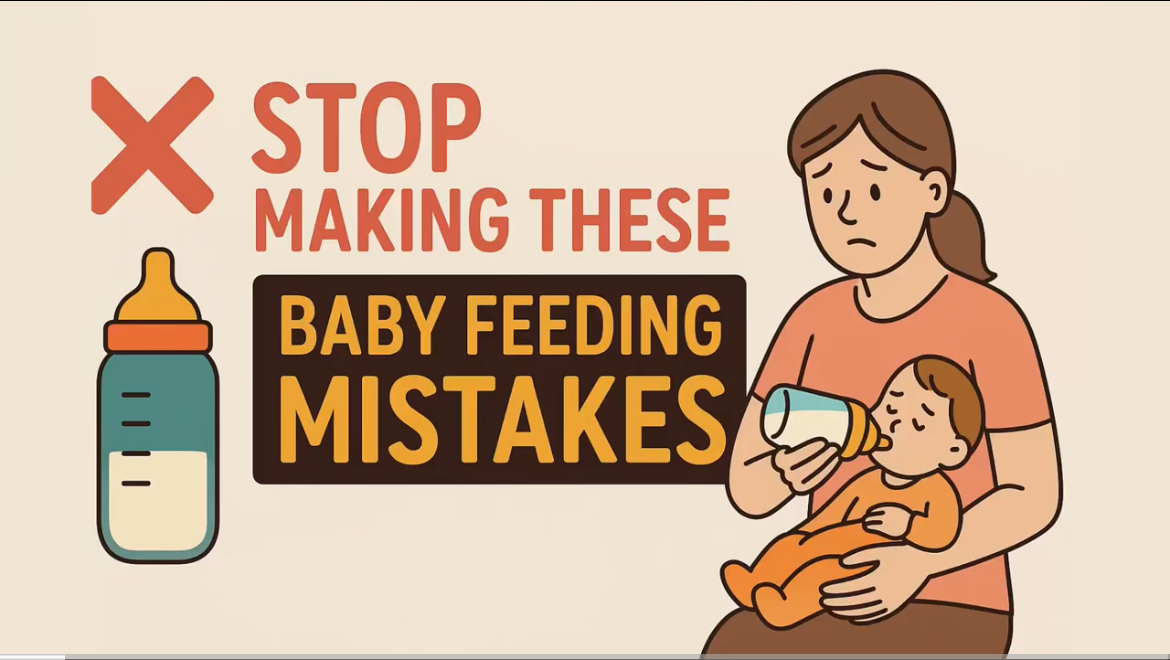
8 Baby Feeding Mistakes in the First 6 Months — And How to Fix Each OneFeeding a newborn looks simple from the outside. Feed when hungry, burp afterwards, repeat. In practice, it is one of the most nuanced and often stressful aspects of new parenthood. Getting feeding right in the first six months matters enormously — it affects your baby's weight gain, sleep, digestion, and your own confidence as a parent.These are the eight most common feeding mistakes parents make in the first six months, why they happen, and exactly what to do differently.Mistake 1: Waiting Until Your Baby Is Crying to FeedCrying is a late hunger cue. By the time your baby is crying, they have already moved through several earlier signals that went unnoticed — rooting (turning the head and opening the mouth), sucking on their hands, increased restlessness, and lip-smacking. A baby who has reached the crying stage is often so distressed that latching or accepting a bottle becomes more difficult, making the feed itself harder.The fix is to learn your baby's early hunger cues and respond to those rather than waiting for the cry. In the first few weeks, spend time watching your baby during alert periods. The earlier signs are subtle but learnable, and recognising them makes a significant difference to how smoothly feeds go.Mistake 2: Following a Rigid Feed Schedule Too EarlyFeeding by the clock — scheduling feeds at fixed intervals regardless of your baby's cues — is generally not recommended in the first six to eight weeks of life. Newborns have small stomachs, variable energy needs, and irregular hunger patterns. Breast milk production in the early weeks is driven by demand, meaning that feeding less frequently than your baby needs can reduce your milk supply at the exact stage when it is being established.After the first two months, a gentle rhythm often emerges naturally as your baby's stomach capacity grows. But in the newborn period, responsive feeding — feeding when your baby shows hunger cues, regardless of what the clock says — is the approach supported by the evidence and recommended by lactation consultants and pediatricians.Mistake 3: Not Burping During the Feed, Only AfterMany parents burp once at the end of a feed and wonder why their baby is still unsettled. Young babies, especially breastfed babies in the early weeks when let-down is strong, swallow significant amounts of air during feeding. This air collects in the stomach and causes discomfort that manifests as arching, fussiness, and pulling off the breast or bottle.The more effective approach is to burp your baby partway through each feed — roughly halfway through a bottle, or when switching breasts. This releases trapped air before it reaches the lower digestive tract and causes more significant discomfort. Some babies need burping more frequently than others, and you will learn your own baby's pattern within the first few weeks.Mistake 4: Overfeeding with a BottleBottle-fed babies — whether formula-fed or receiving expressed breastmilk — are at higher risk of overfeeding than breastfed babies because it is much easier to drain a bottle than the breast. A breastfed baby automatically slows and stops when full; a bottle-fed baby may continue drinking simply because the milk is flowing, even past satiation.Paced bottle feeding is the technique recommended by lactation consultants to address this. Hold your baby semi-upright rather than reclined, use a slow-flow teat, hold the bottle horizontally rather than tipping it steeply, and pause every few minutes by tilting the bottle down. This gives your baby time to register fullness and gives them control over the feed in a way that more closely mimics breastfeeding.Mistake 5: Stopping Breastfeeding Too Soon Due to Perceived Low SupplyPerceived insufficient milk supply is one of the most common reasons mothers stop breastfeeding in the first few weeks, and the evidence suggests that true insufficient supply is far less common than it is perceived to be. Many mothers stop breastfeeding when their breasts feel softer and less full around three to six weeks — mistakenly interpreting this as a reduction in supply when it actually reflects the supply regulating to meet demand.Signs that your baby is genuinely getting enough breastmilk include steady weight gain, at least six wet diapers per day, and a baby who is generally settled between feeds. If you have concerns about your milk supply, a consultation with a certified lactation consultant is far more valuable than switching to formula prematurely. Lactation consultants can observe a full feed, assess your baby's latch, and provide personalised guidance.Mistake 6: Ignoring Growth SpurtsApproximately at one week, three weeks, six weeks, three months, and six months, babies go through growth spurts during which their milk intake increases dramatically for a period of two to five days. During these periods, a breastfed baby may want to feed almost constantly — a pattern called cluster feeding. Many parents interpret this as a sign that they are not producing enough milk and introduce formula top-ups, inadvertently reducing the breast stimulation needed to increase supply to meet the new demand.Understanding growth spurts in advance means you can recognise them for what they are: temporary, biologically normal periods of increased feeding that will resolve on their own. Your supply will adjust to meet the increased demand within a few days, provided you continue feeding on demand.Mistake 7: Not Seeking Help When Feeding Is DifficultBreastfeeding is a learned skill for both mother and baby, and many pairs find it genuinely difficult in the early weeks. Painful feeding, poor weight gain, a baby who is unsettled after most feeds, or a mother with cracked or bleeding nipples are not situations that should be endured in silence in the hope that they will improve. These are situations that benefit enormously from professional support.A certified lactation consultant (IBCLC) can assess your baby's latch, check for tongue tie, observe a full feed, and give practical hands-on guidance. Many issues that seem insurmountable to an exhausted new parent — poor attachment, slow weight gain, nipple pain — are resolvable with the right support. Finding a lactation consultant early, rather than waiting until you are considering stopping breastfeeding, gives you the best chance of a positive outcome.Mistake 8: Introducing Solid Foods Too EarlyThe World Health Organisation, India's National Health Policy, and all major pediatric bodies recommend exclusive breastfeeding or formula feeding for the first six months of life. Introducing solid foods before four to six months is associated with increased risk of choking, digestive distress, food allergies, and — in some studies — obesity later in life.Signs that your baby is developmentally ready for solid foods include: sitting up with minimal support, showing interest in food by watching others eat and reaching for food, and losing the tongue-thrust reflex that causes babies to push things out of their mouths. Starting solids is an exciting milestone, but it should be guided by developmental readiness rather than a fixed date on the calendar.For lactation consultants and pediatricians across India and globally, visit firstchoiceclub.in — India's global directory for pregnancy and newborn services.⸻If this helped you:✅ Save this blog✅ Share with another mom✅ Follow for more baby feeding, sleep, and growth tips!
20 Oct

Baby Shopping Guide: What You Actually Need Month by Month (0–6 Months)Every first-time parent faces the same overwhelming moment. You walk into a baby store or open an online registry guide and find hundreds of items that all promise to be essential. The baby monitor, the wipe warmer, the nappy disposal unit, the special bath thermometer, the nursing pillow, the bouncer, the swing, the play gym. The list seems endless, and the cost adds up faster than you can calculate.The truth is that babies in their first six months need very few things. What they need is warmth, nutrition, cleanliness, safe sleep, and human connection. Most of that does not come from products. This guide gives you the honest, practical list of what you actually need in each month — and what you can safely skip.Before Birth: The Genuine EssentialsThere are a small number of items you should have ready before your baby arrives, because you will need them from the moment you bring your baby home.For sleep, you need a safe sleep surface: a firm, flat crib or bassinet with a well-fitting mattress, no bumpers, no pillows, and no loose bedding. A bedside bassinet that attaches to your bed makes nighttime feeding significantly easier and is particularly well-suited for the first three months.For feeding, if you plan to breastfeed, the main things you need are a good nursing bra (two or three) and breast pads for leakage. A breast pump is worth acquiring — either rented or purchased — though you may not need it immediately. If you plan to formula feed, have at least four to six bottles and a bottle brush ready. Slow-flow teats are most appropriate for newborns.For clothing, newborns need simple, easy-to-fasten garments. Front-opening sleepsuits with popper fastenings are far easier to put on and take off a newborn than garments that go over the head. Buy no more than five to seven in newborn size — many babies outgrow newborn clothing within two to three weeks — and have more in the 0-3 month size.For nappies, have a supply of newborn nappies ready, but do not stockpile. Newborns go through 10 to 12 nappies per day in the early weeks, and babies grow quickly. A bumper pack will last only a few weeks. You will also need fragrance-free baby wipes, a changing mat, and a nappy bin or standard bin with a lid.Month 1: Essentials OnlyIn the first month, your baby sleeps, feeds, and needs to be held. The items that genuinely help are minimal. A baby carrier or wrap sling is worth having early — it keeps your baby close and leaves your hands free, and research shows that babies who are carried cry less. Swaddling blankets (lightweight muslin is ideal in India's climate) help many newborns sleep longer by preventing the startle reflex from waking them.A digital thermometer is essential — you will need it any time your baby seems unwell and a rectal or underarm temperature is needed. Buy it before your baby arrives, not in the middle of your first illness scare at midnight.Months 2 and 3: Developing InteractionFrom around six to eight weeks, your baby becomes more awake and interactive. This is when a few simple play items start to have value. A high-contrast black and white book or card set provides exactly the visual stimulation developing eyes can process — newborns and young infants see high contrast much more clearly than colour. A soft rattle or wrist rattle introduces cause-and-effect learning as babies begin to realise their movements create sound.Tummy time becomes important from birth but is particularly crucial from the second month. You do not need a special tummy time mat for this — a clean, firm surface and you lying face down at your baby's level is more effective than any product. However, if you find that a padded mat with attachments keeps your baby engaged for longer, it is worth having.Months 4 and 5: Mobility and ExplorationBetween three and five months, most babies begin rolling, reaching, and grasping. This is the stage at which a simple play gym becomes genuinely useful — hanging objects to bat at strengthen arm coordination and teach cause and effect. Teething typically begins around three to four months, even if the first tooth does not appear until much later. A set of safe silicone teethers and a supply of muslin cloths (for the associated drooling) are worth having on hand.If you have not already invested in a carrier, this is the stage at which being carried often becomes more rather than less important — babies who are learning to navigate the world often seek more physical closeness, not less. A structured carrier with good lumbar support for the wearer becomes increasingly valuable as your baby grows heavier.Month 6: Starting Solid FoodsThe introduction of solid foods at around six months requires a few specific items. A high chair with a footrest (feet flat on a surface is important for safe swallowing), a set of soft-tipped weaning spoons, a few small bowls, and a waterproof bib. If you plan to make your own purees, a hand blender or food processor is useful but not essential — many families use a standard fork for the early stages of weaning.A sippy cup or open cup for water — offered with meals from six months onwards — rounds out the weaning equipment you genuinely need.What You Do Not NeedWipe warmers are pleasant but entirely unnecessary. Babies adapt to room-temperature wipes within a few seconds. Nappy disposal systems with special cartridges are expensive to maintain and no more hygienic than a regular bin with a lid. Baby shoes before walking are decorative only — bare feet or soft socks are better for developing foot muscles. Elaborate sleep positioners, wedges, and pillows placed in cots are not safe for young babies and should be avoided regardless of marketing claims.⸻🌸 Why Month-by-Month Baby Shopping is the BEST Way✅ You avoid wasting money on things baby outgrows✅ Your home stays clutter-free✅ You buy only what baby needs at each stage✅ You feel organized and confident✅ No panic-buys at midnight!⸻👶 MONTH 0–1: NEWBORN MUST-HAVESIn the first month, your baby mostly sleeps, feeds, and cuddles. Keep it simple!✅ Diapers + wipes✅ 5–7 front-open onesies✅ Swaddles (2–3)✅ Baby soap + lotion✅ Baby nail clipper / filer✅ White noise / lullaby (helps baby sleep!)✅ Birth certificate folder✅ Baby blanket✅ Cotton mittens & socks✅ Burp cloths💡 Tip: Buy only essentials. Newborns grow VERY fast!⸻🌸 MONTH 2: COMFORT & CAREBaby starts moving more and doing tummy time!✅ Soft blanket✅ Tummy time mat✅ Mittens & socks (next size)✅ Baby pillow (optional)✅ Baby grooming kit (comb, brush, nail file)✅ Pacifier / comfort toy✅ Light blanket for outings💡 Tip: Start creating a sleep routine now!⸻🎠 MONTH 3: PLAY & SAFETYBaby becomes curious and playful!✅ Activity gym / play mat✅ Soft rattles & sensory toys✅ Blackout curtains (better daytime sleep)✅ Mild detergent✅ Baby-safe mirror (tummy time fun!)✅ Memory book / milestone cards💡 Tip: Capture those FIRST smiles and laughs! 🥹⸻🦷 MONTH 4: TEETHING STAGEThis month can be drooly and fussy… be prepared!✅ Teethers (MUST-HAVE!)✅ Dribble bibs✅ Soft washcloths✅ Baby-safe teething gel (optional)✅ Bath seat (optional)✅ Larger size clothes (growth spurt!)💡 Tip: Teething starts now—even if teeth don’t show!⸻🌞 MONTH 5: OUTDOOR & EXPLORINGYour baby wants to see the world! 👀✅ Stroller OR baby carrier✅ Sensory toys✅ Sun hat✅ Car seat (if traveling)✅ Playpen / safe play area✅ Crib / co-sleeper (if upgrading)💡 Tip: This is a good time to babyproof your home.⸻🍽 MONTH 6: STARTING SOLIDS! (BIGGEST SHOPPING MONTH!)It’s feeding time! This month needs a few essentials.✅ Feeding bowl + soft-tip spoon✅ High chair / booster seat✅ Sippy cup / training cup✅ Food storage containers✅ Waterproof bibs✅ Baby food maker / steamer (optional)💡 Tip: Introduce one new food at a time to check allergies.⸻💡 BONUS: MONEY-SAVING TIPS FOR MOMS✅ Buy month-by-month (don’t overshop!)✅ Borrow or buy second-hand (for big items)✅ Don’t buy too many newborn clothes✅ Invest in quality, not quantity✅ Watch sales & Amazon/Flipkart deals✅ Choose neutral colors if planning a 2nd baby⸻❌ THINGS YOU DON’T REALLY NEED🚫 Wipe warmer🚫 Fancy crib bedding (unsafe)🚫 Shoes for newborns🚫 Too many gadgets🚫 Branded items “just for looks”you Can download the Baby Shopping PDF (Here)
19 Oct

Lullabies for Babies: Why They Matter and How to Use ThemThere is something remarkable about a parent's voice singing softly in the dark. Long before your baby understands a single word, the rhythm and melody of a lullaby communicates something profound: you are safe, you are loved, and it is time to rest. Lullabies have been used by parents across every culture for thousands of years — and modern research confirms that this ancient practice is genuinely good for your baby's brain, body and emotional development.This guide explains why lullabies work, what benefits they offer your newborn and growing baby, and practical tips for making music a natural part of your daily routine.Why Lullabies Help Babies SleepBabies are born into a world of overwhelming sensory input. Every sound, light, and sensation is new and unfiltered. Falling asleep requires a baby's nervous system to shift from alert to calm — and this transition is genuinely difficult for many infants, especially in the early weeks.A lullaby works because of several overlapping mechanisms. First, the steady, repetitive rhythm mimics the heartbeat your baby heard for nine months inside the womb. This rhythm is instantly familiar and physically calming. Second, the low, consistent volume and tone of a singing voice signals safety — there is no threat, nothing to react to. Third, the predictability of a repeated song becomes a sleep cue over time. Once your baby associates a particular lullaby with the process of falling asleep, hearing it triggers a learned relaxation response.A study published in the journal Pediatrics found that premature babies who were exposed to live lullaby music showed significantly better heart rate stability, improved feeding, and shorter hospital stays compared to babies who received standard care without music. This is some of the strongest evidence we have that lullabies are not simply pleasant — they are therapeutic.The Science Behind Music and Baby Brain DevelopmentThe first three years of life are the most rapid period of brain development a human being ever experiences. During this window, the brain forms more than one million new neural connections every single second. Music plays a specific role in this process.When a baby hears music, multiple areas of the brain activate simultaneously — the auditory cortex processes the sound, the motor cortex responds to rhythm, and the limbic system (the emotional centre) responds to melody and tone. This simultaneous activation strengthens neural pathways across multiple regions, which is why children who are exposed to music early often show advantages in language development, mathematical reasoning, and emotional regulation.Singing specifically, rather than simply playing recorded music, has an additional benefit. Your baby learns to recognise the unique qualities of your voice — its pitch, timbre, rhythm and expressiveness. This recognition forms part of the attachment bond between you and your child. In short, singing to your baby is not just soothing them to sleep. It is one of the foundational acts of building your relationship with them.Traditional Indian Lullabies Worth KnowingIndia has one of the richest lullaby traditions in the world, with beautiful songs in dozens of regional languages that have been passed down through generations of mothers and grandmothers.Aao Nindiya Aao is one of the most widely known Hindi lullabies, its gentle melody and imagery of sleep as a welcome visitor making it instantly calming for babies and familiar to parents across generations. In Tamil Nadu, Thalattu songs like Thaye Yasodha have a distinctive rocking rhythm perfectly suited to the motion of gently swaying a baby. Telugu lullabies like Jo Achutananda, with their longer melodic lines, are especially beautiful and are still sung by grandmothers to newborns across Andhra Pradesh and Telangana.If you do not know the words to any traditional lullaby, that is completely fine. Humming the melody alone is equally effective. Your baby responds to the rhythm and the quality of your voice, not to whether the words are perfectly remembered.How to Build a Lullaby RoutineThe most effective way to use lullabies is as part of a consistent bedtime or nap routine. Routines are powerful tools for infant sleep because babies and young children feel most secure when life is predictable. A simple routine of bath, feed, lullaby, and sleep can help even a difficult sleeper begin to settle more easily within a few weeks of consistent practice.Choose one or two songs that you enjoy singing. This matters — if you find the song tedious, your baby will sense tension in your voice. The most effective lullaby is the one you can sing genuinely and warmly.Dim the lights before you begin singing. Light is one of the most powerful signals to the brain that it is time to be alert. Darkness signals the release of melatonin, the sleep hormone. Combining low light with a familiar melody sends a consistent message to your baby's brain that sleep is coming.Hold your baby close or place them in their sleep space before you begin. The physical closeness, warmth, and familiar smell of your body combined with the sound of your voice creates multiple overlapping comfort signals.Lullabies During Fussy PeriodsLullabies are not only for bedtime. Many parents find that singing during fussy spells — especially in the late afternoon and evening when colic and cluster feeding are most common — provides significant comfort. The key during these moments is to keep your voice steady and calm even if you are feeling stressed. Babies are acutely sensitive to tension in a caregiver's voice. Taking one slow breath before you begin singing can help you regulate your own state, which in turn helps your baby regulate theirs.White noise machines and recorded lullabies can supplement your singing but should not replace it entirely in the early months. The live, responsive quality of a parent singing — slowing down when the baby stirs, getting softer as they relax — is something a recording cannot replicate.A Note for New ParentsYou do not need to have a good singing voice to sing to your baby. Your baby does not care about pitch or technique. They care about the warmth in your voice, the steadiness of your rhythm, and the fact that it is you. Some of the most effective lullaby singers in the world are parents who quietly sing slightly off-key in the dark while rocking a restless newborn at three in the morning. That is what the research calls music therapy, and what parents call love.
16 Oct
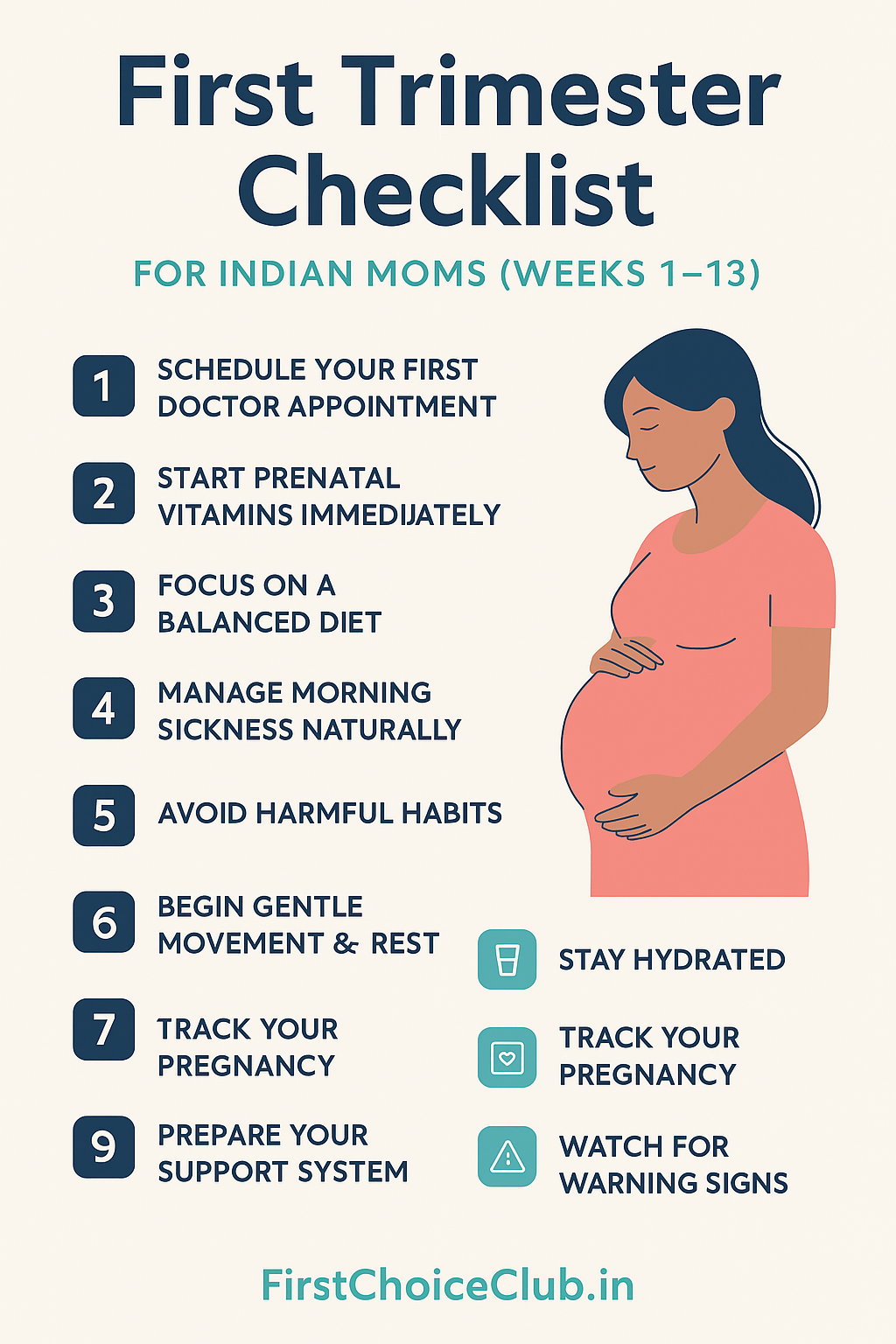
✅ First Trimester Checklist for Indian Moms (Weeks 1–13)Your month-by-month guide to a healthy and stress-free start to pregnancy! The first trimester (Month 1–3) is full of excitement, new emotions, and plenty of questions. From doctor visits to diet changes, here’s your complete 1000-word guide — designed specifically for Indian moms. 🩺 1. Schedule Your First Doctor Appointment When to go: Book your first prenatal appointment as soon as you confirm your pregnancy with a home test (around 5–6 weeks). What to expect:Ultrasound scan: To confirm the heartbeat (usually around 6–8 weeks).Blood & urine tests: To check blood type, hemoglobin, thyroid, sugar, and vitamin levels.Medical history review: Share any past surgeries, conditions, or miscarriages.Prenatal vitamins: Your doctor will prescribe folic acid and possibly iron or vitamin D. Tip: Choose a gynecologist and maternity hospital where you feel comfortable — you’ll be visiting regularly for the next 9 months. 👉 Internal link suggestion: Compare maternity hospitals checklist 💊 2. Start Prenatal Vitamins Immediately Why it matters: Folic acid (400–600 mcg daily) helps prevent neural tube defects and supports early brain development. Other essentials:Iron & calcium (doctor-prescribed only)Vitamin D & B12 if you’re vegetarianOmega-3 fatty acids (optional but helpful for fetal brain growth) Tip: Take vitamins after food to reduce nausea. 🥗 3. Focus on a Balanced Diet ✅ Include:Whole grains (rice, wheat, millets)Protein sources: lentils, paneer, eggs, chicken, fish (avoid raw/mercury-heavy fish)Leafy greens like spinach, methi, and drumstick leavesFruits: oranges, bananas, apples, guava, pomegranateDairy: milk, curd, buttermilkHealthy fats: ghee, nuts, seeds ❌ Avoid:Raw papaya, raw sprouts, unpasteurized milkUndercooked meat or eggsStreet food or foods high in preservatives Tip: Eat small, frequent meals if nausea or acidity is troubling you. 🤢 4. Manage Morning Sickness Naturally Most moms experience nausea and vomiting between weeks 6–12. Here are simple remedies:Start your day with a few crackers or toast before getting out of bed.Sip ginger tea, coconut water, or nimbu pani through the day.Eat small meals every 2–3 hours — never stay hungry.Avoid spicy or oily food and strong smells. If vomiting is severe, consult your doctor — dehydration can be risky. 🚫 5. Avoid Harmful HabitsNo smoking or alcohol — both can harm your baby’s development.Limit caffeine to one small cup of coffee or tea per day (under 200 mg).Avoid over-the-counter painkillers, antibiotics, or herbal medicines unless approved by your doctor. Tip: If you work in a high-stress or chemical environment, discuss workplace safety with your doctor. 🧘♀️ 6. Begin Gentle Movement & Rest Safe exercises (after doctor approval):Prenatal yogaWalking 20–30 mins a dayLight stretching Avoid: High-impact workouts, heavy lifting, or lying flat on your back for long periods (after 12 weeks). Rest well: Fatigue is common — sleep early and nap if needed. 💧 7. Stay Hydrated Drink at least 2–3 litres of water daily. Add variety with:Tender coconut water 🥥Lemon waterButtermilkFresh fruit juices (avoid added sugar) Hydration helps prevent constipation and supports blood flow to your baby. 📒 8. Track Your Pregnancy Start a Pregnancy Journal or Baby Prep Calendar to record:Doctor visitsWeight & symptomsMood changesMilestones This helps you feel more connected to your journey. 🏡 9. Prepare Your Support System Pregnancy can feel overwhelming — building your support system early helps.Share the news with your partner and close family after the first scan.Discuss maternity leave options with your HR or employer.Plan who can accompany you for checkups or help with meals and chores. Tip: Emotional support matters just as much as physical care. 🩹 10. Watch for Warning Signs Call your doctor if you experience: Heavy bleeding or clotsSevere abdominal crampsPersistent vomitingDizziness or faintingHigh feverSudden swelling in face or hands Early detection can prevent complications — never ignore warning signs. 🛏️ 11. Self-Care & Mental Health Pregnancy hormones can bring emotional ups and downs.Practice mindfulness or breathing exercises.Spend time with loved ones.Don’t hesitate to ask for help.Avoid reading too many online horror stories — every pregnancy is different! Tip: Calm, happy moms = healthy babies 💗 🧺 12. Shopping & Essentials (Early Prep) You don’t need to buy everything now, but a few things help:Comfortable cotton maternity brasStretchy leggings or kurtisA notebook or journalEarly pregnancy-safe skincare (fragrance-free, chemical-free) Later in the second trimester, you can prepare your Hospital Bag and Baby Shopping List. 🌸 Sample Daily Routine — First Trimester TimeRoutine6:30 AMWake up slowly, sip warm water with lemon7:00 AMLight breakfast (oats + milk + banana)10:00 AMFruit or coconut water1:00 PMLunch (rice + dal + veg + curd)4:00 PMSnack (nuts or toast)7:00 PMDinner (chapati + sabzi + paneer or fish)Before bedWarm milk or herbal tea, write in your journal 📦 13. Plan Your Finances Early Medical checkups, supplements, and delivery costs can add up.Estimate your hospital delivery cost (normal vs C-section).Start a small pregnancy fund for emergencies.Review your health insurance — check maternity coverage details. 🌼 Final Thoughts The first trimester is a time of adjustment — your body and emotions are changing, and that’s completely normal. Focus on nutrition, rest, and gentle care. Build routines that make you feel supported and informed. With a little planning and self-kindness, you’ll set the perfect foundation for a smooth and joyful pregnancy journey. 🌷 🩵 Download the Printable PDF You can also download the “First Trimester Checklist for Indian Moms” as a free A4 printable from FirstChoiceClub.in. It includes: ✅ Month-by-month diet tips ✅ Medical visit tracker ✅ Hydration & nutrition checklist ✅ Reminder section for vitamins & self-careFirst Trimester Checklist PDF Downloadable
10 Oct

Best Pregnancy Diet — Month by Month Eating well during pregnancy doesn’t mean dieting — it means choosing nutrient-dense, satisfying foods that support your baby’s growth and your energy. Below is an easy month-by-month guide (months 1–9) with a summary table, sample meals, and image suggestions you can use for posts or a printable. I’ve added recommended internal links you can point to on FirstChoiceClub.in for further reading or downloadable checklists.Quick summary table — Key nutrients & foods by month Month Key nutrients to prioritise Sample foods & portions Why it helps 1 (Weeks 1–4) Folic acid, iodine, hydration Fortified cereals, spinach (½ cup cooked), iodized salt, water Neural tube development; prevent early deficiencies 2 (Weeks 5–8) Folic acid, protein, vitamin B6 Lentils (¼ cup cooked), eggs (1), bananas Reduces nausea, supports organ formation 3 (Weeks 9–12) Iron, vitamin C, omega-3 Lean red meat (60–90g), orange (1), flaxseed (1 tbsp) Building blood volume; iron absorption 4 (Months 4) Calcium, vitamin D, protein Yogurt (1 cup), paneer (50g), salmon (60g) Bone and teeth formation 5 (Month 5) Fiber, B-vitamins, healthy fats Oats (½ cup), avocados (½), nuts (handful) Digestion, steady energy, brain development 6 (Month 6) Iron, zinc, vitamin A Chicken (60–90g), sweet potato (½), pumpkin seeds Immune + eye development 7 (Month 7) Protein, calcium, magnesium Cottage cheese, milk, almonds Rapid fetal growth; muscle & bone support 8 (Month 8) Protein, iron, potassium Beans, lean lamb, bananas Preparing blood stores and fluid balance 9 (Month 9) Energy-dense + easy-to-digest foods Smoothies with milk, dates (2–3), khichdi Keep energy up; easy on digestion before labour Month-by-month food guide (what to eat, how much, and quick tips) Month 1 — Focus: folate & gentle routine Even before you realise you’re pregnant, folic acid matters. Aim for 400–600 µg folic acid (supplement + food) and keep hydrated. Snack on fortified cereal, spinach, orange, and a small handful of nuts. Avoid raw/undercooked foods. Month 2 — Focus: protein and nausea-friendly foods Morning sickness often peaks now. Small, frequent meals help — crackers, bananas, ginger tea, boiled eggs, and dal (lentils) are gentle and nourishing. Vitamin B6-rich foods (banana, potato, poultry) may ease nausea.Link to your nausea remedies article or checklist: https://firstchoiceclub.in/best-home-remedies-for-morning-sickness. Month 3 — Focus: iron & vitamin C to boost absorption By now your blood volume is increasing — iron is essential. Pair iron-rich foods (red meat, legumes, dark leafy greens) with vitamin C (citrus, tomatoes) to improve absorption. Consider a doctor-approved iron supplement if needed. Month 4 — Focus: calcium & vitamin D for bones Baby’s bones begin mineralising. Include dairy or fortified alternatives (milk, yogurt, paneer), eggs, and safe oily fish for vitamin D and omega-3s. Internal link suggestion: https://firstchoiceclub.in/second-trimester-checklist (for trimester nutrition tips). Month 5 — Focus: fibre and healthy fats Constipation is common — increase fiber from oats, fruits, vegetables, and whole grains. Add healthy fats (avocado, nuts) for brain development. Keep protein steady. Month 6 — Focus: iron and zinc for immunity Continue iron-rich meals and add zinc (nuts, seeds, meat) to support immunity. Swap heavy meals for lighter, nutrient-dense plates to avoid heartburn. Month 7 — Focus: building stores & hydration Baby grows quickly; you need additional calories and protein. Aim for 300–450 extra kcal/day depending on activity (ask your clinician). Dairy, pulses, lean meat, and fortified cereals help. Month 8 — Focus: iron top-ups & potassium Top up iron and potassium to manage swelling and cramps — beans, bananas, potatoes, lentils. Keep salt moderate but include electrolytes if advised. Internal link suggestion: https://firstchoiceclub.in/baby-prep-calendar (for late-pregnancy checklists). Month 9 — Focus: easy digestion & energy reserves Choose energy-dense but digestible foods — smoothies with milk, dates, khichdi, mashed potatoes. Smaller meals more often can help if heartburn is present. Keep hydrated and stick to familiar, comforting foods. Practical serving-size examples & sample day (useful table)MealExample (3rd trimester sample day)BreakfastOats (½ cup) with milk + banana + 1 tbsp flaxseedMid-morningYogurt (1 cup) + few almondsLunchBrown rice (1 cup), dal (1 cup), mixed veg, 60–90g lean meatSnackFruit + handful of roasted chana or nutsDinnerGrilled fish or paneer (60–90g), roti (1–2), saladBedtimeWarm milk (1 cup) or a date + milk smoothieSafety notes & quick tipsSupplements: Continue folic acid, iron, and other supplements only as recommended by your healthcare provider.Foods to avoid: Raw seafood, unpasteurised dairy, undercooked meat/eggs, excessive caffeine (>200 mg/day), very high-mercury fish.Hydration: Aim for 2–3 litres/day (more in hot weather or if active).Food safety: Wash fruits/veg thoroughly; cook meats to safe temperatures.First Trimester Checklist — https://firstchoiceclub.in/first-trimester-checklistSecond Trimester Checklist — https://firstchoiceclub.in/second-trimester-checklistBaby Prep Calendar — https://firstchoiceclub.in/baby-prep-calendarMorning Sickness Remedies — https://firstchoiceclub.in/best-home-remedies-for-morning-sickness
09 Oct

Best Home Remedies for Morning Sickness (For Indian Moms)Morning sickness is one of the most common pregnancy symptoms—affecting nearly 70–80% of expecting moms in their first trimester. Despite the name, nausea and vomiting can strike any time of day. While it can be uncomfortable, the good news is that there are safe, natural, and effective home remedies—many rooted in Indian traditions—that can help you manage morning sickness and feel better.In this guide, we’ll cover: • Why morning sickness happens • Effective Indian home remedies to ease nausea • Dietary tips and lifestyle hacks • When to consult your doctor⸻🌿 Why Do Indian Moms Experience Morning Sickness?Morning sickness is mostly triggered by hormonal changes, especially the rise of hCG (human chorionic gonadotropin) and estrogen in early pregnancy. Other factors like sensitivity to smells, fatigue, stress, or an empty stomach can make nausea worse.👉 It usually starts around week 6 of pregnancy, peaks around week 9–12, and improves after the first trimester, though some women may experience it longer.⸻🍋 Top Indian Home Remedies for Morning SicknessHere are some tried-and-tested remedies loved by generations of Indian moms:1. Ginger (Adrak) – Nature’s Anti-Nausea Herb • Chew a small piece of fresh ginger in the morning. • Sip ginger tea (boil ginger slices in water, strain, and sip warm). • Mix ginger juice with honey for a soothing effect.👉 Ginger helps calm the stomach and reduces nausea naturally.⸻2. Lemon (Nimbu) – A Refreshing Reliever • Smelling fresh lemon peels can instantly ease nausea. • Drink lemon water with a pinch of rock salt for hydration. • Suck on lemon candy or add lemon juice to your meals.🍋 Vitamin C also supports immunity during pregnancy.⸻3. Jeera (Cumin Seeds) Water • Boil 1 tsp cumin seeds in water, cool it, and sip slowly. • Jeera helps improve digestion and calms the stomach. • You can also chew roasted cumin seeds with a pinch of rock salt.⸻4. Tulsi Leaves (Holy Basil) • Chew 3–4 washed tulsi leaves in the morning. • Drink tulsi tea (boil leaves in water, strain, and sip warm).🌿 Tulsi is known in Ayurveda to balance digestion and reduce nausea.⸻5. Ajwain (Carom Seeds) • Dry roast ajwain, crush, and keep in a small jar. Inhale its aroma or chew a pinch. • Ajwain water (boil seeds in water, cool, and sip) eases nausea and bloating.⸻6. Cardamom (Elaichi) • Keep a cardamom pod in your mouth and suck on it slowly. • Add elaichi to tea or warm milk for gentle relief.👉 Cardamom’s soothing aroma and flavor help curb nausea.⸻7. Coconut Water (Nariyal Pani) • Fresh coconut water hydrates and balances electrolytes. • It also provides natural sugars and essential minerals.🥥 A refreshing and safe option for moms dealing with dehydration from vomiting.⸻8. Mint (Pudina) • Mint chutney with meals can soothe digestion. • Sip mint tea (boil pudina leaves in water, strain, and sip). • Chewing fresh mint leaves helps too.⸻🥗 Dietary Tips for Morning SicknessIn addition to remedies, these small food changes can make a big difference: • Eat small, frequent meals instead of 3 large meals. • Avoid spicy, oily, and very strong-smelling foods. • Keep dry snacks (like khakra, toast, or plain biscuits) by your bedside. • Stay hydrated with water, coconut water, or buttermilk. • Avoid long gaps between meals to prevent an empty stomach.⸻🧘 Lifestyle Hacks for Relief • Get plenty of rest—fatigue makes nausea worse. • Step into fresh air when you feel nauseous. • Try gentle yoga stretches or deep breathing. • Wear loose, comfortable clothing. • Identify and avoid triggers (certain smells, foods, or places).⸻⚠️ When to Call Your DoctorMorning sickness is usually harmless, but seek medical advice if: • You can’t keep any food or water down. • You lose weight rapidly. • You feel dizzy, weak, or dehydrated. • Vomiting is severe and persistent.This could indicate Hyperemesis Gravidarum, which needs medical attention.⸻✅ Final ThoughtsMorning sickness is a natural part of pregnancy, but it doesn’t have to take over your life. With simple and safe Indian home remedies like ginger, lemon, cumin water, tulsi, and coconut water—plus mindful eating and rest—you can manage nausea effectively.Remember: every pregnancy is different. What works for one mom may not work for another. Listen to your body, try different remedies, and always consult your doctor if symptoms become severe.
08 Oct
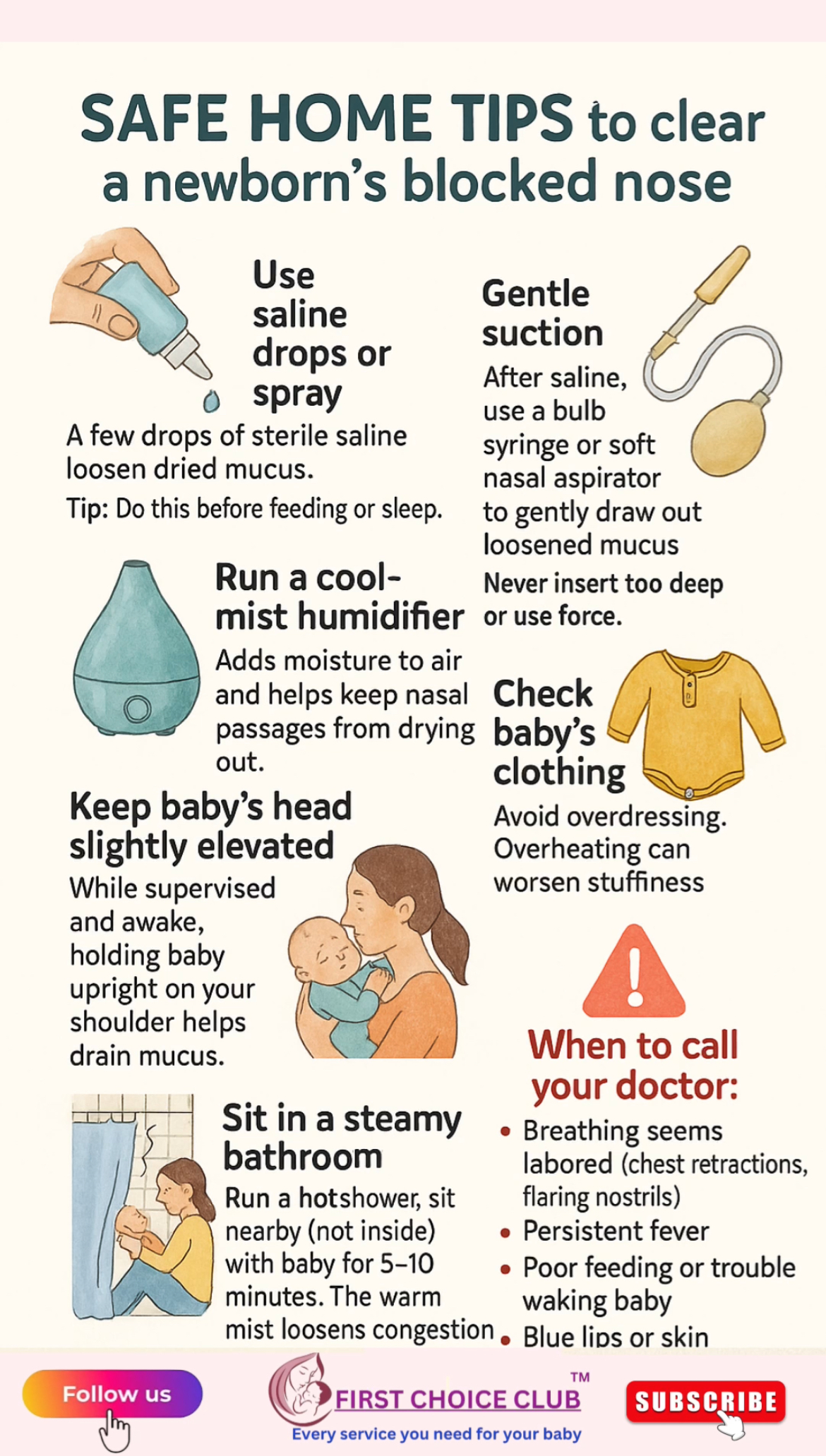
Blocked Nose in Newborns: What Causes It, Safe Home Remedies, and When to WorryIf your newborn sounds like a tiny, congested little snuffler, you are not alone. Nasal congestion is one of the most common concerns new parents bring to their pediatrician in the first weeks of life — and in the vast majority of cases, it is completely harmless. But because newborns are obligate nose-breathers (meaning they breathe almost exclusively through their nose for the first few months of life), even mild congestion can interfere with feeding and sleep and cause significant parental anxiety.This guide explains why newborns get congested so often, what you can safely do about it at home, what you should never do, and the specific signs that warrant a call to your doctor.Why Newborns Get Congested So EasilyThere are several reasons newborn noses block up so readily, and most of them are to do with anatomy and biology rather than illness.Small nasal passagesA newborn's nasal passages are very narrow — about the diameter of a pencil. Even a small amount of mucus, dried secretion, or tissue swelling is enough to partially obstruct airflow and create the snuffling sound that worries parents. This does not mean your baby has a cold.Physiological congestionIn the first few weeks after birth, many newborns experience what is called physiological congestion — congestion caused simply by the transition from the fluid-filled womb to the air-filled world. The nasal passages, previously bathed in amniotic fluid, are adjusting to breathing air. This usually resolves on its own within the first month and requires no treatment.Dry airLow humidity dries the mucous membranes lining the nasal passages. In air-conditioned environments — which are common across India, particularly in cities — the air can become very dry, causing nasal secretions to thicken and form crusts that partially block the passages. This is one of the most common causes of persistent mild congestion in otherwise healthy babies.Milk in nasal passagesDuring feeding, particularly with a strong let-down reflex, small amounts of milk can enter the nasal passages. This causes temporary congestion that usually clears within a few minutes.Safe Home Remedies That Actually WorkSaline nasal dropsSterile saline nasal drops are the single most effective and safest treatment for newborn nasal congestion. They work by softening and loosening dried mucus, making it easier to clear. Use two to three drops in each nostril, let it work for about 30 seconds, and then use gentle suction to remove the loosened secretions. Saline drops can be used before every feed and before sleep. They are available at every pharmacy in India without prescription and are completely safe for newborns from birth.Important: use only sterile saline drops specifically formulated for infants. Do not use adult nasal sprays, decongestant sprays, or saline sprays with preservatives on a newborn.Gentle nasal suctionAfter applying saline drops, a rubber bulb syringe or a dedicated nasal aspirator removes loosened mucus from the nostrils. Squeeze the bulb before inserting it gently just inside the nostril, then release slowly to create gentle suction. Never insert the syringe tip deeply into the nostril, and never use a regular syringe or any device with a rigid tip. Limit suction to two or three times per nostril per session — too-frequent suctioning irritates the nasal lining and can worsen congestion.HumidifierA cool-mist humidifier in your baby's room adds moisture to the air, prevents nasal secretions from drying out and hardening, and reduces the frequency and severity of congestion episodes. Place the humidifier at a safe distance from the cot — at least one metre away — and clean it every day to prevent mould and bacteria from growing in the water reservoir. Do not use warm-mist humidifiers, which can cause burns if your baby gets close to them, and avoid adding menthol or eucalyptus products to the water.Upright positionGravity helps. Holding your baby upright on your shoulder or in a carrier after feeds allows mucus to drain more easily from the nasal passages. If your baby is congested at night, placing a thin, firm wedge under the head end of the cot mattress (not under your baby's head directly) can slightly elevate the sleeping position and reduce nighttime congestion. Never prop your baby with pillows or rolled blankets — these are serious SIDS hazards.SteamSitting in a bathroom while you run a hot shower creates a warm, humid environment that can temporarily relieve congestion. Sit with your baby on your lap — not in the shower itself — for ten to fifteen minutes. Ensure the room is warm but not dangerously hot, and monitor your baby carefully throughout. The effect is temporary but can be particularly useful before bedtime feeds when congestion is interfering with feeding.What You Must Never Use on a Congested Newborn• Vicks VapoRub or any menthol-containing balm — these are not safe for children under two years old and can cause breathing difficulties in infants• Adult or child decongestant nasal sprays — over-the-counter decongestants are not approved for use in children under six years and are potentially dangerous for newborns• Oral decongestant medications — never give a newborn any over-the-counter cold or congestion medication without explicit instruction from your pediatrician• Forceful blowing of the nose — newborn nasal passages are too delicate and fragile for this• Cotton buds inserted into the nostrils — these can cause injury and push mucus deeper Congestion vs a Cold: How to Tell the DifferenceSimple nasal congestion without other symptoms is rarely caused by a viral infection. A cold, by contrast, typically presents with a runny nose (often clear initially, then thickening to yellow or green over several days), sneezing, mild fever, reduced feeding, and increased fussiness. Most babies catch their first cold somewhere between six weeks and three months of age, usually from a family member.A baby with a cold needs the same care as one with simple congestion — saline drops, gentle suction, humidification, and upright positioning — with additional attention to feeding and hydration. Fever in a baby under three months old (38°C or above) always requires same-day medical assessment regardless of the apparent cause.When to Call Your PediatricianMost newborn congestion is benign and responds to simple home management. However, contact your doctor if your baby shows any of the following: a fever above 38°C, difficulty breathing (rapid breathing, visible effort, ribs showing, or noisy breathing beyond the normal snuffling), refusal to feed or feeding significantly less than usual for more than one feed, blue or grey colour around the lips or fingertips, or congestion that has persisted for more than ten days without any improvement.Trust your instincts. If something about your baby's breathing feels wrong, get it assessed. You are not overreacting by calling your pediatrician. Finding a trusted pediatrician before your baby needs one is something every new parent should do — visit firstchoiceclub.in to find verified pediatricians across India and globally.
29 Jul
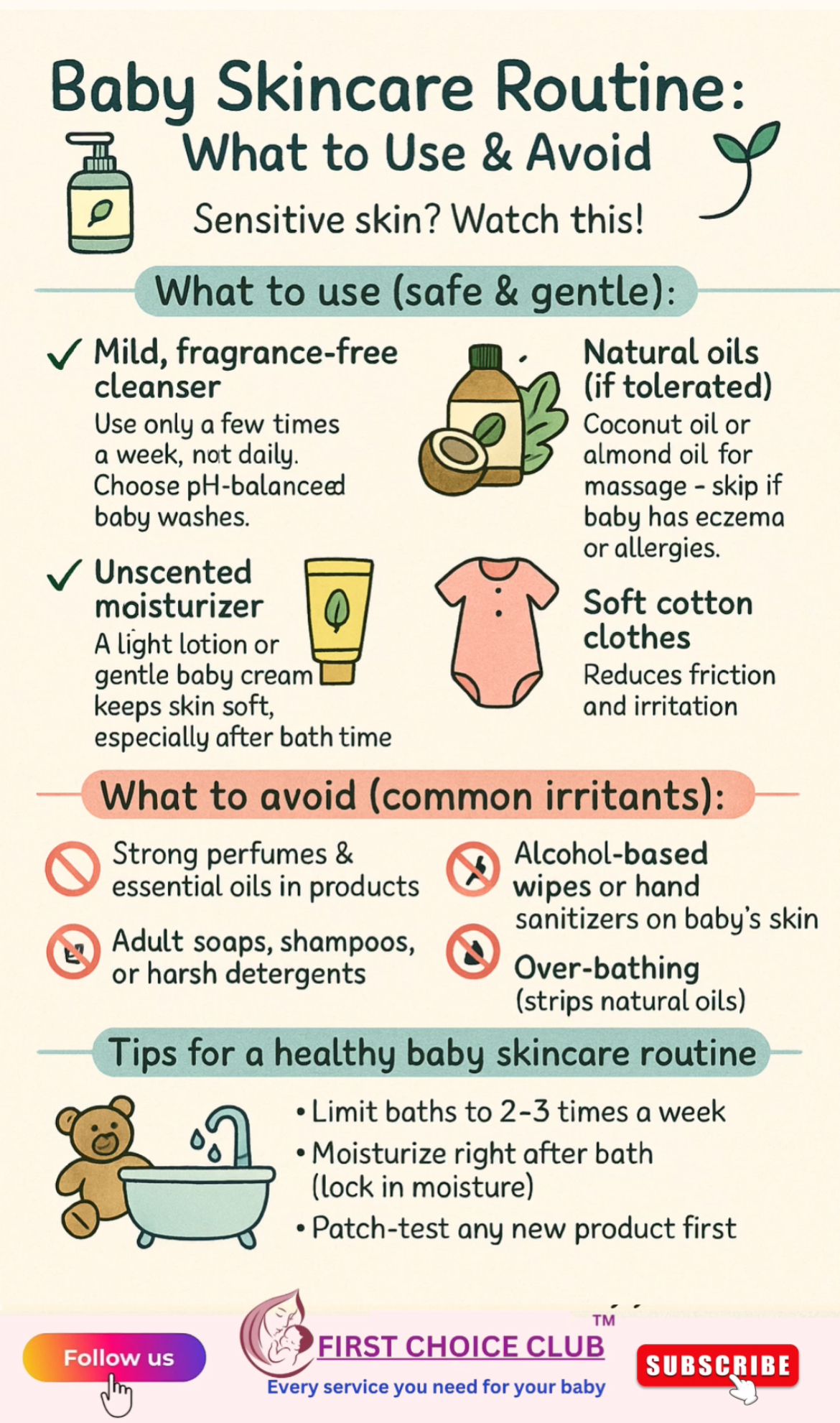
Baby Skincare Routine: What to Use, What to Avoid, and What New Parents Need to KnowNewborn skin is one of the most remarkable things about a new baby. It is soft, delicate, and almost impossibly smooth — but it is also thinner, more permeable, and more reactive than adult skin. Understanding how to care for it properly makes a real difference, both in keeping your baby comfortable and in preventing common skin conditions that affect many infants in the first year of life.This guide covers what is safe to use on your baby's skin, what to avoid, how to build a simple and effective skincare routine, and what to watch for if something goes wrong.Why Baby Skin Is Different from Adult SkinA newborn's skin is approximately 30 percent thinner than adult skin, and the outermost protective layer — called the stratum corneum — is less developed at birth. This means the skin's barrier function is reduced: it loses moisture more easily, absorbs substances more readily (including ingredients in products applied to the skin), and reacts to irritants and allergens more quickly.In the first few weeks after birth, newborns shed a fine layer of skin as they adjust from the aquatic environment of the womb to the dry world outside. This peeling is completely normal and does not require any cream or treatment. The vernix caseosa — the white waxy coating that protects skin in the womb — is also beneficial and can be left to absorb naturally rather than washed off immediately after birth.Safe and Gentle Products to UseThe guiding principle for baby skincare is less is more. Healthy newborn skin needs very little intervention. When products are needed, the criteria for choosing them are straightforward: fragrance-free, dye-free, pH-balanced, and formulated specifically for infant skin.CleanserUse a mild, fragrance-free baby wash or baby soap no more than two to three times per week. Daily bathing with soap strips the natural oils from baby skin and disrupts the skin barrier, making conditions like eczema more likely. On non-bath days, a simple top-and-tail wash with warm water is all that is needed.Look for cleansers with a pH of around 5.5 — close to the natural pH of baby skin. Many conventional soaps have a much higher pH and are too harsh for newborn skin even if they are marketed as gentle.MoisturiserA light, unscented moisturiser applied after bath time helps maintain the skin barrier and prevents moisture loss. This is particularly important in India's air-conditioned environments, which significantly reduce humidity. White petroleum jelly (Vaseline) is one of the most extensively studied and effective baby skin protectants and is often recommended by dermatologists as a first-line moisturiser for infants. It is inexpensive, fragrance-free, and very unlikely to cause reactions.Massage OilBaby oil massage is a deeply rooted Indian tradition with real benefits for newborn development, including improved sleep, reduced colic symptoms, and support for weight gain in premature infants. Coconut oil and sunflower oil are generally considered safe for most babies. However, mustard oil — which is commonly used for baby massage in parts of India — has been associated with skin barrier disruption in research studies and is not recommended by dermatologists. If your baby has a family history of eczema, consult your pediatrician before using any massage oil.Barrier Cream for Nappy AreaA zinc oxide-based barrier cream applied at each nappy change forms a protective layer between the skin and moisture, significantly reducing the likelihood of nappy rash. Apply a thin layer to clean, dry skin with each change. If a rash does develop, thicker application of zinc oxide cream and more frequent nappy-free time usually resolves it within two to three days. A rash that persists beyond four to five days, spreads significantly, or appears bright red and raw may be a fungal infection and needs assessment by your pediatrician.What to Avoid on Baby SkinSeveral commonly used products are unsuitable for infant skin despite being widely available and sometimes marketed for babies.• Fragranced products — even those described as 'lightly scented' or using 'natural' fragrances. Fragrance is one of the most common causes of contact dermatitis in infants. If you can smell it, it contains fragrance compounds.• Talcum powder — the American Academy of Pediatrics advises against using talc-based powder near babies because the fine particles can be inhaled and cause lung damage. Cornstarch-based powders are safer but generally unnecessary.• Adult skincare products — moisturisers, body lotions and oils formulated for adults often contain retinoids, alpha-hydroxy acids, or essential oils that are too potent for infant skin.• Antibacterial soaps — these often contain harsh ingredients and disrupt the normal microbiome of the skin, which plays a role in immune development.• Products containing essential oils — tea tree oil, lavender oil, peppermint oil and others are not safe for infant skin and should not be used on babies under 12 months. Common Baby Skin Conditions and What They MeanNeonatal AcneApproximately 20 percent of newborns develop small white or red spots on the face in the first few weeks of life, caused by maternal hormones still circulating in the baby's system. Neonatal acne typically resolves completely within four to six weeks without any treatment. Do not apply any cream to it — this will not speed resolution and may cause irritation.Cradle CapCradle cap — medically called seborrhoeic dermatitis — appears as yellow or brownish greasy scales on the scalp, typically in the first three months. It is not caused by poor hygiene or an allergy and is not itchy or uncomfortable for your baby. Gentle daily washing and careful combing with a soft baby brush usually resolves it over several weeks. Massaging a small amount of coconut oil onto the scalp before washing can help loosen the scales. Cradle cap that spreads to the face, behind the ears, or into skin folds, or that appears inflamed, is worth showing to your doctor.EczemaEczema affects approximately 15 to 20 percent of babies and typically appears in the first six months of life as red, dry, itchy patches — most commonly on the cheeks, forehead, scalp, and limbs. Babies with a family history of eczema, asthma, or hay fever are at higher risk. The cornerstone of eczema management in infancy is consistent moisturisation — applying an emollient cream two to three times daily and immediately after bathing. If the eczema is severe, infected (weeping, crusty, or causing significant distress), or not responding to moisturiser within two weeks, your pediatrician can prescribe appropriate topical treatment.When to See Your DoctorMost baby skin conditions are benign and self-resolving. However, contact your pediatrician or dermatologist if your baby develops a rash that spreads rapidly, a rash that does not fade when pressed with a glass (non-blanching rash), skin that appears yellow or jaundiced, a rash accompanied by fever, or any skin change that is causing your baby visible distress.For trusted pediatricians and baby care services in your area, visit firstchoiceclub.in — India's global directory for pregnancy and newborn services.
29 Jul
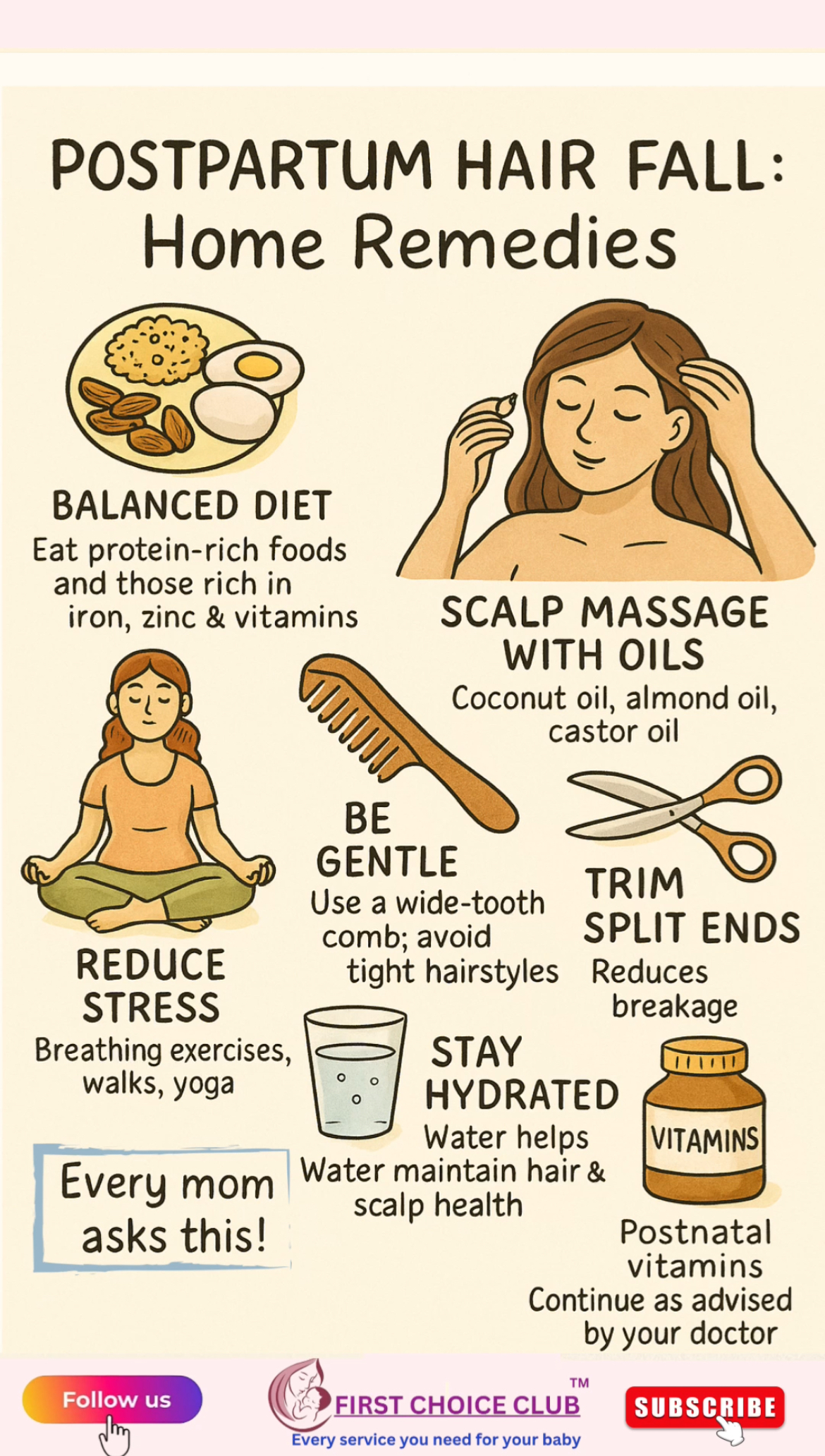
✨ Postpartum Hair Fall: Home RemediesEvery new mom asks about postpartum hair fall! Here’s why it happens and simple home remedies to help your hair recover naturally.Many moms notice clumps of hair coming out in the shower or on their pillow a few months after giving birth.It feels scary — but it’s very common and usually temporary.Here’s why it happens and what gentle, natural home remedies can help.⸻🌼 Why postpartum hair fall happensDuring pregnancy, high estrogen keeps hair in its growth phase, so it feels thicker and fuller.After delivery, hormone levels drop, and lots of hair moves into the shedding phase at once — usually around 2–4 months postpartum.This is called postpartum telogen effluvium, and it often lasts a few months before slowing down.⸻✅ Home remedies & gentle care tips:🥗 Balanced diet:Eat protein-rich foods (dal, eggs, nuts) and foods rich in iron, zinc & vitamins.🥥 Scalp massage with oils:Coconut oil, almond oil, or castor oil massages once or twice a week improve circulation and nourish hair roots.🧘♀️ Reduce stress:Simple breathing exercises, walks, or short yoga can help — stress worsens shedding.🪮 Be gentle:Use a wide-tooth comb; avoid tight hairstyles, heat styling & chemical treatments.💧 Stay hydrated:Water helps maintain hair and scalp health.✂️ Trim split ends:Keeps hair looking healthier and reduces breakage.💊 Postnatal vitamins:Continue as advised by your doctor — nutrients like biotin & iron support healthy hair regrowth.⸻⚠ When to see your doctor: • Hair fall is very heavy, lasts longer than a year • Notice bald patches or round spots • Other symptoms like fatigue, feeling cold, or mood changes (may suggest thyroid or iron deficiency)⸻🌱 Real talk:Postpartum hair fall feels scary, but it’s usually a sign your body is readjusting.With gentle care, patience, and time, hair growth usually returns to normal. ❤️
28 Jul
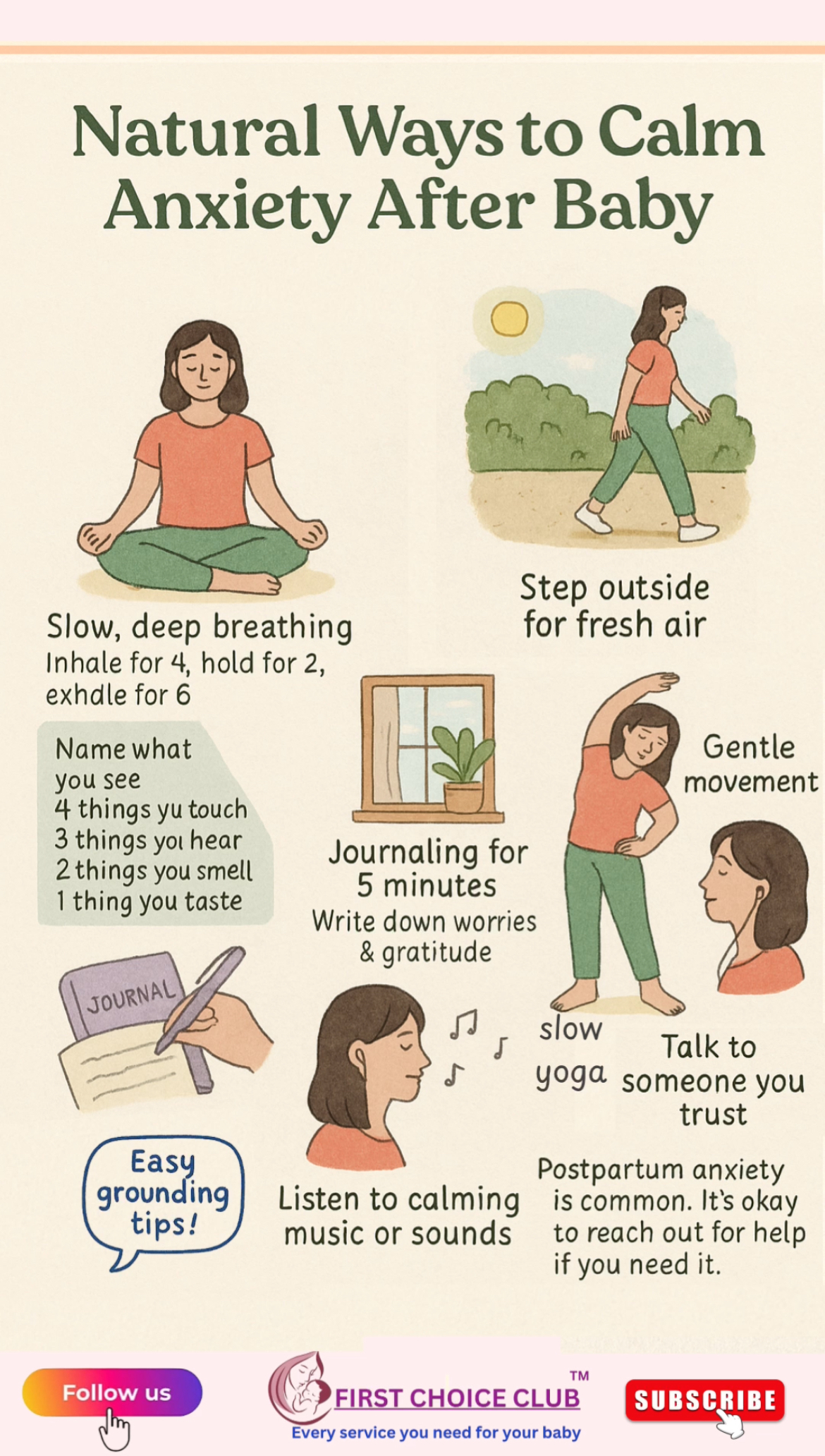
🌱 Natural Ways to Calm Anxiety After BabyHook: “Easy grounding tips!”Having a baby changes everything — including your emotions.Many new moms feel anxious, restless, or overwhelmed, especially in the quiet hours when everyone else is asleep.Here are gentle, natural ways to soothe postpartum anxiety and feel more grounded:⸻✅ 1️⃣ Slow, deep breathingInhale for 4 counts, hold for 2, exhale for 6.Even a minute can calm racing thoughts and help your body relax.✅ 2️⃣ Step outside for fresh airA quick walk around your balcony, garden, or block can clear your mind and reset your mood.✅ 3️⃣ Name what you see, hear & feelA quick grounding exercise: • 5 things you see • 4 things you touch • 3 things you hear • 2 things you smell • 1 thing you tasteThis gently brings your mind back to the present.✅ 4️⃣ Journaling for 5 minutesWrite down your worries, then list three small things you’re grateful for today.It doesn’t have to be perfect — just get it out of your head and onto paper.✅ 5️⃣ Gentle movementStretching, slow yoga, or a few deep shoulder rolls can release tension held in your body.✅ 6️⃣ Listen to calming music or soundsSoft lullabies, nature sounds, or guided meditations can soothe your mind.✅ 7️⃣ Talk to someone you trustShare how you feel with your partner, a friend, or another mom.Saying it out loud can make it feel lighter.⸻🌸 Real talk:Postpartum anxiety is common, and needing help doesn’t mean you’re failing.These tips can help — but if anxiety feels overwhelming or lasts beyond a couple of weeks, it’s okay (and brave!) to reach out to your doctor or a mental health professional.
29 Jul
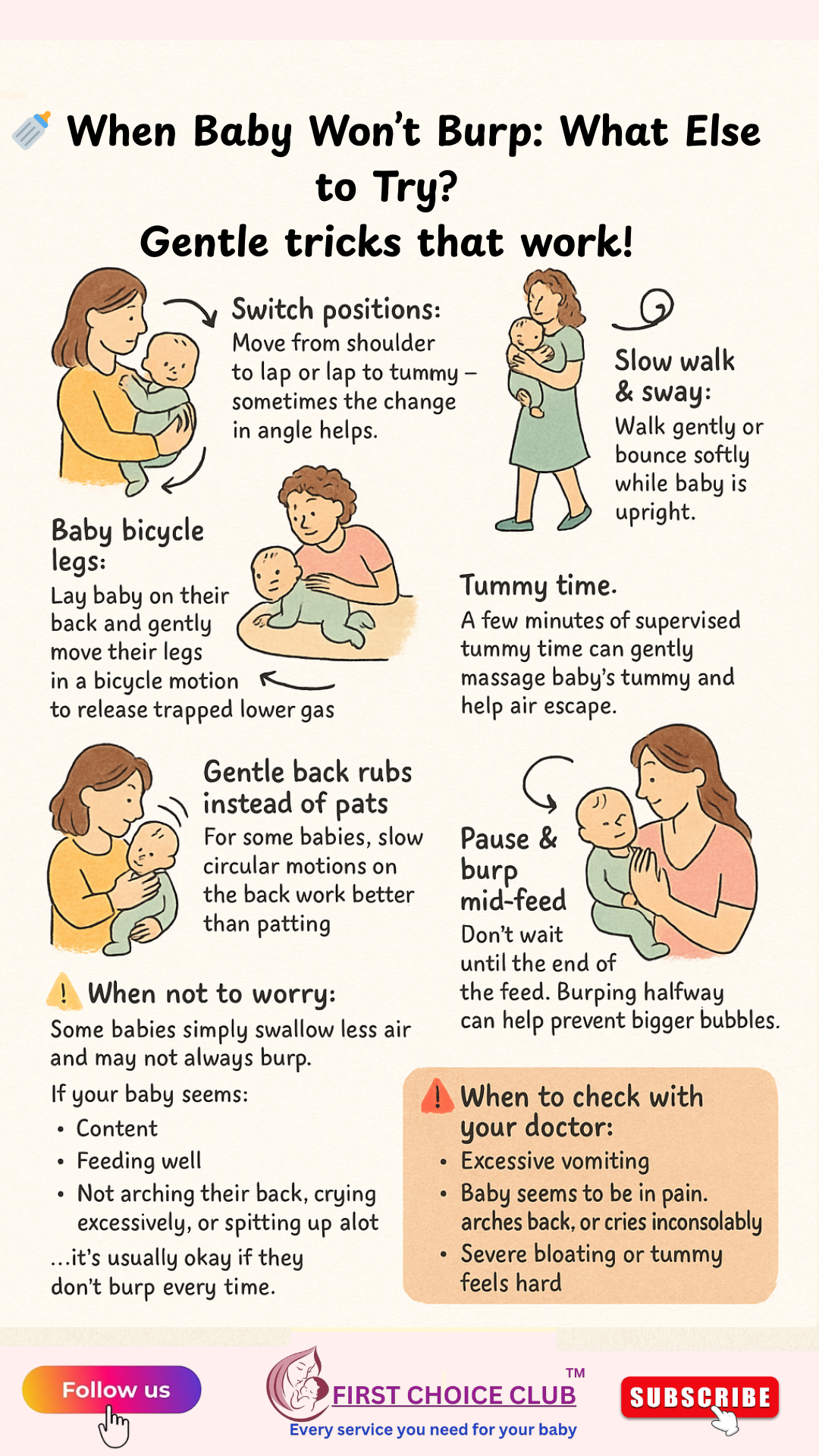
When Your Baby Won't Burp: Why It Happens and Every Technique That Actually WorksThe burp. It seems like it should be the simplest thing in the world — feed your baby, pat their back, they burp, everyone moves on. But any experienced parent will tell you that some nights, no matter how long you pat, how many positions you try, or how carefully you were with the feed, the burp simply refuses to come. Your baby squirms, pulls their legs up, fusses, and you sit in the dark at midnight wondering what you are doing wrong.You are not doing anything wrong. Burping is genuinely variable between babies and between feeds. This guide explains why some babies swallow more air than others, why some feeds produce more gas, every burping position and technique that works, and when it is actually okay to simply give up and put your baby down.Why Babies Need to Burp at AllWhen babies feed — whether from the breast or a bottle — they inevitably swallow some air along with the milk. This swallowed air collects in the stomach and, if it is not released, moves into the intestines where it causes the cramping, bloating, and discomfort that most people call gas or wind. In the stomach, trapped air creates a sensation of fullness that can make a baby seem unsettled and hungry again shortly after a feed even when they have taken enough milk.Burping releases the swallowed air from the stomach before it has a chance to move downward. It is particularly important in the first three to four months of life, when babies have not yet developed the digestive tract motility to move gas through easily on their own.Why Some Babies Are Harder to Burp Than OthersFeeding methodBreastfed babies typically swallow less air than bottle-fed babies, particularly when the milk flow is well-regulated and the latch is good. A strong let-down reflex can cause a breastfed baby to gulp and swallow air, but generally breastfed babies need less burping than formula-fed babies. Formula-fed babies, especially those using fast-flow teats, swallow significantly more air with each feed and usually need to be burped more deliberately.Teat flow rateIf you are bottle feeding and finding that your baby is consistently gassy and difficult to burp, the teat flow rate may be too fast. A teat that delivers milk faster than your baby can swallow forces them to gulp, swallowing significant amounts of air in the process. Try switching to a slow-flow teat and see if the situation improves over two to three feeds. This single change resolves persistent wind and burping difficulty in many babies.Feeding positionHow a baby is positioned during a feed significantly affects how much air they swallow. A baby who is feeding in a very reclined position (nearly horizontal) tends to swallow more air than one who is feeding in a more upright position. For bottle-fed babies, holding the baby at approximately a 45-degree angle and keeping the teat full of milk (paced bottle feeding) reduces air intake considerably.Some babies simply produce less gasJust as adults vary in how much they burp and pass gas, babies vary too. Some babies barely need burping at all — they swallow minimal air, have relaxed lower oesophageal sphincters that allow gas to escape naturally, and rarely seem gassy. Others are the opposite. Both ends of the spectrum can be entirely normal.The Three Classic Burping PositionsOver the shoulderThis is the most commonly used position and works well for most babies. Hold your baby upright with their chin resting on your shoulder, their tummy pressed gently against your chest. Support their bottom with one hand and use the other to gently pat or rub their back in a slow, rhythmic motion. The gentle pressure of their tummy against your shoulder helps dislodge trapped air.Sitting on your lapSit your baby on your knee facing outward or to the side. Support their chin and chest firmly with one hand — your fingers spread to support the chest, your thumb and forefinger forming a gentle V under the chin to keep the head up. Use your other hand to pat or rub the back. This position works well for babies who resist the over-the-shoulder position or for parents who find it awkward.Face-down across your lapLay your baby tummy-down across both your knees, making sure their head is slightly higher than their chest and is well-supported. Gently pat or rub the back. The tummy-down position creates a different pressure dynamic and works particularly well for babies who have been difficult to burp in the upright positions.What to Try When Nothing Is WorkingChange positions mid-attemptIf you have been trying one position for more than two minutes without success, switch. Moving from over-the-shoulder to sitting upright to face-down and back again shifts the air bubble within the stomach, often dislodging it in a way that staying in one position cannot.Try gentle back-rubbing instead of pattingFor many babies, slow circular rubbing of the back from the base of the spine upward is more effective than patting. The gentle upward pressure physically moves trapped air toward the oesophagus. Try this for a full minute before returning to patting.Bicycle legsLay your baby on their back and gently move their legs in a cycling motion — alternating legs as if they are pedalling a slow bicycle. This movement stimulates the abdominal muscles and digestive tract, helping move gas both upward (to burp) and downward (to pass as wind). It is particularly effective for gas that has moved past the stomach into the intestines and is causing lower abdominal discomfort.A brief pause and restartSometimes a baby who is tense and squirming because of trapped gas makes it harder for the gas to escape. Try stopping the burping attempt, giving your baby a minute of calm skin-to-skin or gentle rocking to relax them, and then trying again. A relaxed baby burps more easily than a distressed one.Burp mid-feed, not just afterIf your baby is consistently difficult to burp at the end of a feed, try burping partway through instead. For bottle-fed babies, pause at around the halfway point of the feed. For breastfed babies, burp when switching sides. Releasing air mid-feed prevents large air bubbles from accumulating and makes the after-feed burp much more manageable.When Is It Okay to Give Up?If you have spent five to ten minutes trying to burp your baby and nothing has worked, it is usually safe to put your baby down. A baby who settles comfortably after being placed in their sleep space — on their back, in a safe sleep environment — almost certainly does not have a significant amount of trapped air causing discomfort. Some feeds simply produce less gas than others, and not every feed will produce a burp.However, a baby who cannot settle, who pulls their legs up, arches their back, and cries persistently after being put down is showing signs of genuine discomfort that warrants continuing your efforts. Try the bicycle legs technique in this position, give a gentle tummy massage in clockwise circles, or hold your baby upright for another ten minutes before trying to settle them again.When to Mention It to Your PediatricianOccasional difficulty burping is entirely normal. However, speak to your pediatrician if your baby seems to be in significant pain during or after most feeds, if you notice your baby spitting up large volumes (not just small posseting) with most feeds, if your baby is not gaining weight well, or if the gas and discomfort seem to be genuinely affecting their quality of life and sleep. These may be signs of gastro-oesophageal reflux, which is common and treatable, or of a milk sensitivity that warrants investigation.
28 Jul
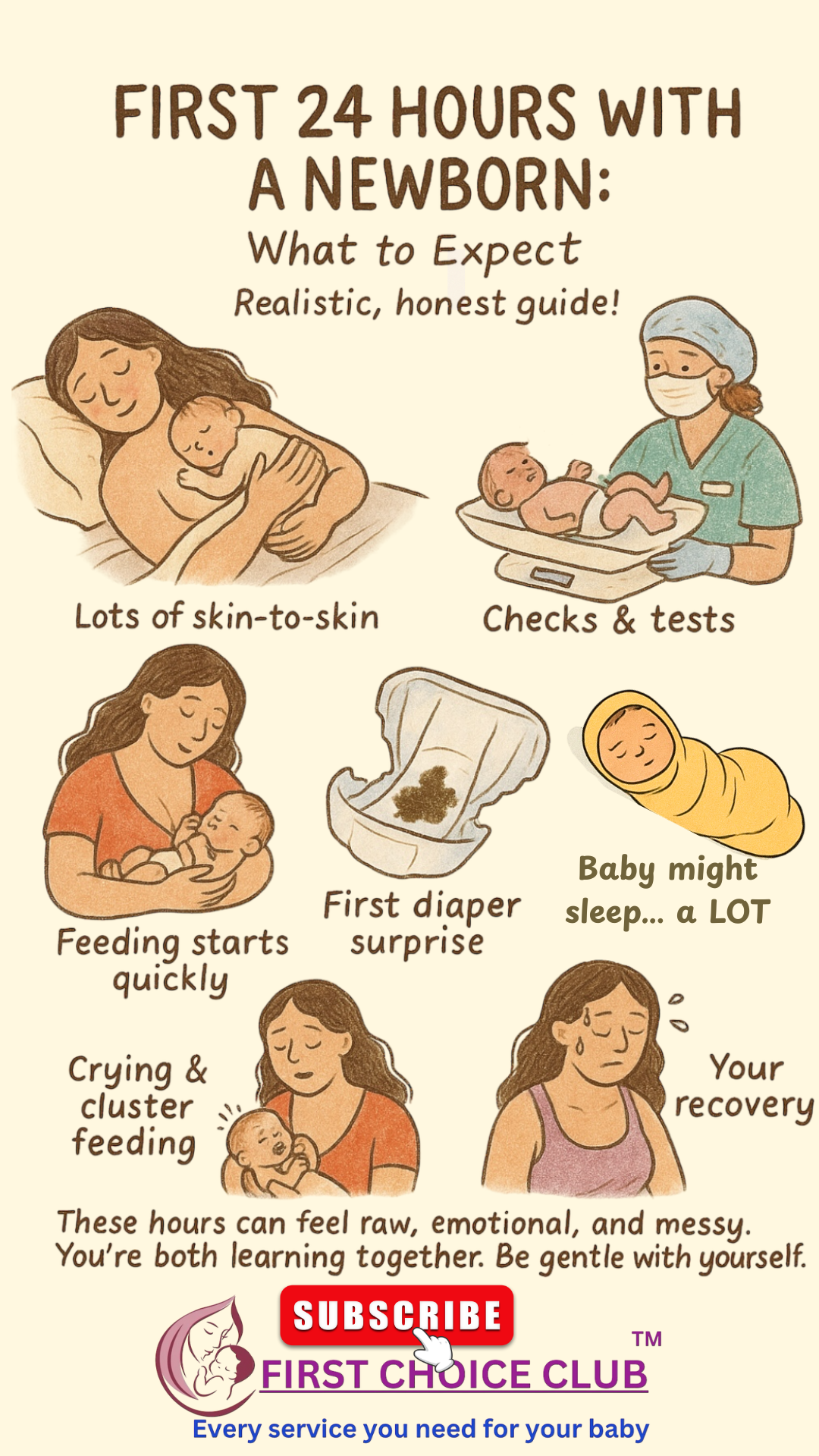
👶 First 24 Hours with a Newborn: What to Expect!The moment your baby is placed in your arms feels magical — but the first 24 hours after birth can also be messy, raw, and overwhelming. Forget the Instagram-perfect photos: real life in those first hours looks different for every family.Here’s what really happens, so you feel prepared, not panicked.⸻🌼 1️⃣ Lots of skin-to-skinRight after birth, your baby is usually placed on your chest.This is more than just sweet bonding time: it helps regulate their: • Temperature • Heartbeat • BreathingIt also helps your body release oxytocin, which can calm you and support early milk production.Skin-to-skin can be done by either parent, and it’s beautiful to continue often, not just immediately after birth.⸻🍼 2️⃣ Feeding starts quicklyYour baby may root, turn toward your chest, or make sucking motions.Even if it feels clumsy or brief, this first hour is often called the “golden hour” for initiating breastfeeding.Expect: • Frequent, sometimes frustrating latch attempts • Short feeds • Sleepy pausesDon’t worry if it doesn’t look perfect — you’re both learning together.⸻🧷 3️⃣ Checks & testsIn the first 24 hours, nurses or doctors usually: • Weigh and measure your baby • Give vitamin K injection (helps prevent bleeding) • Apply eye ointment (protects against infection) • Monitor vital signsThese are routine and done gently, often right in your room.⸻😴 4️⃣ Baby might sleep… a LOTAfter birth, many babies enter a very sleepy phase.They may sleep most of the first day, sometimes making it hard to wake them for feeds.This can worry new parents, but it’s usually normal and temporary.Your care team will guide you if your baby needs extra encouragement to feed.⸻💩 5️⃣ First diaper surpriseSometime in the first day, you’ll see your baby’s first stool, called meconium.It’s: • Thick and sticky • Dark green or blackIt can be surprising (and messy!), but it’s completely normal.⸻💗 6️⃣ Crying & cluster feedingAfter that sleepy phase, babies often become: • Fussy • Seem to want to feed constantlyThis is called cluster feeding — it helps build your milk supply and soothes your newborn.It’s tiring but normal, and it usually calms down in a day or two.⸻🩹 7️⃣ Your recoveryYou’ve just done something incredible — but your body needs care, too.Common things you may feel: • Shivering or shaking (from hormones) • Night sweats • Soreness, especially if you had a tear or C-section • Overwhelm and big emotionsTips:✅ Accept help from nurses, family, or your partner✅ Drink water and eat when you can✅ Rest whenever possible — even 10-minute naps help⸻🌱 Real talk:These first hours can feel messy, emotional, and far from perfect.You and your baby are both learning together.It doesn’t have to look like a photoshoot to be beautiful.Be gentle with yourself, mama — presence matters more than perfection. ❤️⸻✨ Extra Tips for the First 24 Hours:✅ Ask visitors to wait if you feel tired or overwhelmed✅ Keep your baby in the room with you (rooming-in supports feeding & bonding)✅ Write down questions to ask the nurse or lactation consultant✅ Take photos — even imperfect, raw ones become precious memories🧡 Final reminder:Every birth and baby is different.If anything feels off — like baby not waking for feeds, fever, or you feeling dizzy or faint — call your nurse or doctor immediately.You don’t have to know everything on day one.You only need to love your baby and yourself through it.
27 Jul
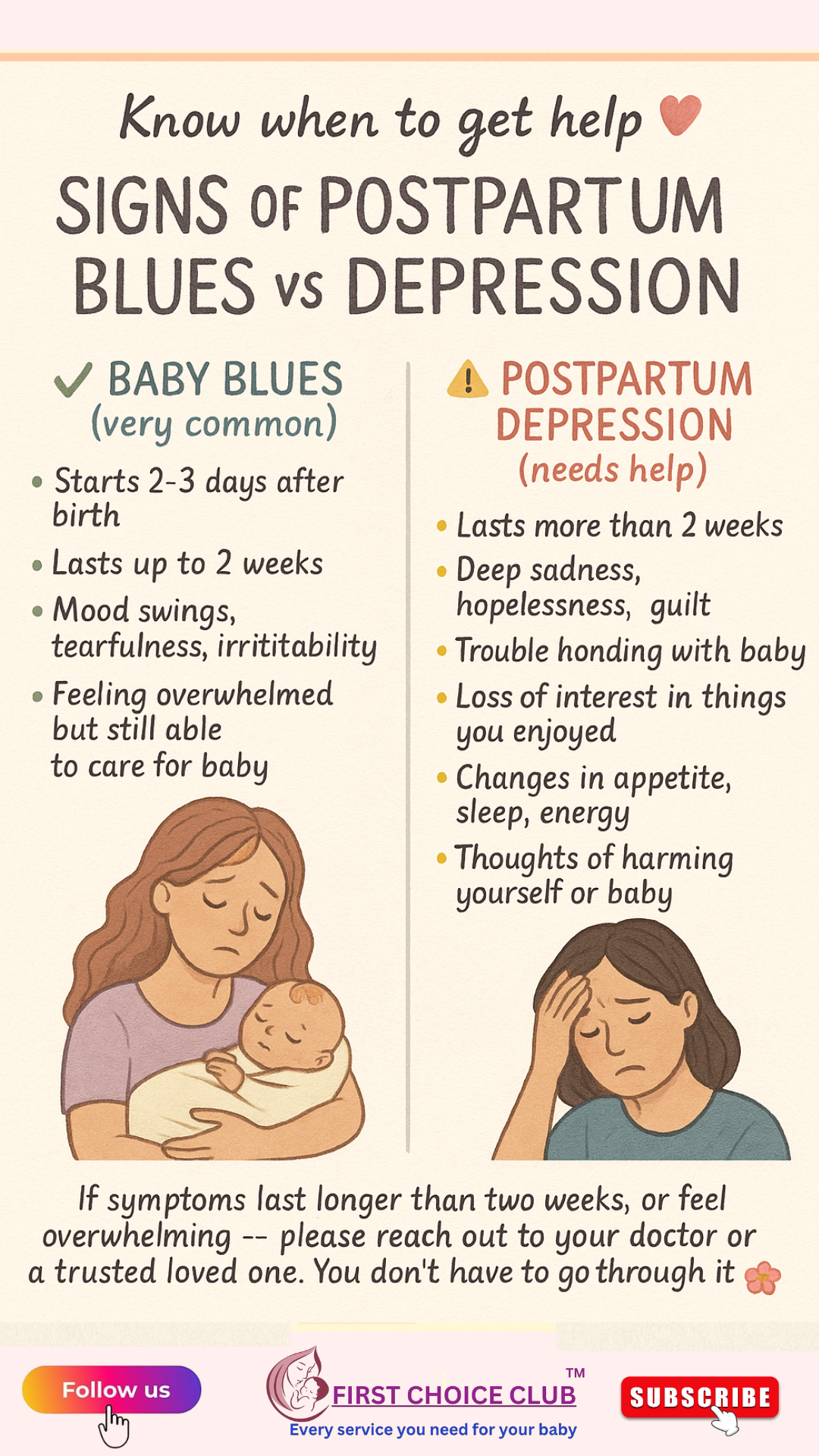
🌼 Signs of Postpartum Blues vs Depression: Know Wheny to Get Help ❤️Becoming a mother is one of life’s most beautiful transformations, but it can also feel overwhelming, exhausting, and confusing. While it’s common to experience emotional ups and downs after birth, it’s important to recognize the difference between postpartum blues (often called baby blues) and postpartum depression. Knowing these signs early can help you get the right support — because you don’t have to go through it alone. ❤️⸻🤱 What Are Postpartum Blues (Baby Blues)?Postpartum blues are very common, affecting up to 70–80% of new mothers worldwide. They typically appear 2–3 days after giving birth and may last for about 1–2 weeks.Baby blues happen because of: • Sudden drop in pregnancy hormones (estrogen & progesterone) • Physical exhaustion from childbirth • Adjustment to round-the-clock newborn care • Lack of sleep and big life changesCommon signs of baby blues: • Mood swings: happy one moment, tearful the next • Feeling overwhelmed but still able to care for the baby • Irritability or anxiety • Trouble sleeping (even when the baby sleeps) • Reduced concentration • Crying unexpectedlyThese feelings usually come and go and improve on their own. Simple support — like rest, help from family, and talking to other moms — often helps.⸻⚠️ What Is Postpartum Depression?Postpartum depression (PPD) is different from baby blues.It is more intense, lasts longer (more than 2 weeks), and needs professional help.Studies show PPD affects around 10–15% of new mothers. It can appear anytime within the first year after birth, though it often starts within the first few months.Signs of postpartum depression: • Persistent sadness, hopelessness, or emptiness • Feelings of guilt or worthlessness • Loss of interest in activities you used to enjoy • Difficulty bonding with your baby • Withdrawal from family and friends • Changes in appetite or significant weight change • Trouble sleeping or sleeping too much • Low energy or extreme fatigue • Thoughts of harming yourself or your babyIf you or someone you know is experiencing these symptoms, it’s so important to reach out for medical help.⸻🌱 Why Recognizing the Difference MattersMany moms don’t ask for help because: • They feel they “should be happy” • Fear of judgment • Worry that asking for help means they’re failing as mothersBut postpartum depression is not your fault.It’s a medical condition that can be treated. The sooner it’s recognized, the sooner you can feel better.⸻🌸 Tips for Coping & Seeking HelpWhether you’re experiencing baby blues or postpartum depression, here are gentle, practical steps that might help:✅ Talk openly: Share your feelings with your partner, family, or friends.✅ Accept help: Let others cook, clean, or hold the baby so you can rest.✅ Prioritize rest: Sleep when your baby sleeps, even if chores wait.✅ Move gently: Short walks and fresh air can boost mood.✅ Connect: Join new mom groups or online communities.✅ Nourish your body: Balanced meals and staying hydrated help physical recovery.✅ Be kind to yourself: Remind yourself healing takes time.If feelings don’t improve after two weeks, or if sadness feels overwhelming, please contact your doctor or a trusted mental health professional.⸻❤️ When to Seek Immediate HelpSeek help right away if you: • Have thoughts of harming yourself or your baby • Feel unable to care for your baby • Experience severe anxiety, panic attacks, or hallucinationsThese can be signs of postpartum depression or a rare but serious condition called postpartum psychosis, which needs urgent medical attention.⸻🧡 Final Words: You’re Not AloneEvery postpartum journey is different. Feeling sad, anxious, or overwhelmed does not make you a bad mother — it makes you human.With awareness, support, and professional care, recovery is possible.Don’t wait to reach out. You deserve help, hope, and healing. 🌸If this article helped you, please share it with another mama who might need it. ❤️
26 Jul
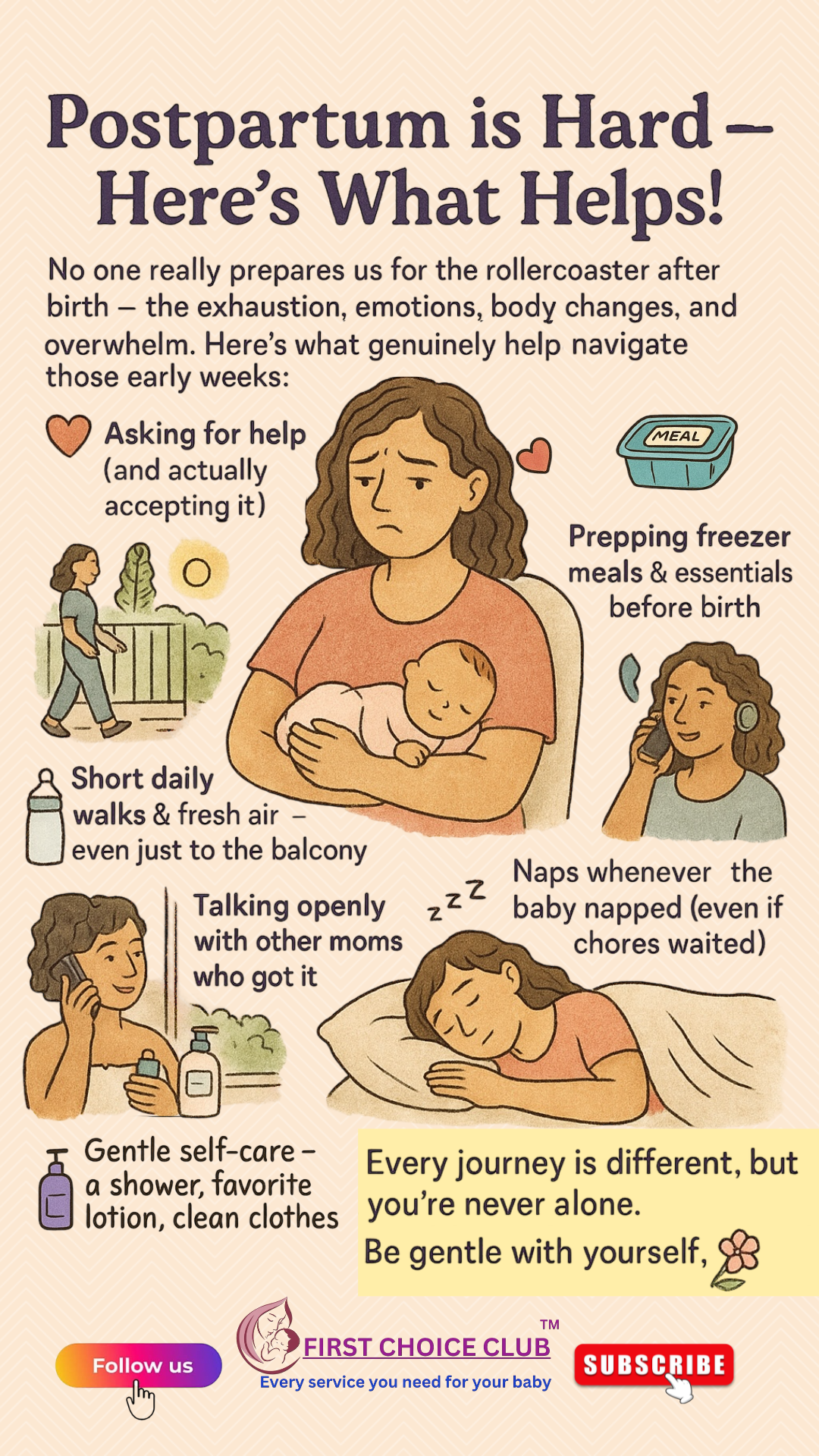
🌸 Postpartum is Hard — Here’s What Helps!The postpartum period — often called the “fourth trimester” — is a time of immense physical recovery, emotional adjustment, and learning how to care for a newborn. While it’s often portrayed as a magical bonding period, the reality can be messy, overwhelming, and exhausting. Many new mothers quietly wonder, “Is it normal to feel this way?” The answer is yes — and you’re not alone.In this post, let’s talk honestly about why postpartum recovery feels so hard, and what small, practical things can truly help you navigate this phase.⸻🤱 Why the postpartum period feels so overwhelmingAfter childbirth, your body and mind go through changes that are as intense as pregnancy itself: • Hormonal shifts: Right after delivery, estrogen and progesterone levels drop dramatically. These changes can affect mood, energy, and sleep patterns. • Physical recovery: Whether you had a vaginal birth or C-section, your body is healing — from stitches, swelling, sore muscles, and more. • Sleep deprivation: Newborns wake often for feeding, making deep, restorative sleep nearly impossible in the early weeks. • Emotional weight: Many mothers feel pressure to “bounce back,” be a perfect parent, and manage household responsibilities, all while feeling exhausted. • Identity shift: Becoming a parent can challenge your sense of self, your relationship, and your confidence.These factors combine to create what many call the “postpartum rollercoaster.” It’s normal to feel both deep love for your baby and moments of sadness, frustration, or anxiety.⸻❤️ What can really help during postpartum recoveryEveryone’s journey is unique, but here are gentle, realistic things that can make the postpartum period more manageable:1️⃣ Ask for (and accept) helpMany moms feel they should handle everything themselves, but postpartum recovery is not the time to be a superhero. • Let your partner, family, or friends help with chores, cooking, or holding the baby so you can rest. • Consider asking for help before the baby arrives: freeze meals, stock up on essentials, or arrange for someone to stay over for a few nights.⸻2️⃣ Prepare freezer meals and essentialsIn the final weeks of pregnancy, batch-cooking simple meals can be a lifesaver. When you’re tired or healing, it helps to have ready-to-eat food: • Soups, dals, stews, and khichdi freeze well. • Keep healthy snacks (nuts, dry fruits, granola bars) within easy reach for quick energy.⸻3️⃣ Prioritize small moments of fresh air and movementEven a 5–10 minute walk on your balcony, terrace, or in a park can help lift your mood. Light movement aids blood circulation, supports healing, and offers a mental break. • Start slowly and listen to your body. • Combine walks with gentle stretches or breathing exercises.⸻4️⃣ Connect with other momsTalking to someone who gets it can be incredibly comforting. • Join postpartum support groups, either locally or online. • Share your struggles honestly. Often, you’ll discover others feel the same.⸻5️⃣ Nap whenever you canThe classic advice, “Sleep when the baby sleeps,” isn’t always practical — but even short naps matter. • Close your eyes and rest, even if you don’t fall asleep. • Ask someone to watch the baby so you can rest without worry.⸻6️⃣ Practice gentle self-carePostpartum self-care doesn’t have to be elaborate: • A warm shower and fresh clothes. • Massaging your scalp or feet. • Lighting a candle or listening to calming music. • Using a mild lotion to soothe dry skin.These moments can remind you that you’re still you, even as you adjust to motherhood.⸻🌱 Supporting your mental and emotional healthUp to 80% of new moms experience “baby blues” — mood swings, tearfulness, and anxiety in the first two weeks. For most, this passes naturally. But if feelings of sadness, hopelessness, or anxiety continue beyond two weeks or worsen, it may be postpartum depression or anxiety.If you notice: • Persistent low mood • Trouble bonding with your baby • Feeling worthless, guilty, or very anxious • Thoughts of harming yourself or your babyReach out immediately to a healthcare professional, counselor, or trusted family member.Seeking help is a sign of strength — never shame.⸻🍲 Eating well during postpartumNutrition plays a big role in recovery: • Focus on iron-rich foods to replenish blood loss. • Include protein for tissue healing. • Add colorful fruits and vegetables for vitamins and minerals. • Hydrate well — aim for water, soups, and herbal teas.Traditional postpartum foods like panjiri, gond laddoos, and methi seeds (in moderation) can support recovery — but always check with your doctor, especially if breastfeeding.⸻🏡 Managing household tasksIt can feel impossible to keep up with housework during postpartum. Here’s what helps: • Lower your standards temporarily — it’s okay if the house isn’t perfect. • Use meal delivery apps occasionally. • Keep a basket with essentials (diapers, wipes, snacks, water) near you to avoid constant trips.⸻👩❤️👨 Caring for your relationshipMany couples find the early months after birth stressful. Communicate openly with your partner: • Share how you’re feeling. • Divide baby care and chores realistically. • Schedule small moments of connection — even 10 minutes of conversation after the baby sleeps.⸻🧘♀️ When to ask for professional helpSee your doctor if you experience: • Severe pain, fever, heavy bleeding, or foul-smelling discharge. • Signs of postpartum depression or anxiety. • Breast pain, cracked nipples, or breastfeeding concerns.Don’t wait — your health matters too.⸻✨ Remember: You are doing your bestPostpartum is not about “bouncing back.” It’s about healing, adjusting, and learning to care for yourself and your baby. • Some days will feel manageable; others may feel overwhelming — both are normal. • Celebrate small wins: a shower, a nap, a shared smile with your baby.⸻🌸 Final thoughtsMotherhood isn’t meant to be done alone. Build your support system, take things slowly, and show yourself the same compassion you give your baby.If you’re reading this and struggling right now: you’re not failing — you’re healing, growing, and doing the hardest job in the world. Be gentle with yourself, mama. ❤️
25 Jul

🌡 How to Check If Baby Has a Fever (Simple Tips for New Parents)Nothing makes new parents more anxious than wondering if their tiny baby has a fever. Babies can often feel warm after crying, feeding, or playing — so how do you know when it’s an actual fever and what should you do?Let’s break it down step-by-step so you feel confident and calm.⸻🧸 Why babies sometimes feel warmNewborns and infants have an immature temperature-regulation system. • Warm room? Baby feels warm. • After crying or active kicking? Baby feels warm. • Swaddled? Baby feels warm.That doesn’t always mean they have a fever. The best way to know: measure, don’t guess.⸻✅ Most accurate way: Digital thermometerA rectal temperature using a digital thermometer is the gold standard for babies under 3 months. • Place a small dab of petroleum jelly on the thermometer tip. • Gently insert 1/2 to 1 inch into the baby’s rectum while they’re lying on their back with legs lifted. • Wait for the beep — it only takes a few seconds.📍 A rectal temperature of 100.4°F (38°C) or higher is considered a fever in infants.⸻🌼 Other thermometer types (and when to use) • Axillary (underarm): Easier but slightly less accurate. • Temporal (forehead scan): Convenient for quick checks in older babies. • Ear thermometers: Best for babies over 6 months; not accurate in very young infants.Avoid: • Old mercury thermometers (can break & spill mercury). • Checking by touch only (parents’ hands aren’t reliable thermometers!).⸻⚠ When to call your doctor immediatelyFor babies under 3 months: • Rectal temperature ≥ 100.4°F (38°C) • Difficulty waking, poor feeding, unusual fussiness, or breathing troubles.For babies older than 3 months: • Fever lasts more than 24–48 hours • Baby seems unusually lethargic, has trouble breathing, or shows signs of dehydration (fewer wet diapers)Always trust your instincts — if your baby seems “off” even without a high temperature, call your pediatrician.⸻💡 Practical tips for checking temperature calmly • Choose a quiet moment — maybe after a diaper change. • Have another caregiver help gently hold baby still. • Sing or talk softly to soothe them. • Keep the thermometer clean — wipe with rubbing alcohol before and after.⸻📌 Do’s & Don’ts at home✅ Do dress baby in light clothes if they’re hot.✅ Do keep the room comfortably cool (about 24°C).✅ Do give plenty of feeds — hydration helps.❌ Don’t overdress, swaddle too tightly, or use thick blankets.❌ Don’t give any medicine without your pediatrician’s advice — especially for babies under 3 months.⸻❤️ SummaryThe only sure way to know if your baby has a fever is by using a digital thermometer — ideally rectally for babies under 3 months.Any fever in newborns is important and should prompt a call to the pediatrician.Measure, observe, and trust your parental instincts — your calm approach matters as much as the thermometer! 🌸
24 Jul
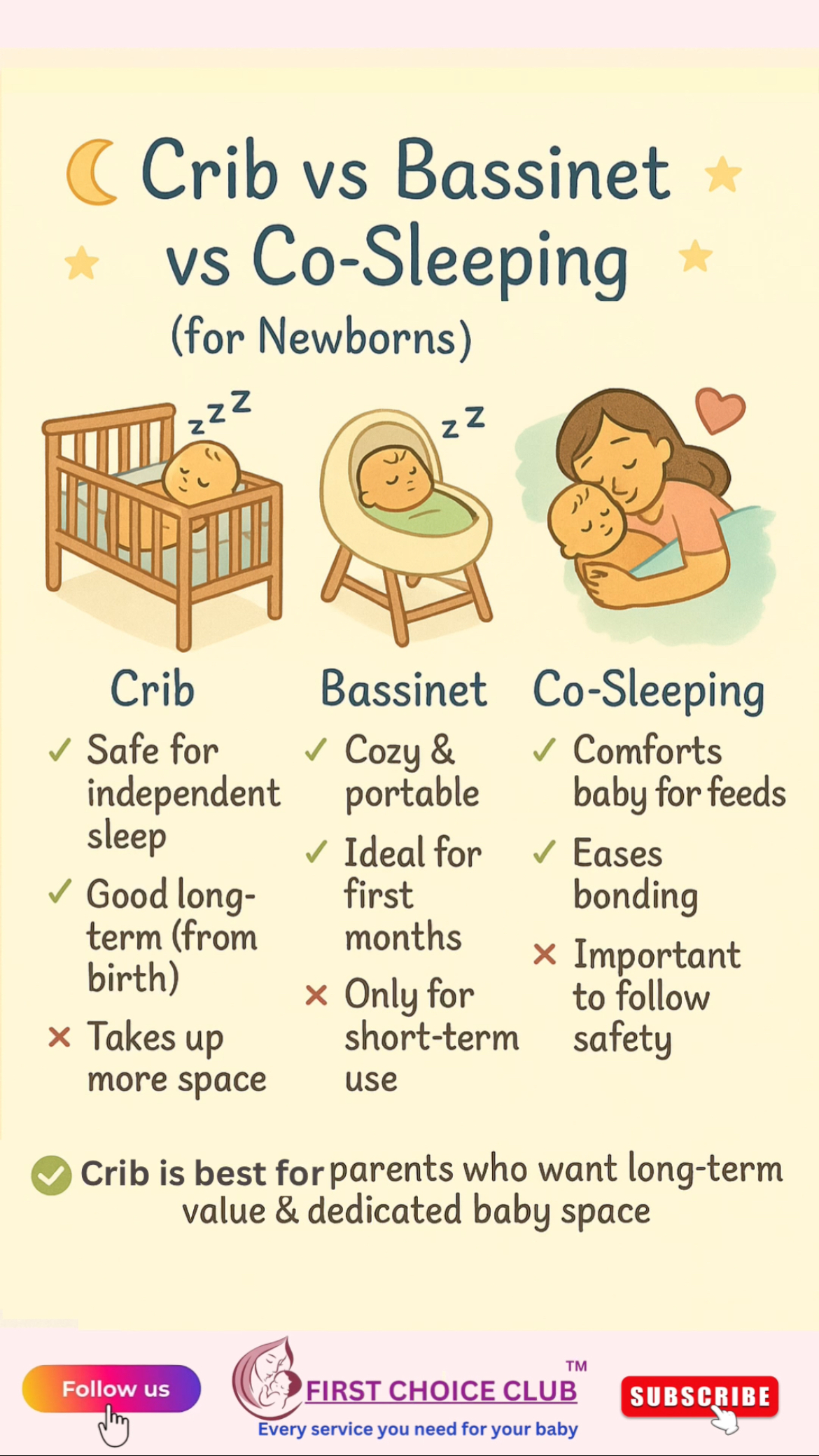
Co-Sleeping with Your Baby: A Complete Safety Guide for Indian ParentsCo-sleeping — the practice of sleeping in close proximity to your baby — is not a modern trend. It is the default sleeping arrangement for the majority of families around the world, and it has been the norm in India for generations. Yet co-sleeping is also a topic surrounded by genuine safety concerns that every parent needs to understand before making a decision about where their baby sleeps.This guide explains the different types of co-sleeping, the evidence on risks and benefits, and the specific safety practices that make co-sleeping as safe as possible for your family.Understanding the Different Types of Co-SleepingCo-sleeping is not a single practice — it describes several different arrangements that have very different risk profiles.Room-sharing means your baby sleeps in the same room as you but on a separate surface — in a cot, bassinet, or bedside sleeper placed next to your bed. This is the arrangement recommended by the American Academy of Pediatrics, the UK's National Health Service, and India's major pediatric bodies. Room-sharing offers the convenience and closeness of co-sleeping while maintaining a separate, safe sleep surface for your baby. Studies consistently show that room-sharing reduces the risk of Sudden Infant Death Syndrome (SIDS) by up to 50 percent compared to solo sleeping in a separate room.Bed-sharing means your baby sleeps in the same bed as you. This is what most people mean when they say co-sleeping, and it is the arrangement that carries the most significant safety risks if not done carefully. The risks are real — bed-sharing in unsafe conditions is associated with an increased risk of accidental suffocation, entrapment between the mattress and the wall or headboard, and overheating. However, the absolute risk for healthy, term babies in a safe environment with non-smoking, non-drinking parents is considerably lower than is sometimes communicated in Western medical literature.The Cultural Context for Indian FamiliesIn India, bed-sharing is deeply embedded in family culture. It is associated with closer bonding, easier breastfeeding at night, and a collective approach to childcare that is fundamentally different from the Western model of independent infant sleep. Many Indian grandmothers and mothers will tell you that generations of healthy children grew up sleeping alongside their parents.This context is important. Dismissing co-sleeping as simply dangerous misrepresents the evidence and fails to support the millions of Indian families for whom it is a genuine and considered choice. The goal of this guide is not to tell you what to do, but to ensure that whatever you choose, you have the information to do it as safely as possible.Evidence-Based Safety Practices for Bed-SharingIf you choose to bed-share, the following practices are supported by the available evidence as significantly reducing risk.Always place your baby on their back to sleep. This applies regardless of where your baby sleeps — in a cot, bassinet, or your bed. The supine (back) position is the single most important factor in reducing SIDS risk, reducing mortality from this cause by more than 50 percent since its widespread adoption in the 1990s.Use a firm mattress. Soft surfaces — memory foam, thick pillow-top mattresses, feather beds, sofas, and armchairs — are the environments where the risk of accidental suffocation is highest. A firm, flat mattress is essential for safe bed-sharing. This is one reason the widely discussed UNICEF-supported 'Safe Sleep Seven' guidelines specify a firm sleep surface as a core requirement.Keep bedding away from your baby. Adult duvets, pillows, and heavy blankets are not safe for babies. Your baby should sleep on the mattress itself, not on top of bedding, and there should be no pillows within reach. If the room is cool, dress your baby in a sleep suit or sleeping bag appropriate for the temperature.Never bed-share if either parent has consumed alcohol or sedating medications. This is an absolute, non-negotiable safety rule. Alcohol significantly impairs the natural arousal responses that help a sleeping adult respond to a baby's distress. The risk of accidental overlaying — rolling onto the baby — is dramatically increased when a parent has been drinking. The same applies to prescribed sleeping tablets, antihistamines, and recreational drugs.Never bed-share if either parent smokes. Parental smoking is one of the strongest independent risk factors for SIDS, and the risk is compounded by bed-sharing. This applies even if neither parent smokes in the bedroom — third-hand smoke on clothing and bedding is sufficient to increase risk.Do not bed-share with a premature baby or a baby with low birth weight without specific guidance from your pediatrician. Premature infants have less developed arousal mechanisms and are more vulnerable.The Bedside Sleeper: A Middle-Ground OptionIf you want the closeness of bed-sharing without the risks, a bedside sleeper or co-sleeper crib offers a practical solution. These attach to the side of your adult bed, keeping your baby on a separate, firm surface at the same height as your mattress. This arrangement allows easy nighttime feeding without lifting your baby out of a cot, maintains physical closeness, and avoids the risks associated with sharing your adult sleeping surface.Bedside sleepers are widely available in India and are worth considering if you are uncertain about full bed-sharing or if your mattress does not meet the safety criteria above.When to Reconsider Co-SleepingAs your baby grows, their sleep needs and safety considerations change. Once a baby can roll over independently — typically around four to six months — the risk profile of bed-sharing changes. By the time a baby is crawling and pulling themselves up, the risk of falling from the bed becomes a more significant concern. Many families transition to a floor bed at this stage, placing the mattress directly on the floor so that falls are inconsequential.For guidance on infant sleep, newborn care or to find trusted pediatricians in your area, visit firstchoiceclub.in — India's global pregnancy and newborn services directory.
22 Jul
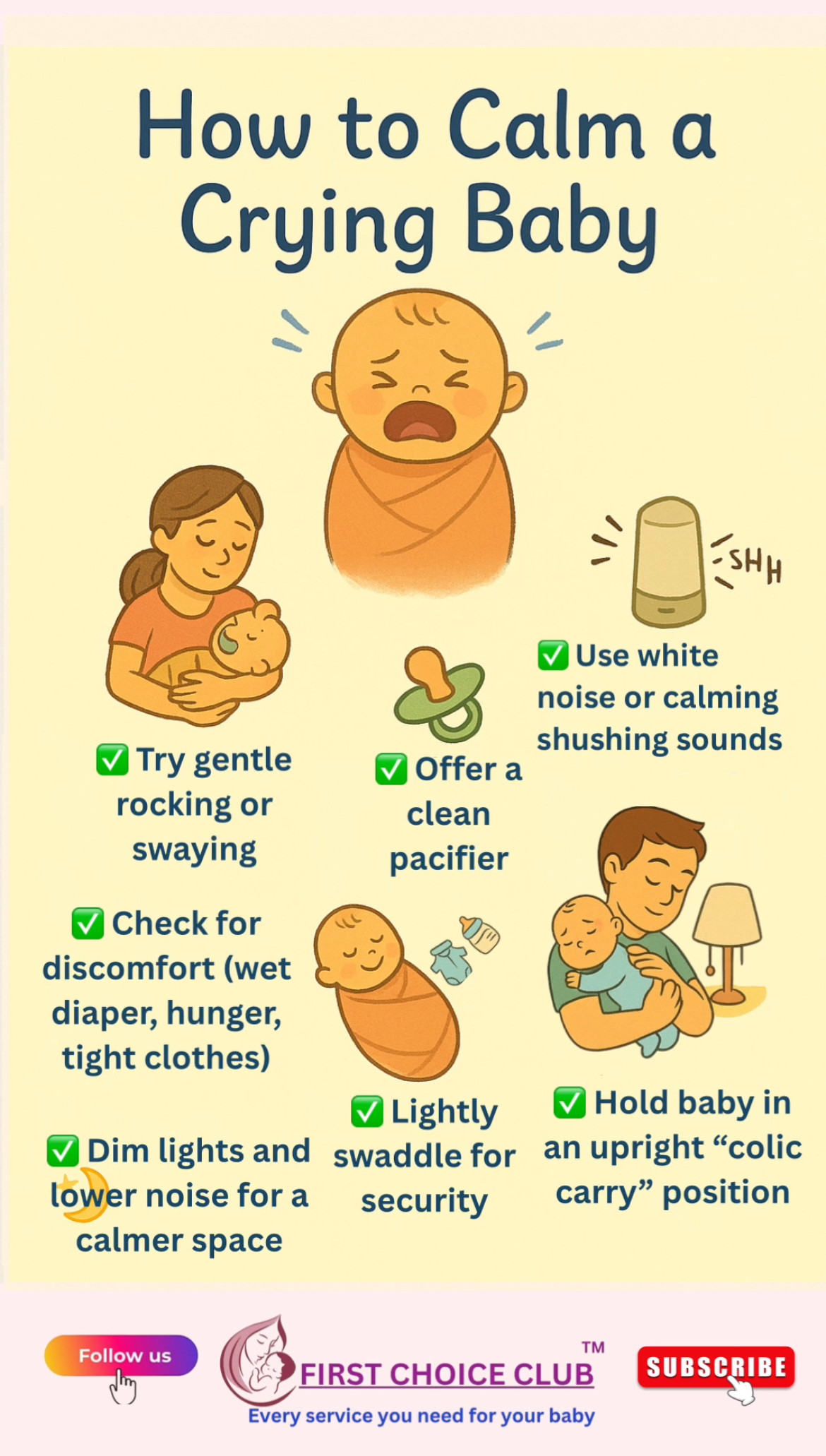
🍼 How to Calm a Crying Baby in Seconds! (Complete Guide for New Parents)Every new parent knows the feeling: you’ve fed, burped, and changed your baby, yet the crying continues — and your stress rises with every second. Don’t worry — crying is your baby’s primary way to communicate in the early months. But understanding the possible reasons behind those tears, along with practical calming techniques, can help you soothe your baby quickly and confidently.In this post, you’ll learn: • Why babies cry so much • How to identify what your baby might be trying to tell you • Proven, gentle methods to calm a crying baby — sometimes in just seconds! • When to worry and when to relaxLet’s get started! 🌸⸻🤔 Why Do Babies Cry So Much?Crying is completely normal — and healthy — in newborns and infants. Most babies cry for about 1-3 hours per day in the first few months. This is how they express hunger, tiredness, discomfort, or simply a need for closeness.Common reasons why babies cry:✅ Hunger (the most common reason!)✅ Dirty or wet diaper✅ Need to burp (trapped gas can be uncomfortable)✅ Feeling too hot or too cold✅ Overstimulation (too much noise, light, or activity)✅ Sleepiness or fighting sleep✅ Colic (unexplained, intense crying, often in the evenings)✅ Need for comfort or cuddlingLearning to “read” your baby’s cries takes time, but the more you observe, the quicker you’ll spot patterns.⸻✨ 7 Gentle, Quick Techniques to Calm Your Baby1️⃣ Gentle rocking or swayingBabies are used to constant motion inside the womb. Hold your baby close and rock gently side to side, or sway while walking slowly around the room. Using a baby carrier can also help, freeing your hands while your baby feels snug and safe.2️⃣ Use white noise or calming shushing soundsThe womb is a surprisingly noisy place! White noise (from a machine, app, or even a hairdryer on low placed safely away) or gentle shushing mimics those sounds, calming babies quickly. Many parents swear by “shhhh… shhhh…” sounds close to the baby’s ear.3️⃣ Offer a pacifier (if your baby likes one)Sucking is soothing for many babies, even when they aren’t hungry. A clean pacifier can help babies calm down fast.4️⃣ Check for discomfortSometimes the crying stops immediately once you fix the cause: change a wet diaper, loosen tight clothes, remove a hair wrapped around a finger, or offer a feed if it’s been a while.5️⃣ Light swaddle for securityNewborns often startle themselves awake with sudden arm movements. A light, breathable swaddle makes them feel snug — like in the womb — and can stop crying quickly.6️⃣ Hold in an upright “colic carry” or tummy holdGas or tummy discomfort is common. Try placing your baby face down across your forearm (tummy down, head supported), or upright on your shoulder while gently patting their back.7️⃣ Create a calming environmentLower the lights, move to a quieter room, and speak softly. Babies can get overstimulated, and reducing sensory input often calms them in seconds.⸻🕒 The “5 S’s” Method (Dr. Harvey Karp)Dr. Karp’s famous method includes: • Swaddle: snug, not too tight • Side or stomach position: for calming only (always put baby to sleep on their back!) • Shush: loud, rhythmic shushing sounds • Swing: gentle, small movements • Suck: pacifier or clean fingerUsed together, these can calm many crying babies remarkably fast.⸻💡 Extra Tips Parents Swear By✅ Try skin-to-skin contact: your warmth and heartbeat soothe naturally✅ Offer a warm bath✅ Go outside: fresh air and gentle motion of a stroller or baby carrier can do wonders✅ Gently massage baby’s tummy in clockwise circles to help with gas✅ Sing softly or hum — your voice is familiar and comfortingEvery baby is unique, so try different combinations to discover what works best.⸻🚨 When Crying Could Signal Something More SeriousOccasional, hard-to-calm crying is normal. But call your pediatrician if: • Crying sounds high-pitched, weak, or unusually persistent • Baby has fever, vomiting, rash, trouble breathing, or refuses feeds • Baby seems unusually sleepy or hard to wake • You suspect pain or injuryTrust your instincts: you know your baby best.⸻🌼 Staying Calm as a ParentIt can be overwhelming when nothing seems to work. Remember: • It’s not your fault — babies cry, often without clear reasons • Place your baby safely in the crib for a few minutes and step away if you feel overwhelmed • Take deep breaths, ask for help from a partner or family member, and remind yourself this phase will pass⸻📌 Key Takeaways✅ Babies cry to communicate, not to upset you✅ Try gentle rocking, white noise, swaddling, and other proven techniques✅ Watch for patterns to understand your baby’s needs✅ Seek help if crying seems unusual or you feel concerned⸻💕 Final ThoughtsEvery baby — and every day — is different. What calms your baby in seconds one night might take longer the next. That’s normal. Your patience, gentle touch, and love are the real “magic” that helps your baby feel secure.With time, you’ll gain confidence and find your baby’s favorite soothing tricks — and those crying spells won’t feel so stressful anymore. ❤️
21 Jul
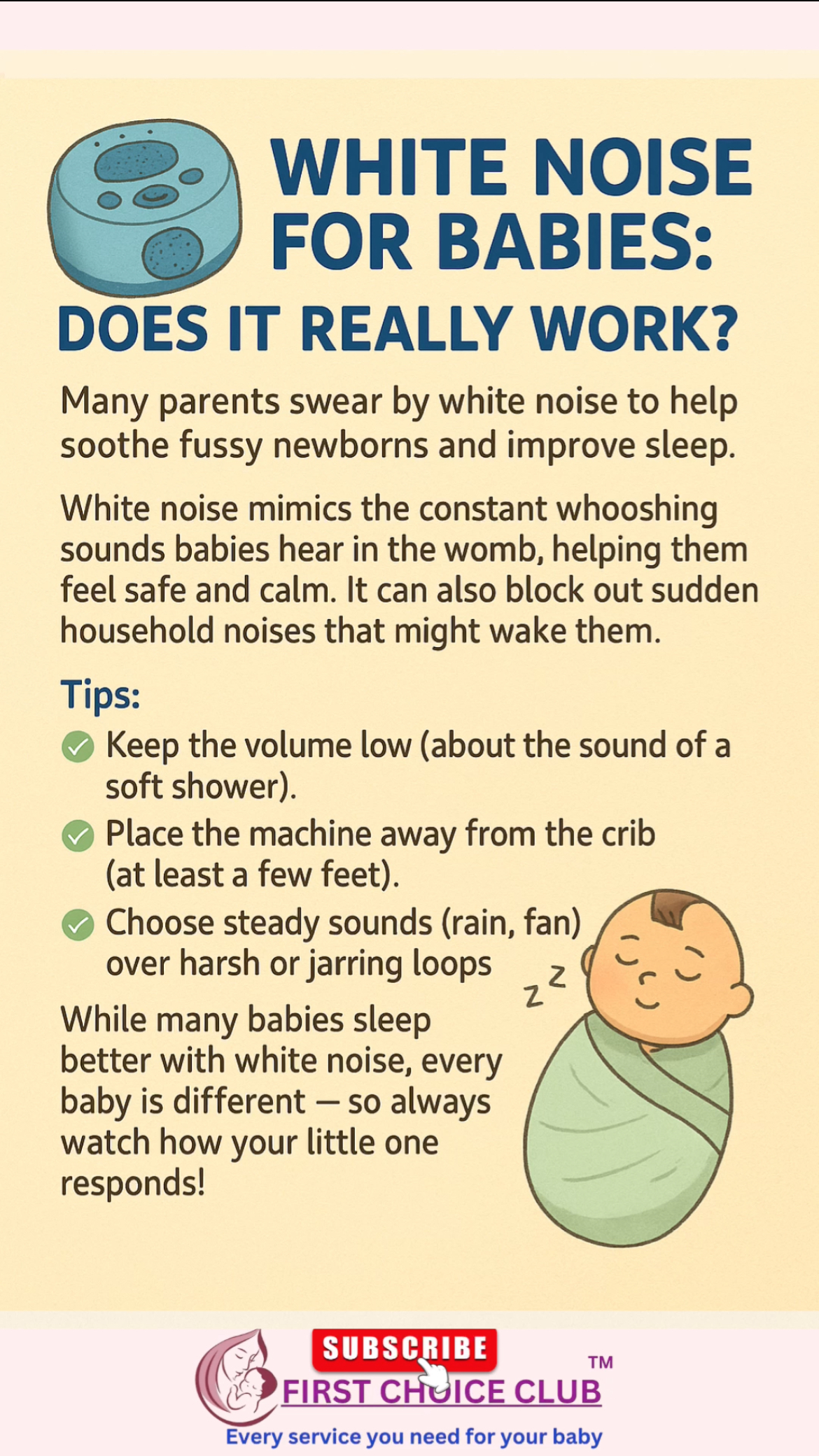
White Noise for Babies: Does It Really Work? A Parent's Complete GuideIf you have ever turned on a fan, a running tap, or a dedicated white noise machine to help a restless newborn fall asleep, you are in good company. White noise has become one of the most widely recommended tools for infant sleep, endorsed by pediatricians, sleep consultants, and millions of parents who swear it transformed their nights. But how does it actually work, is it safe, and does every baby respond to it the same way? This guide answers all of those questions.What Is White Noise?White noise is a consistent, steady sound that contains all frequencies audible to the human ear played at equal intensity. Think of the constant hiss of a television not tuned to any channel, the steady rush of a shower, or the drone of an air conditioner. Because white noise contains all frequencies simultaneously, it effectively masks other sounds — a door slamming, a phone ringing, a dog barking — that might startle a sleeping baby awake.The term is also used loosely to describe pink noise (which has more emphasis on lower frequencies and sounds like steady rain or ocean waves) and brown noise (even deeper, like a strong waterfall or low rumble). All three are used for infant sleep, and research suggests pink noise may be particularly effective at promoting deep sleep because its frequency pattern more closely resembles natural sounds.Why Does White Noise Help Babies Sleep?The most compelling explanation for why white noise works comes from the womb. For nine months, your baby existed inside an environment that was anything but quiet. The constant whooshing of blood flowing through the placenta, the muffled sounds of the outside world, the rhythmic percussion of your heartbeat — all of this added up to a consistent soundscape of approximately 70 to 80 decibels, roughly the volume of a vacuum cleaner running in the next room.Birth is, among other things, a transition from continuous noise to a world where silence is interrupted by sudden, unpredictable sounds. For many newborns, especially in the first three months of life, this is genuinely disorienting. A consistent white noise source bridges that transition. It provides the steady auditory backdrop the baby was accustomed to while still being safe and appropriate for a home environment.There is also a neurological mechanism at work. Steady, repetitive sound activates a calming reflex in young babies that pediatrician Dr. Harvey Karp describes as the calming reflex. This reflex, which exists in all healthy newborns, is triggered by stimuli that mimic the womb environment — rhythmic motion, swaddling, and sound. White noise is one of the most reliable triggers of this reflex.What Does the Research Say?The research on white noise and infant sleep is genuinely encouraging. A study published in the Archives of Disease in Childhood found that 80 percent of newborns fell asleep within five minutes when exposed to white noise, compared to 25 percent in the control group. Studies in neonatal intensive care units have found that white noise reduces stress indicators in premature infants and improves sleep quality.Research also suggests white noise can be helpful for babies with colic. A 2020 study found that colicky infants showed reduced crying duration when exposed to consistent white noise compared to periods of quiet. This likely reflects the calming effect of steady sound on an overstimulated nervous system.How to Use White Noise SafelyWhile white noise is safe when used correctly, there are important guidelines every parent should follow to protect their baby's developing hearing.Volume is the most important consideration. Keep the sound at or below 50 decibels, which is roughly the level of a quiet conversation or a gentle shower. You can download a free sound meter app on your phone to check the volume at your baby's ear level. Many dedicated white noise machines designed for infants have a maximum volume of around 50 decibels, making them inherently safer than using a speaker or playing audio through a phone.Distance matters too. Place the white noise source at least 1.5 to 2 metres away from your baby's crib or sleep space. Never place a speaker inside the cot or directly next to your baby's head.Choose steady sounds rather than music or nature sounds with varying dynamics. A consistent, flat soundscape is more effective for sleep maintenance because sudden increases in volume — even pleasant ones — can trigger the startle reflex and wake your baby.The Best Types of White Noise for BabiesA dedicated white noise machine designed for infants is the safest and most convenient option. Brands like Marpac Dohm, LectroFan, and Dreamegg are widely available in India and offer consistent volume with no sudden fluctuations.Free options work well too. A running fan placed at a safe distance provides effective white noise and also helps regulate room temperature. Many parents use free apps like Calm or White Noise Lite on a phone placed across the room.For babies who do not respond to the classic white noise hiss, try pink or brown noise, rain sounds, or ocean waves. These lower-frequency options work better for some babies and are also easier for parents to sleep through.Does Every Baby Respond to White Noise?No — and it is important to say this honestly. Most babies respond positively to white noise, especially in the newborn period. However, some babies show no particular response, and a small number seem more alert or agitated with background noise rather than calmer. If your baby does not settle with white noise after a week of consistent use, it simply may not be the right tool for your particular child. Every baby is different, and no single sleep technique works universally.If you are looking for trusted newborn care services or pediatricians who can advise on infant sleep, visit firstchoiceclub.in — India's global directory for pregnancy and baby services.
21 Jul
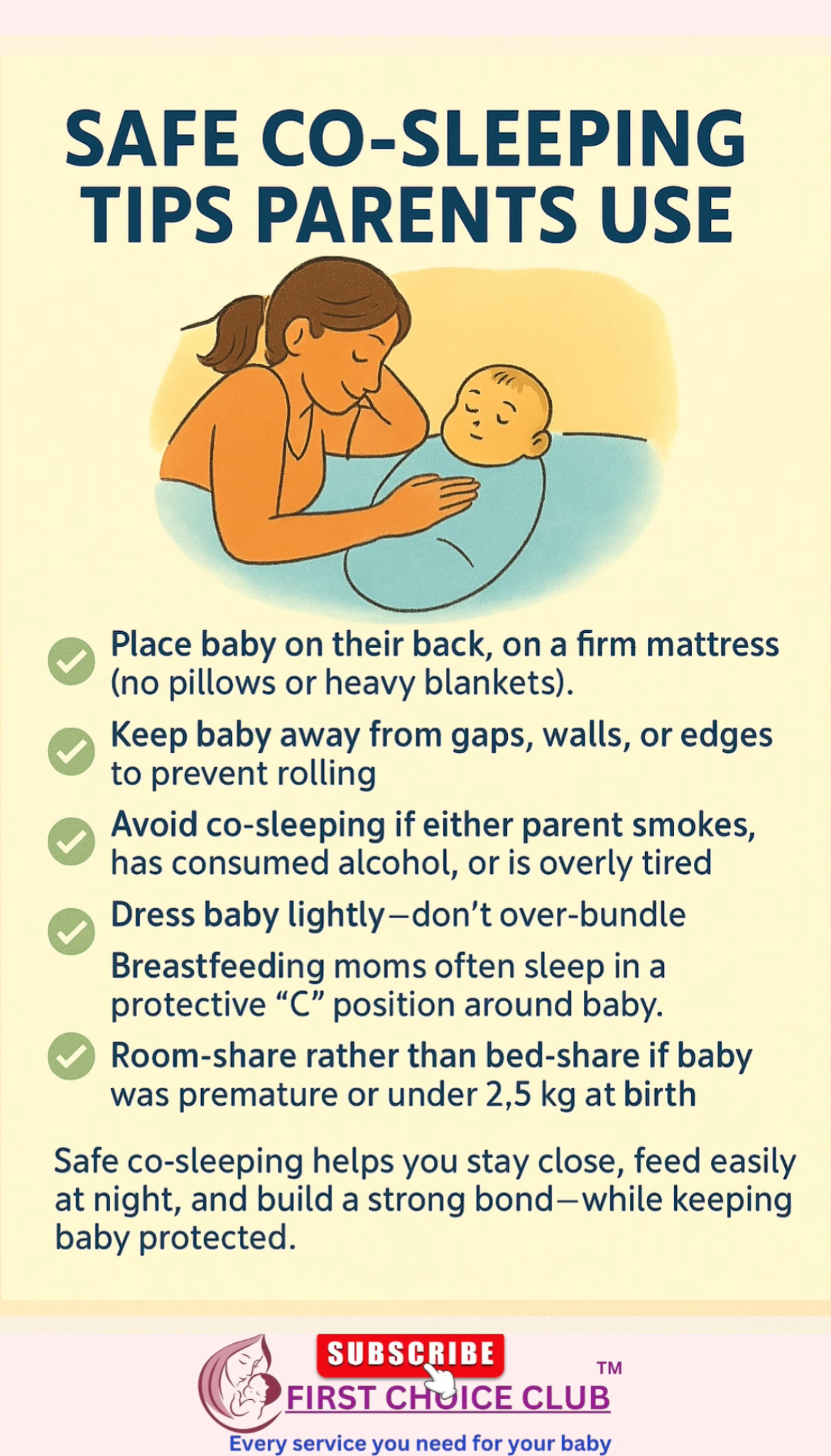
Safe Co-Sleeping Tips Parents Use! 💤✨ Many Indian families choose to co-sleep — and it can be safe if you follow the right precautions! Here’s what experienced parents do: ✅ Place baby on their back, on a firm mattress (no pillows or heavy blankets). ✅ Keep baby away from gaps, walls, or edges to prevent rolling. ✅ Avoid co-sleeping if either parent smokes, has consumed alcohol, or is overly tired. ✅ Dress baby lightly — don’t over-bundle. ✅ Breastfeeding moms often sleep in a protective “C” position around baby. ✅ Room-share rather than bed-share if baby was premature or under 2.5 kg at birth. 🌙 Safe co-sleeping helps you stay close, feed easily at night, and build a strong bond — while keeping baby protected.
21 Jul

10 Signs Your Baby Is Happy and Healthy — A New Parent's Reassurance GuideNew parents spend a significant portion of their waking hours — and many of their sleeping ones — wondering whether their baby is okay. Is she eating enough? Is he gaining enough weight? Should she be smiling by now? This constant vigilance is not anxiety; it is love. And it is completely normal.This guide gives you 10 specific, observable signs that your baby is thriving. Understanding what healthy development actually looks like gives you both reassurance when things are going well and confidence to recognise when they might not be.1. Your Baby Is Gaining Weight SteadilyWeight gain is one of the clearest indicators of healthy development in the first year of life. Most babies lose a small amount of weight in the first few days after birth — typically up to 7 to 10 percent of their birth weight — before regaining it by around day 10 to 14. After that, a healthy baby gaining weight from breastmilk or formula should gain approximately 150 to 200 grams per week in the first three months.Your pediatrician will plot your baby's weight on a growth chart at each visit. What matters most is not hitting a specific number but following a consistent upward trajectory on the chart, regardless of which percentile your baby sits in.2. Your Baby Is Producing Plenty of Wet and Dirty DiapersDiaper output is one of the most reliable ways to know your baby is getting enough milk, especially in the early weeks before you can see how much your breastfed baby is consuming. After the first week of life, a well-fed baby should produce at least six wet diapers every 24 hours. Fewer than this is a signal to contact your pediatrician or lactation consultant the same day.3. Your Baby Makes Eye ContactFrom birth, babies are drawn to faces — and particularly to eyes. A healthy newborn will fix their gaze on your face during feeding and alert periods, and by six to eight weeks, this gaze becomes a genuine, intentional meeting of eyes. This early eye contact is one of the first forms of social communication and a strong sign of healthy neurological development.4. Your Baby Smiles SociallyThe first real smile — sometimes called the social smile — typically appears between six and eight weeks of age. This is different from the reflexive smiles of the newborn period. A social smile is a direct response to seeing your face, hearing your voice, or being engaged with. It requires facial muscle control, social awareness, and a functional visual system. The appearance of the social smile on schedule is one of the milestones pediatricians check most carefully at the six-week review.5. Your Baby Is Alert and Curious During Wakeful PeriodsA healthy baby is not alert all the time — newborns sleep for 14 to 17 hours per day and that is entirely normal. But during their wakeful periods, a thriving baby should show genuine interest in their environment. They should track moving objects with their eyes, turn toward sounds, and show responsiveness to your face and voice. A baby who is consistently flat, unresponsive or glassy-eyed during periods when they should be alert is worth mentioning to your doctor.6. Your Baby Settles After FeedsA fed baby is generally a content baby. While all babies cry, and some cry a great deal in the early months, a baby who is getting adequate nutrition should show a period of relative contentment after most feeds. If your baby cries continuously even immediately after feeding or never seems settled, this may indicate feeding difficulties, reflux, or another issue worth discussing with your pediatrician.7. Your Baby Responds to Your VoiceFrom the moment of birth, your baby recognises your voice — they have been hearing it for months. A healthy baby should quiet or turn toward the sound of a familiar voice, and by three months, should begin to coo and vocalise in response to being spoken to. This back-and-forth vocal exchange is the earliest form of conversation and a foundational building block for language development.8. Your Baby Is Meeting Developmental MilestonesDevelopmental milestones are general guidelines for when most babies develop specific skills. While there is significant normal variation — some babies roll at four months, others at six — the general arc of development should be progressing. Key early milestones include lifting the head during tummy time by two months, social smiling by eight weeks, reaching for objects by four to five months, and sitting with support by six months. If you have concerns about your baby's development, always raise them at your next pediatric appointment rather than waiting to see.9. Your Baby's Skin, Eyes and Fontanelle Look NormalHealthy baby skin should be soft, free of persistent rashes, and warm to the touch. The eyes should be bright and clear, with no persistent discharge, redness, or cloudiness. The fontanelle — the soft spot on the top of the head — should feel slightly soft when gently pressed and should neither be sunken inward nor bulging outward. A sunken fontanelle can indicate dehydration; a bulging one can indicate increased intracranial pressure. Both warrant same-day medical attention.10. Your Baby Has a Healthy CryA healthy baby cry is strong, clear, and purposeful. It communicates need — hunger, discomfort, fatigue, or a desire for closeness. A cry that is weak, extremely high-pitched, or that sounds qualitatively different from your baby's usual cry is worth noting and mentioning to your doctor. You will learn to distinguish your baby's different cries over the first few weeks, and this instinctive knowledge is genuinely valuable. Trust it.For trusted pediatricians and newborn care services in your area, visit firstchoiceclub.in — India's global directory for pregnancy and baby services.
21 Jul
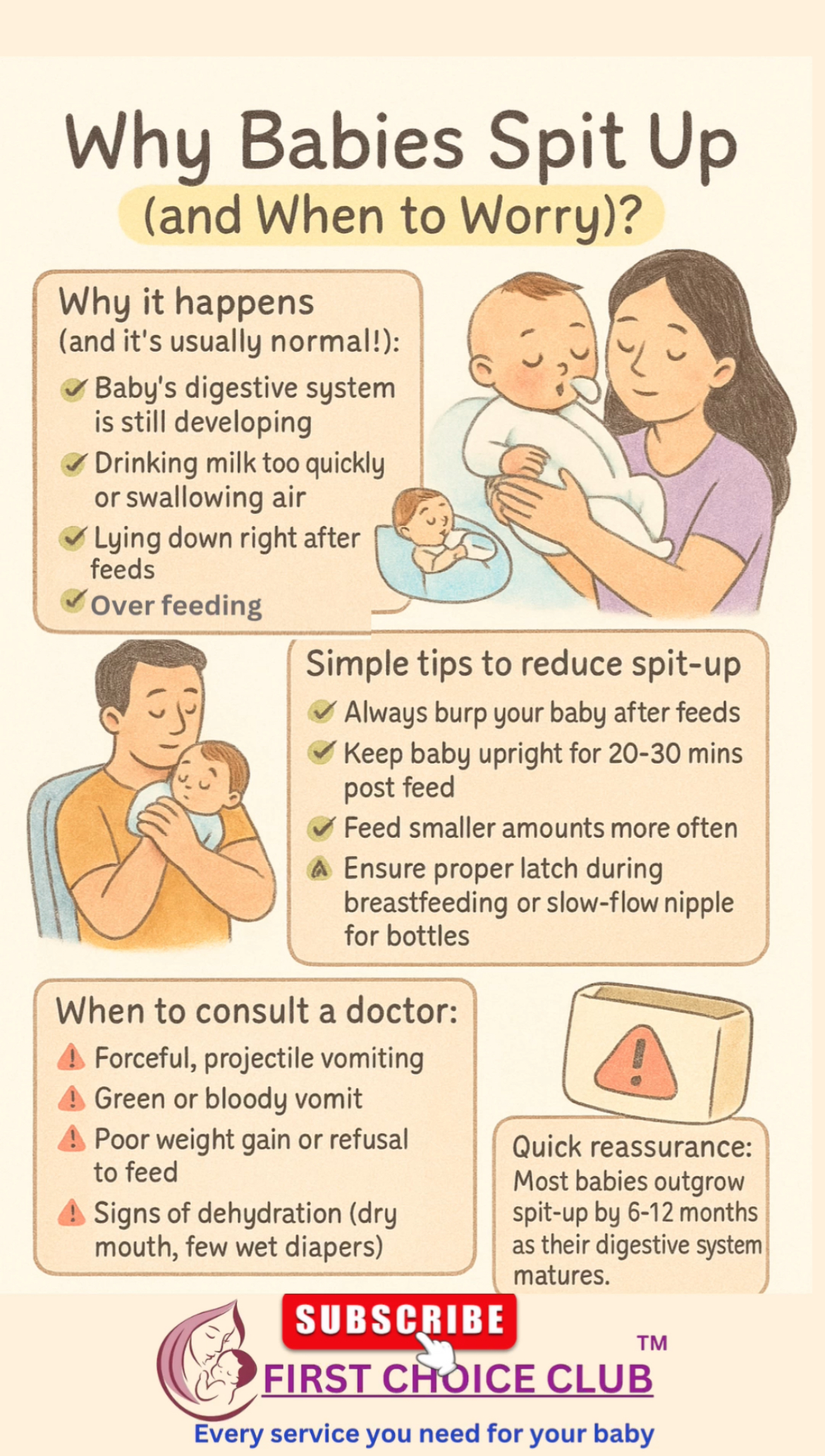
🤱 Why Babies Spit Up (and When to Worry)?⸻🍼 Why it happens (and it’s usually normal!):• Baby’s digestive system is still developing• Drinking milk too quickly or swallowing air• Lying down right after feeds• Overfeeding⸻🌱 Simple tips to reduce spit-up:✅ Always burp your baby after feeds✅ Keep baby upright for 20–30 mins post feed✅ Feed smaller amounts more often✅ Ensure proper latch during breastfeeding or slow-flow nipple for bottles⸻⚠️ When to consult a doctor:🚨 Forceful, projectile vomiting🚨 Green or bloody vomit🚨 Poor weight gain or refusal to feed🚨 Signs of dehydration (dry mouth, few wet diapers)⸻💡 Quick reassurance:Most babies outgrow spit-up by 6–12 months as their digestive system matures.
20 Jul
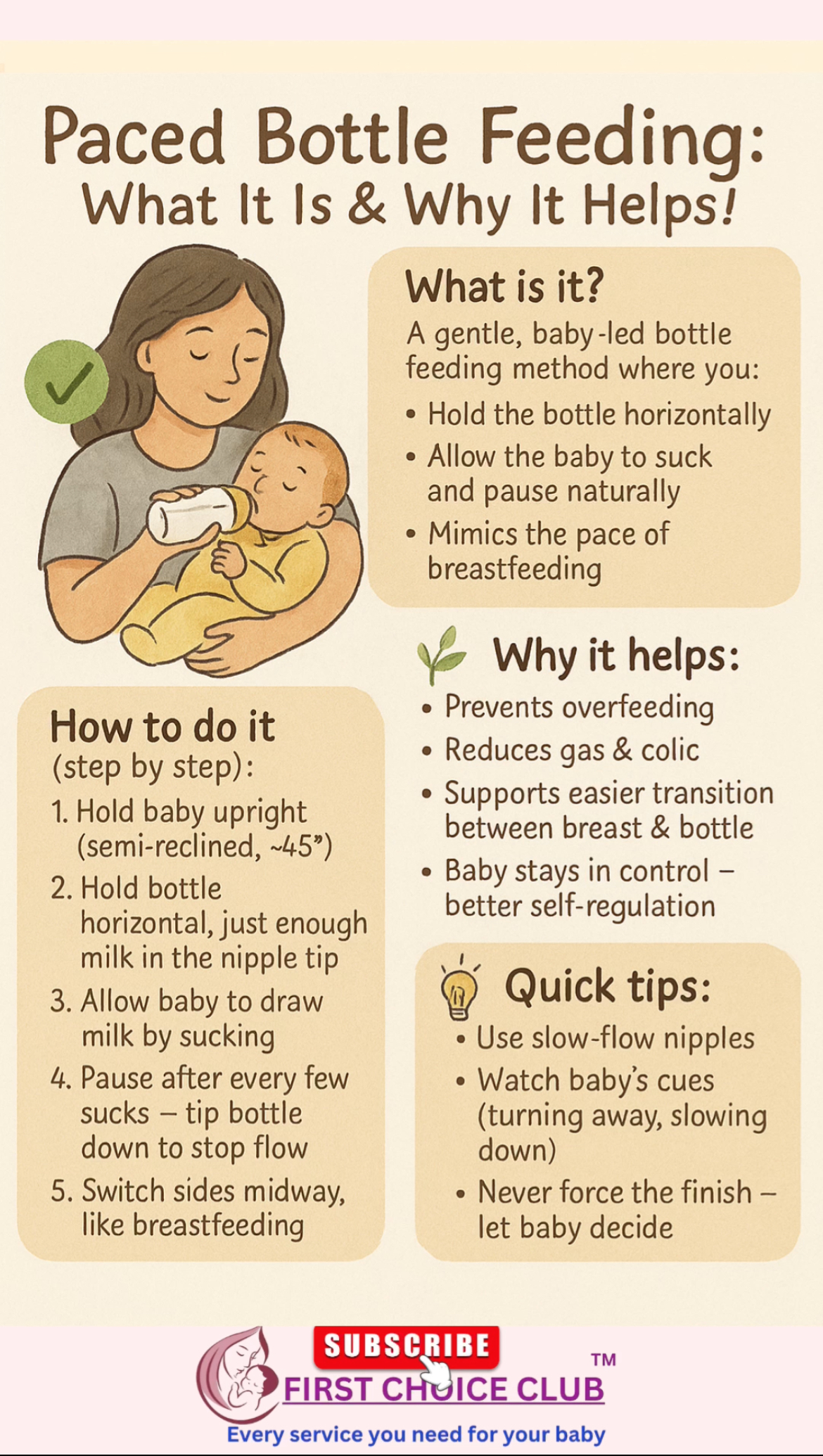
🍼 Paced Bottle Feeding: What It Is & Why It Helps!⸻✅ What is it?A gentle, baby-led bottle feeding method where you: • Hold the bottle horizontally • Allow the baby to suck and pause naturally • Mimics the pace of breastfeeding⸻🌱 Why it helps:• Prevents overfeeding• Reduces gas & colic• Supports easier transition between breast & bottle• Baby stays in control — better self-regulation⸻🪑 How to do it (step by step):1️⃣ Hold baby upright (semi-reclined, ~45°)2️⃣ Hold bottle horizontal, just enough milk in the nipple tip3️⃣ Allow baby to draw milk by sucking4️⃣ Pause after every few sucks — tip bottle down to stop flow5️⃣ Switch sides midway, like breastfeeding⸻💡 Quick tips:• Use slow-flow nipples• Watch baby’s cues (turning away, slowing down)• Never force the finish — let baby decide
19 Jul
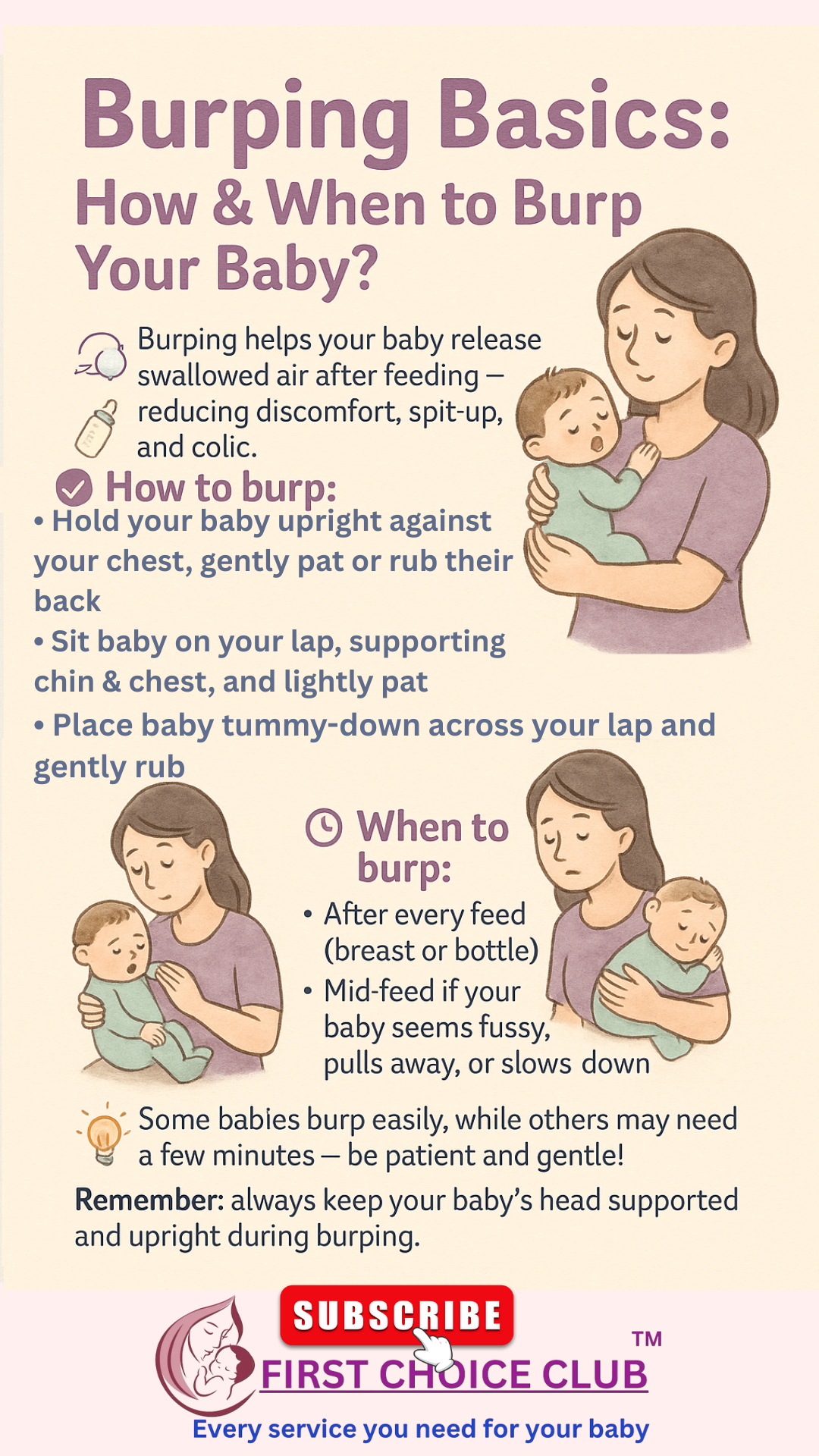
✨ Burping Basics: How & When to Burp Your Baby? ✨ Burping helps your baby release swallowed air after feeding — reducing discomfort, spit-up, and colic. 🍼💨 ✅ How to burp: • Hold your baby upright against your chest, gently pat or rub their back • Sit baby on your lap, supporting chin & chest, and lightly pat • Place baby tummy-down across your lap and gently rub ⏱ When to burp: • After every feed (breast or bottle) • Mid-feed if your baby seems fussy, pulls away, or slows down 💡 Some babies burp easily, while others may need a few minutes — be patient and gentle! Remember: always keep your baby’s head supported and upright during burping.
18 Jul
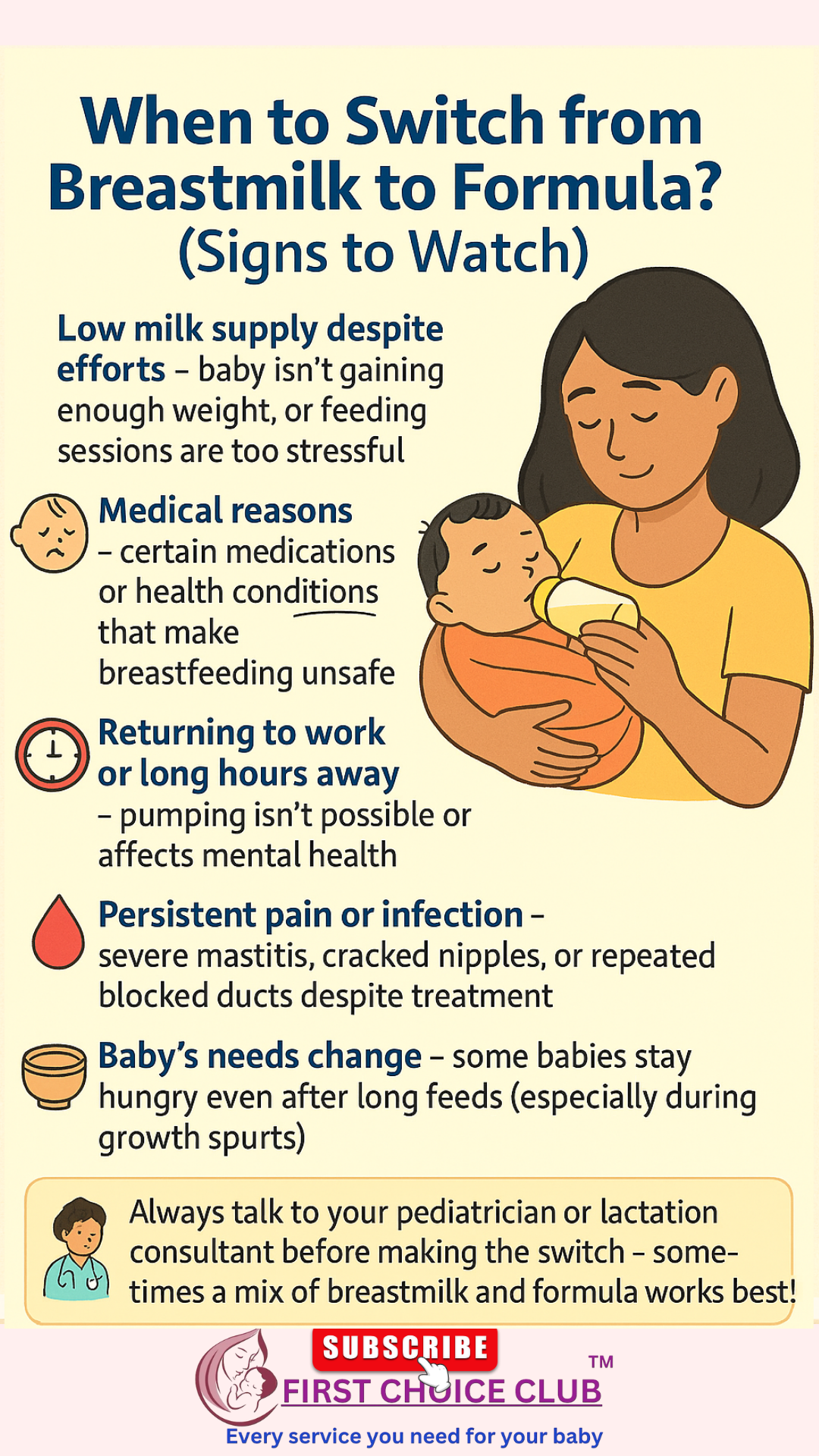
✨ When to Switch from Breastmilk to Formula? ✨Every baby’s journey is unique — but there are gentle signs to watch for when it might be time to consider formula or combination feeding:👶 Baby isn’t gaining enough weight despite frequent feeds🥛 Your milk supply is consistently low even after trying remedies🏥 Medical advice from your pediatrician suggests supplementing🍼 You’re returning to work or facing lifestyle changes that impact exclusive breastfeeding💡 Remember: Switching doesn’t mean you’re failing — it means you’re making the best choice for you and your baby! ❤️
17 Jul
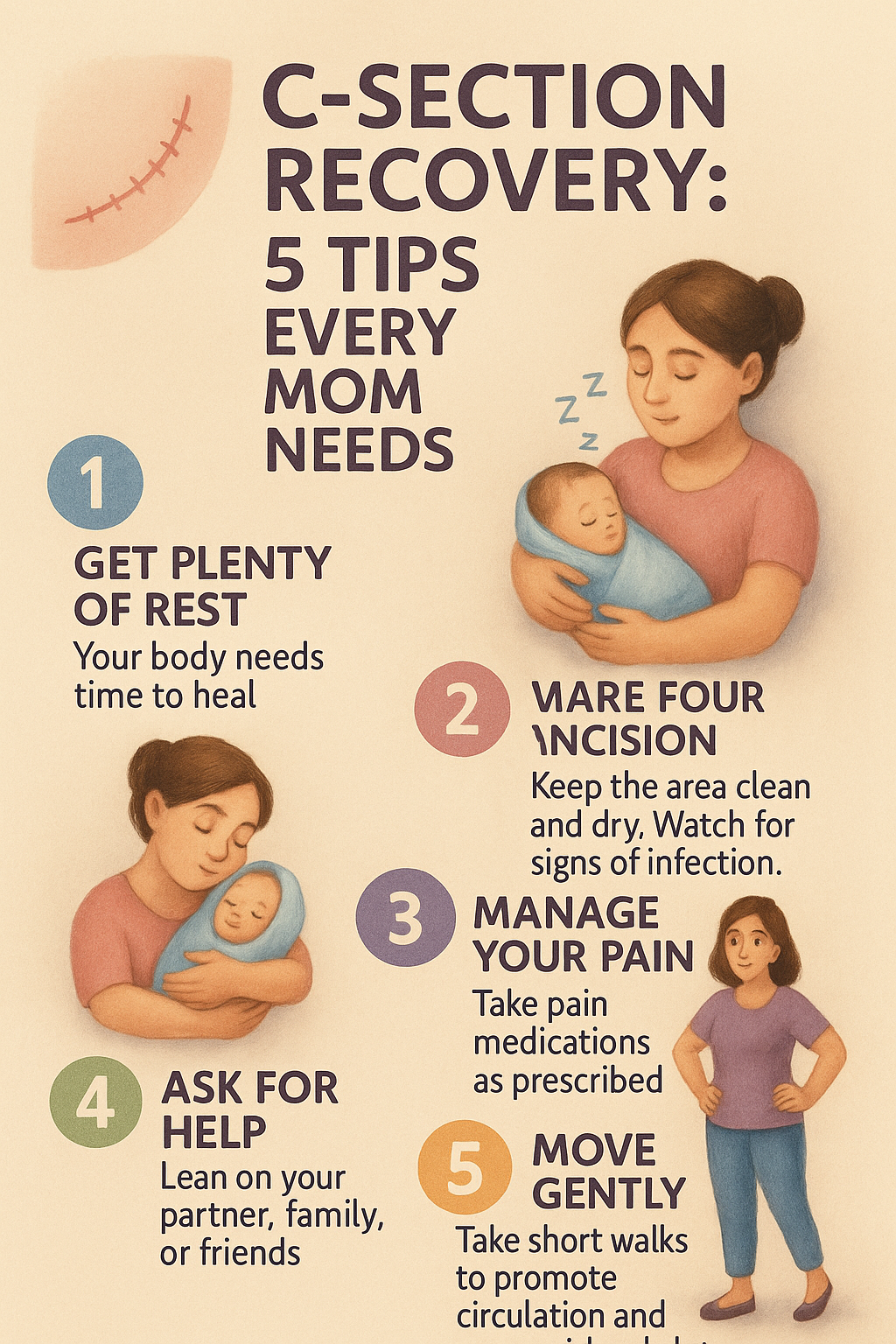
✨ C-Section Recovery: 5 Tips Every Mom Needs at Home ✨Recovering from a C-section takes patience, care, and a few smart habits to feel better each day. Here’s what new moms should know:1️⃣ Prioritize Rest & Gentle Movement• Rest as much as possible, but also do short slow walks to boost circulation and healing.2️⃣ Wound Care• Keep the incision clean and dry.• Wear loose, breathable cotton clothes to avoid friction.3️⃣ Pain Management• Take prescribed medications as directed.• Use a small pillow to support your abdomen when coughing or sneezing.4️⃣ Nutrition & Hydration• Eat iron-rich foods, fresh fruits, and protein to support healing.• Drink plenty of water to stay hydrated and aid recovery.5️⃣ Listen to Your Body• Watch for signs of infection: redness, swelling, fever, or discharge.• Don’t lift heavy objects until your doctor clears you.💡 Bonus tip: Accept help from family and focus on bonding with your baby — recovery takes time, and that’s perfectly okay!
03 Jul
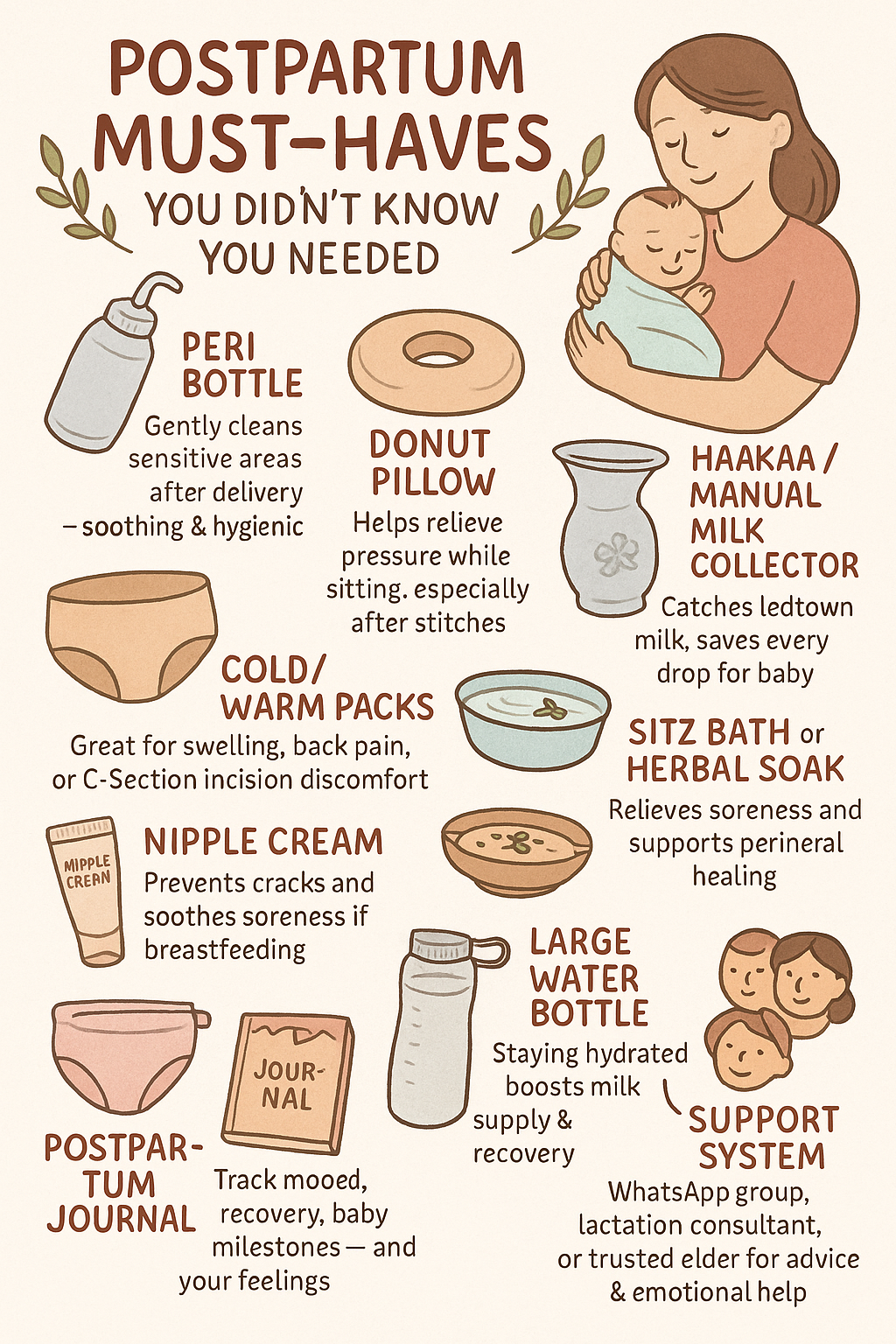
🌸 Postpartum Must-Haves You Didn’t Know You Needed⸻🛏 1. Peri BottleGently cleans sensitive areas after delivery — soothing & hygienic.⸻🪑 2. Donut PillowHelps relieve pressure while sitting, especially after stitches.⸻🧊 3. Cold/Warm PacksGreat for swelling, back pain, or C-section incision discomfort.⸻👙 4. High-Waist Cotton UnderwearSoft, breathable, and won’t rub against your incision.⸻🍼 5. Haakaa / Manual Milk CollectorCatches letdown milk, saves every drop for baby.⸻🫧 6. Sitz Bath or Herbal SoakRelieves soreness and supports perineal healing.⸻🧴 7. Nipple CreamPrevents cracks and soothes soreness if breastfeeding.⸻💧 8. Large Water BottleStaying hydrated boosts milk supply & recovery.⸻📔 9. Postpartum JournalTrack mood, recovery, baby milestones — and your feelings.⸻👩🍼 10. Support SystemWhatsApp group, lactation consultant, or trusted elder for advice & emotional help.
04 Jul
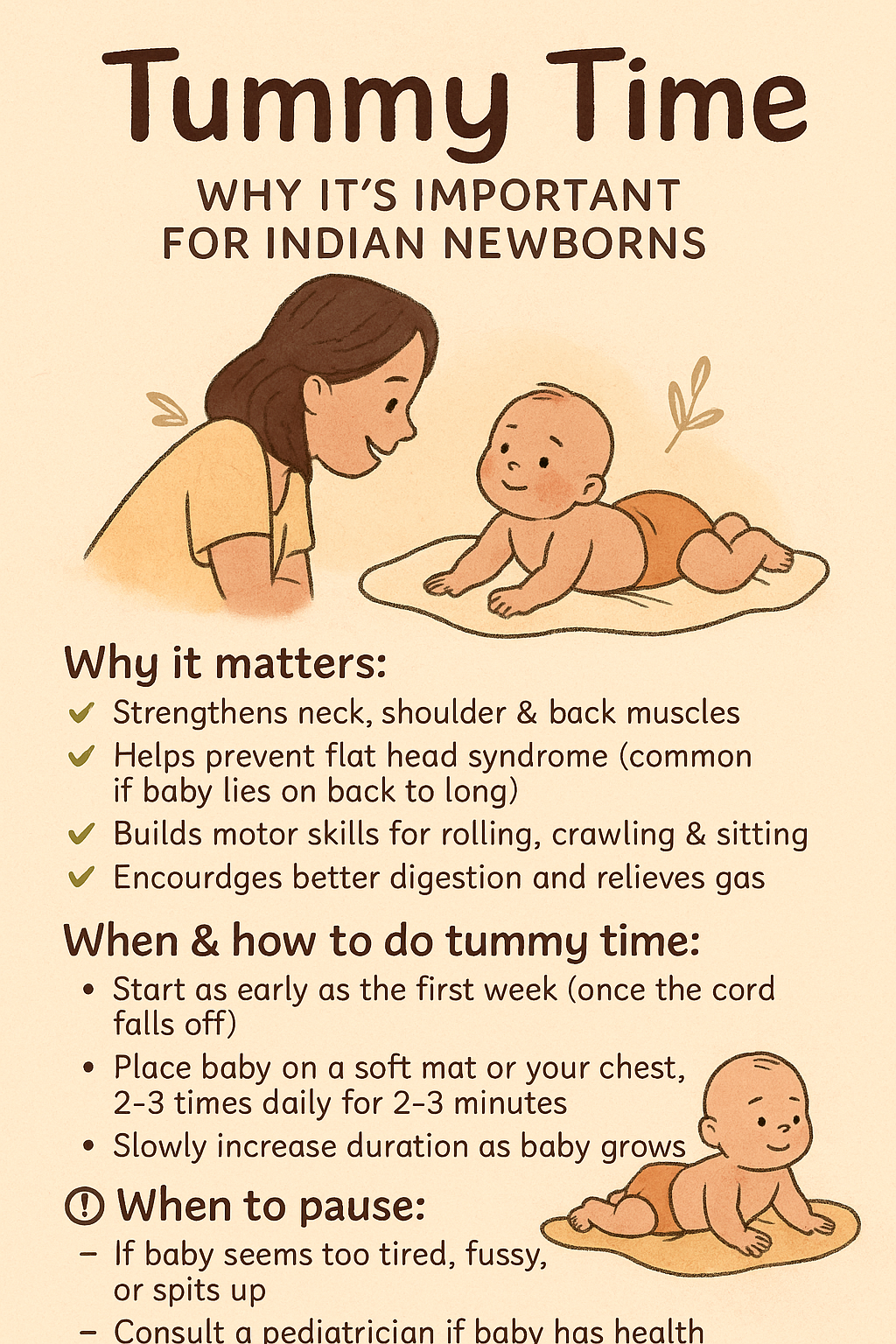
🤱 Tummy Time: Why It’s Important for# Newborns?Tummy time isn’t just cute playtime — it’s an important step in your baby’s development, starting right from the first month!⸻🌱 Why it matters:✅ Strengthens neck, shoulder & back muscles✅ Helps prevent flat head syndrome (common if baby lies on the back too long)✅ Builds motor skills for rolling, crawling & sitting✅ Encourages better digestion and relieves gas⸻🕒 When & how to do tummy time:• Start as early as the first week (once the cord falls off)• Place baby on a soft mat or your chest, 2–3 times daily for 2–3 minutes• Slowly increase duration as baby grows• Always supervise closely — never leave baby unattended⸻🇮🇳 Tips for Moms:• After bath, place baby tummy-down on your lap for gentle massage• Use colorful cloth toys to engage baby• Avoid tummy time right after feeding to prevent spit-up⸻⚠️ When to pause:• If baby seems too tired, fussy, or spits up• Consult your pediatrician if baby has health conditions that limit movement
05 Jul
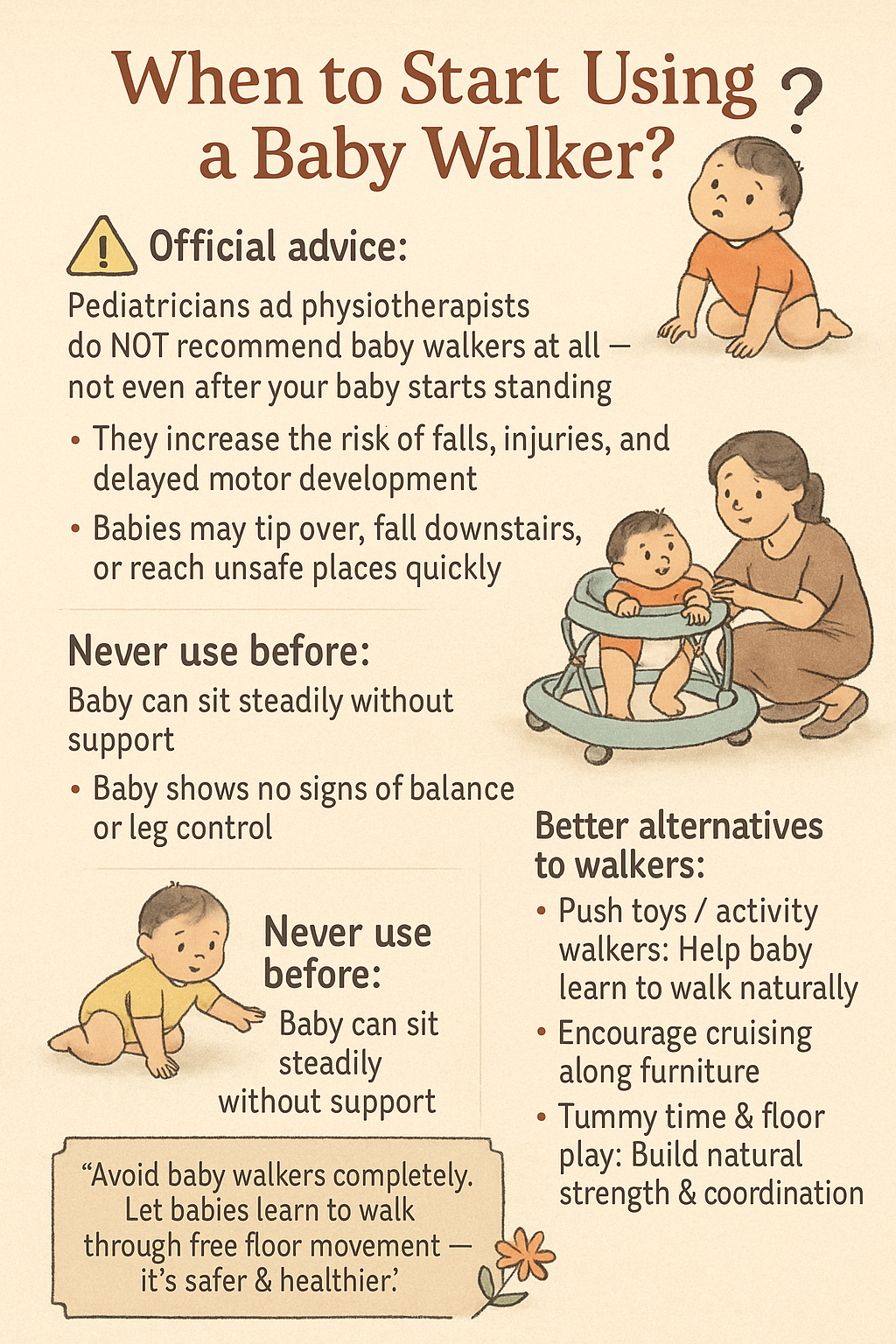
🚼 When to Start Using a Baby Walker?⸻⚠️ Official advice:Pediatricians and physiotherapists do NOT recommend baby walkers at all — not even after your baby starts standing.Why? • They increase the risk of falls, injuries, and delayed motor development • Babies may tip over, fall downstairs, or reach unsafe places quickly⸻✅ If you still choose to use (with extreme caution): • Only after 8–10 months, when baby can:• Sit unassisted• Show stable head & neck control • Use for very short, supervised sessions only • Keep away from stairs, sharp edges & kitchens • Choose walkers with broad base & safety locks⸻🚫 Never use before: • Baby can sit steadily without support • Baby shows no signs of balance or leg control⸻🌱 Better alternatives to walkers: • Push toys / activity walkers: Help baby learn to walk naturally • Encourage cruising along furniture • Tummy time & floor play: Build natural strength & coordination⸻👩⚕️ pediatricians recommend:Avoid baby walkers completely. Let babies learn to walk through free floor movement — it’s safer & healthier.
06 Jul
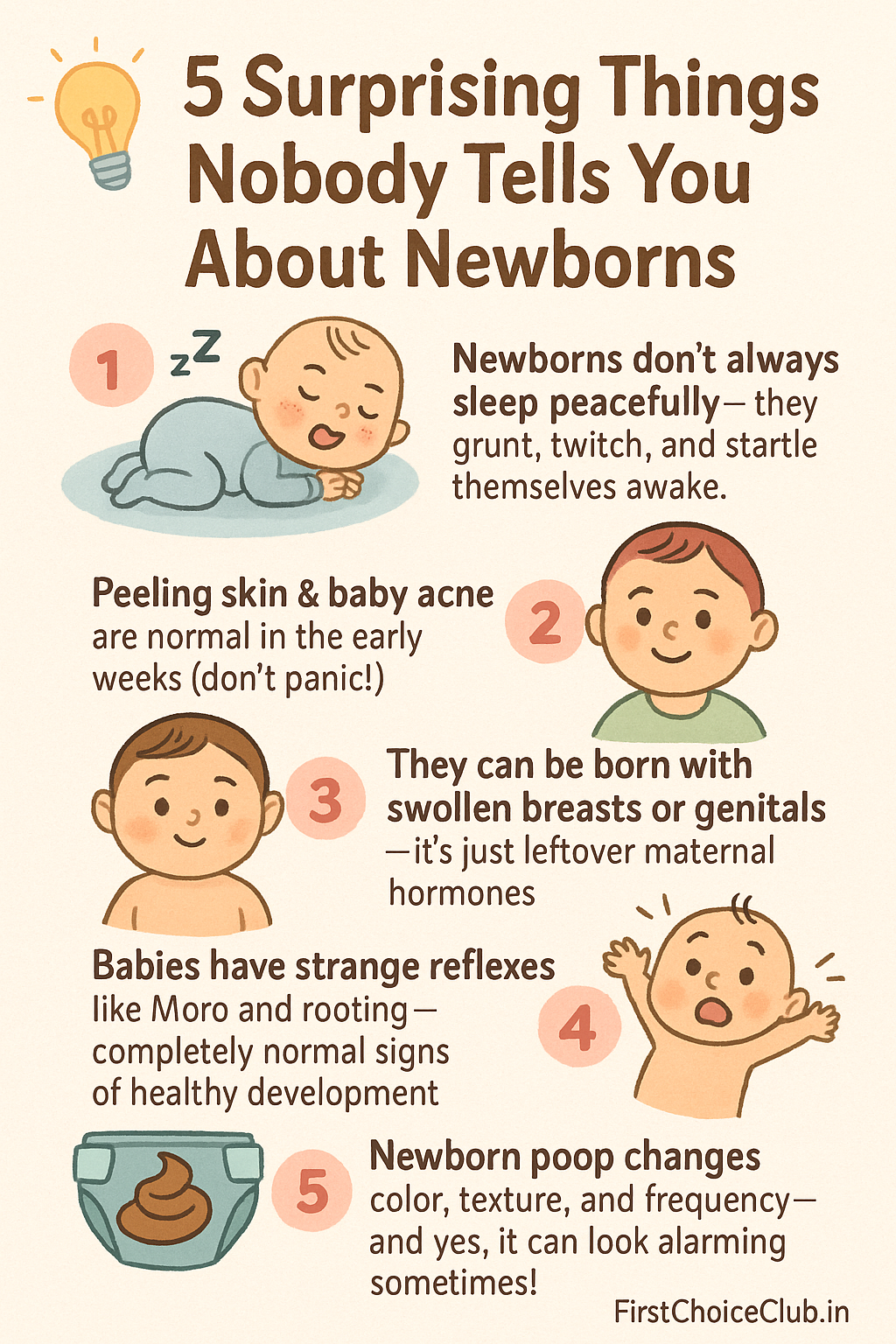
✨ 5 Surprising Things Nobody Tells You About Newborns! 👶💛Becoming a parent comes with endless love and plenty of surprises!Here are a few things most new moms and dads wish they knew sooner:1️⃣ Newborns don’t always sleep peacefully — they grunt, twitch, and startle themselves awake.2️⃣ Peeling skin & baby acne are normal in the early weeks (don’t panic!).3️⃣ They can be born with swollen breasts or genitals — it’s just leftover maternal hormones.4️⃣ Babies have strange reflexes like Moro and rooting — completely normal signs of healthy development.5️⃣ Newborn poop changes color, texture, and frequency — and yes, it can look alarming sometimes!💡 Every baby is different, and these little quirks are part of what makes the newborn stage so special.
07 Jul

🌿 Eco-Friendly Newborn Essentials Checklist (India – 2025 Guide)As more Indian parents become conscious of sustainability, eco-friendly baby products are gaining popularity — not just for environmental reasons, but for baby’s health and comfort too. Choosing gentle, non-toxic, reusable, and biodegradable newborn essentials ensures you’re giving your child a safe start while supporting the planet.Here’s a complete Eco-Friendly Newborn Checklist for Indian families, including product types, tips, and Indian brands where possible.⸻🍼 Feeding Essentials1. Glass or Stainless Steel Feeding BottlesAvoid plastic bottles, even BPA-free ones. Go for: • Glass bottles – Easy to sterilize, non-toxic. • Stainless steel bottles – Durable and great for travel.Popular Indian brands: LuvLap Glass Bottles, Philips Avent (glass), Vaya Baby Bottles.2. Organic Cotton Burp Cloths • Soft, chemical-free, and reusable. • Avoid synthetic blends which can irritate newborn skin.Brands: Kaarpas, SuperBottoms, Bumpadum.3. Reusable Nursing Pads • Made from bamboo or cotton, these pads are washable and reduce landfill waste from disposables.Try: Mommy Milk Pads (India), SuperBottoms Nursing Pads.⸻🧷 Diapering Essentials4. Cloth DiapersModern cloth diapers (MCNs) are leak-proof, breathable, and come in adorable prints.Types: Pocket, AIO (All-In-One), pre-folds with covers.Top eco-friendly Indian brands: • SuperBottoms • Bumpadum • Snugkins • Tushions5. Coconut Oil for Diaper RashSkip petroleum-based creams. Virgin coconut oil works well as a natural rash guard.6. Reusable WipesUse soft muslin or flannel squares dipped in warm water or aloe vera solution. Replaces disposable wet wipes, which take 100+ years to break down.DIY Tip: Use old cotton sarees or towels to create reusable wipes.⸻🛁 Bath & Body Care7. Cold-Pressed Oils for MassageChoose oils free from parabens and artificial fragrance: • Coconut oil (summer) • Mustard or sesame oil (winter)Organic options: Conscious Chemist, Little Rituals, Kama Ayurveda.8. Natural Baby Soap/ShampooAvoid sulphates, parabens, and artificial fragrance.Brands: • Mother Sparsh • The Moms Co. • Rustic Art baby range • Kama Ayurveda Baby Cleanser9. Hooded Towels & Washcloths (Organic Cotton) • Gentle on baby’s skin. • Look for GOTS-certified organic cotton.⸻👶 Clothing & Bedding10. Organic Cotton Onesies and JhablasAvoid synthetic fibers that don’t breathe well and cause overheating. Stick to: • Undyed or naturally dyed clothes • GOTS-certified organic brandsIndian brands: Tiber Taber (organic line), Kaarpas, Greendigo, Love the World Today (LTWT), Aagghhoo.11. Muslin Swaddles • Light, breathable, multipurpose (swaddling, burping, nursing cover, stroller shade). • Natural dyes and soft texture are perfect for baby’s skin.12. Eco-Friendly Baby BlanketsUse layered organic cotton or handwoven baby quilts made without polyester fill.⸻🧼 Laundry & Cleaning13. Plant-Based Baby Laundry DetergentStandard detergents may contain harsh chemicals. Choose: • Phosphate-free • Fragrance-free • BiodegradableBrands: Mamaearth, Rustic Art, The Better Home, BabyOrgano.14. Wool Dryer Balls • Replace disposable dryer sheets. • Speeds up drying time and softens clothes naturally.⸻🎒 Travel & Outdoor15. Eco Diaper Bags • Made from recycled cotton, jute, or sustainable canvas. • Avoid PU leather or plastic-based bags.16. Wooden Teethers & ToysAvoid plastic or gel-filled toys. Go for: • Neem wood teethers (naturally anti-bacterial) • Painted with edible colorsIndian Brands: Shumee, Ariro, Bhoomi Toys.17. Reusable Wet BagsStore soiled diapers or clothes while traveling. Replace single-use plastic covers.⸻🏠 Home & Nursery18. Sustainable Baby FurnitureLook for: • Cribs or cots made of natural wood with non-toxic polish • Avoid MDF/particle board (emits formaldehyde)Indian sources: Boingg!, Little Birdie, Mothercare India (wood line).19. Organic Mosquito NetInstead of chemical sprays or coils, opt for breathable nets around sleeping areas.20. Natural Room Fresheners • Use camphor, essential oils, or potpourri. • Avoid sprays with phthalates or synthetic fragrance.⸻🌍 Waste-Free Tips for New Parents • Skip disposable bibs, breast pads, and changing sheets — opt for washable ones. • Upcycle old cotton sarees/tees into cleaning cloths, diapers, or baby wipes. • Buy second-hand baby gear (strollers, carriers) from trusted sources like Facebook groups or OLX. • Limit toys to a few natural items — rotate them instead of buying more.⸻🛒 Where to Buy Eco-Friendly Newborn Products in India Platform Highlights SuperBottoms India’s top cloth diaper and eco babywear brand Brown Living India’s largest zero-waste product platform Greendigo GOTS-certified organic cotton baby clothes Shumee Eco-conscious wooden toys Amazon India Good range of natural & organic baby brands FirstCry Filter by ‘organic’ & ‘sustainable’ categories 💡 Final Tips for Going Green with Your Newborn • Don’t try to be 100% eco-perfect — even a few sustainable choices matter. • Educate family and caregivers about cloth diapers, natural oils, and eco-toys. • Prioritize quality over quantity — less clutter, more mindfulness. • Look for certifications: GOTS (organic cotton), ECOCERT, BPA-free, cruelty-free, and vegan where applicable.⸻By making thoughtful, earth-friendly choices, you’re not only protecting your baby’s delicate skin and health but also shaping a better future for them. Small switches — like cloth wipes instead of disposable ones — go a long way when practiced daily.Every eco step you take today is a gift to your child’s tomorrow. 💚
09 Jul

🌿 Feeling anxious that your milk supply isn’t enough?Breastfeeding can feel overwhelming, especially when you’re worried if your baby is getting enough milk.Don’t worry, mama — you’re not alone! Many Indian moms turn to gentle, time-tested home remedies to support healthy lactation. 🍼💗✅ Methi (Fenugreek) Seeds – Soak overnight or add to curries; known to help boost milk.✅ Shatavari Powder – An Ayurvedic herb often used in warm milk.✅ Ajwain (Carom Seeds) Water – Sipped warm, it aids digestion & may improve flow.✅ Gond Laddoo & Panjiri – Traditional postpartum snacks packed with nutrition.✅ Hydration & Rest – Never underestimate enough water, balanced diet & sleep!✨ Always check with your pediatrician or lactation consultant before adding herbs, especially if you have medical conditions.Remember mama: your worth isn’t measured in ounces. You’re already doing amazing! 🌸
10 Jul
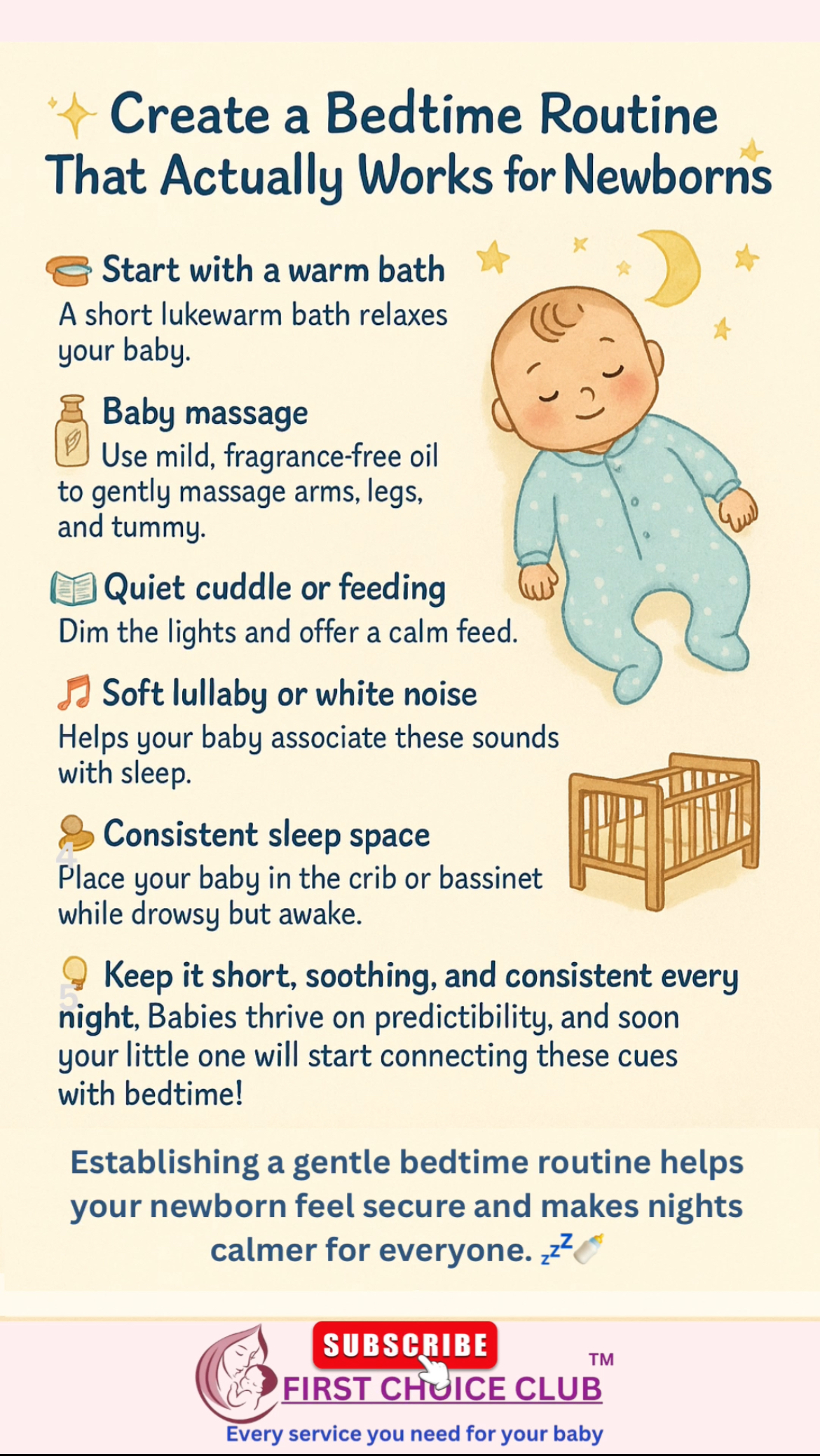
✨ Create a Bedtime Routine That Actually Works for Newborns ✨Establishing a gentle bedtime routine helps your newborn feel secure and makes nights calmer for everyone. 💤🍼🌙 Start with a warm bath: A short lukewarm bath relaxes your baby.🧴 Baby massage: Use mild, fragrance-free oil to gently massage arms, legs, and tummy.📖 Quiet cuddle or feeding: Dim the lights and offer a calm feed.🎵 Soft lullaby or white noise: Helps your baby associate these sounds with sleep.🛏 Consistent sleep space: Place your baby in the crib or bassinet while drowsy but awake.💡 Keep it short, soothing, and consistent every night. Babies thrive on predictability, and soon your little one will start connecting these cues with bedtime! 🌼
10 Jul
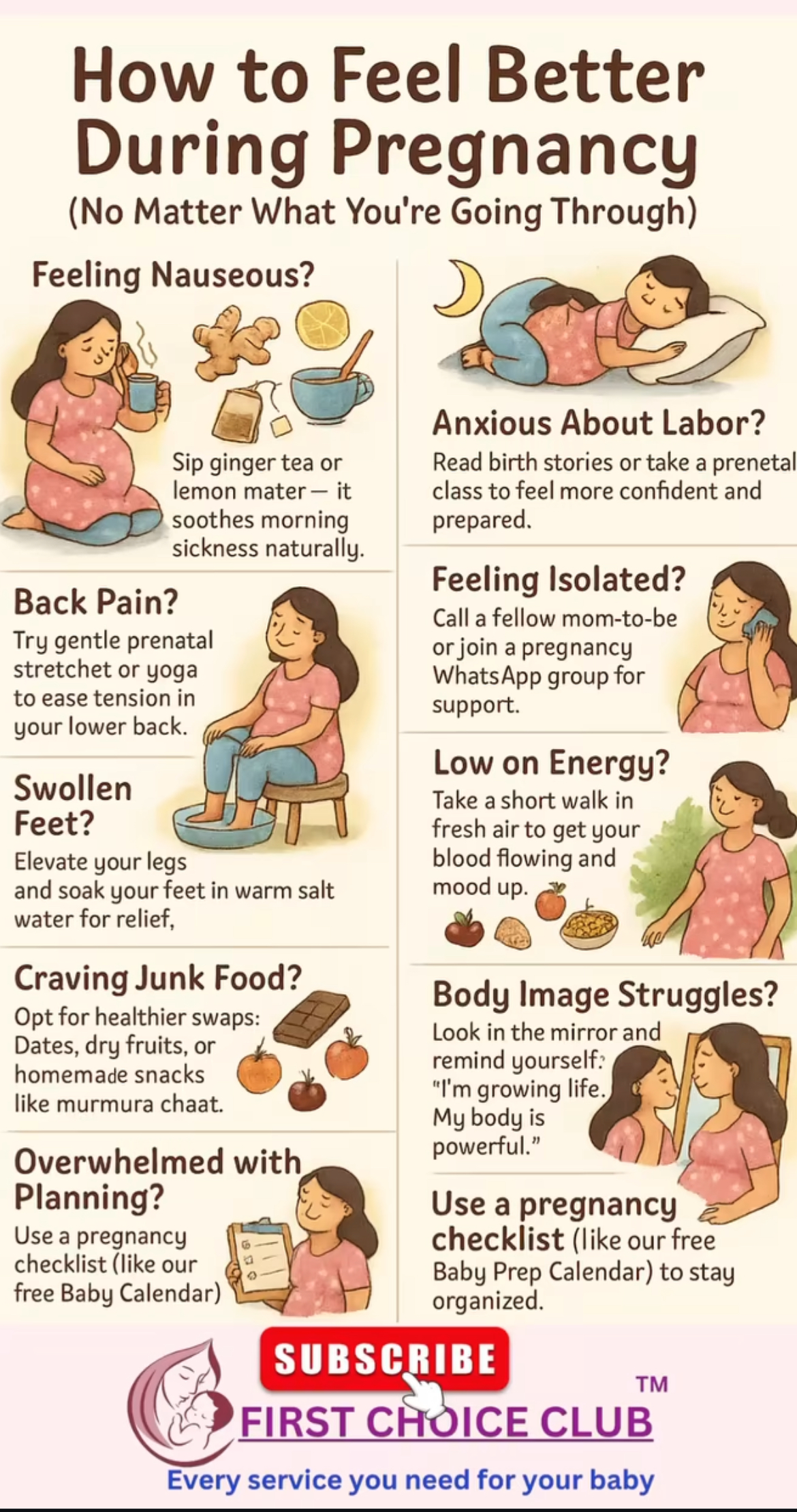
🤰 How to Feel Better During Pregnancy (No Matter What You’re Going Through)1. Feeling Nauseous?🫖 Sip ginger tea or lemon water — it soothes morning sickness naturally.2. Back Pain?🧘♀️ Try gentle prenatal stretches or yoga to ease tension in your lower back.3. Swollen Feet?🦶 Elevate your legs and soak your feet in warm salt water for relief.4. Can’t Sleep?🌙 Use a pregnancy pillow and listen to calming music before bed.5. Anxious About Labor?📘 Read birth stories or take a prenatal class to feel more confident and prepared.6. Feeling Isolated?📞 Call a fellow mom-to-be or join a pregnancy WhatsApp group for support.7. Low on Energy?🚶♀️ Take a short walk in fresh air to get your blood flowing and mood up.8. Craving Junk Food?🍫 Opt for healthier swaps: Dates, dry fruits, or homemade snacks like murmura chaat.9. Body Image Struggles?💖 Look in the mirror and remind yourself: “I’m growing life. My body is powerful.”10. Overwhelmed with Planning?📋 Use a pregnancy checklist (like our free Baby Prep Calendar) to stay organized.
11 Jul
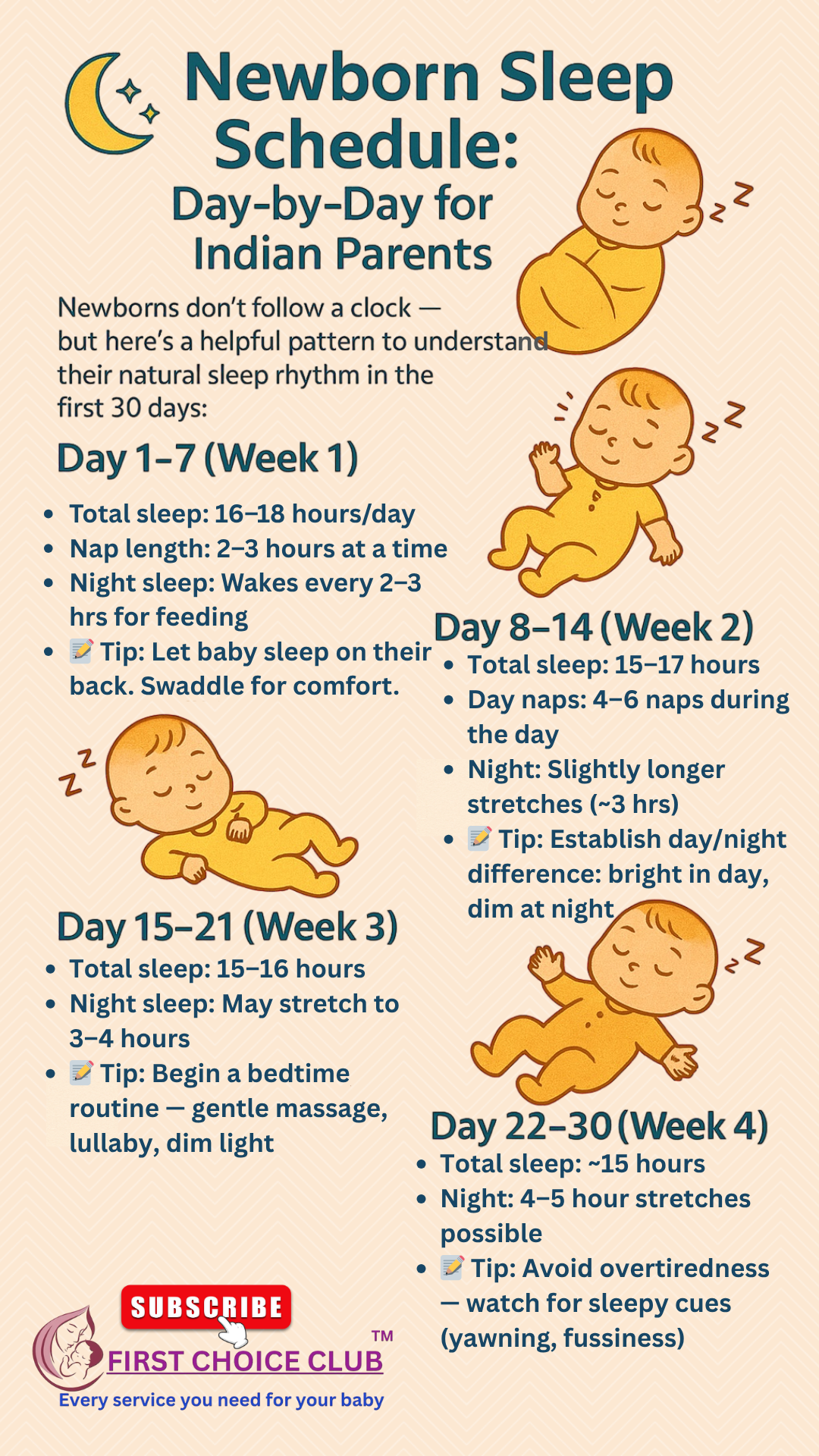
💤 Newborn Sleep Schedule: Day-by-Day for Indian Parents (0–1 Month)Newborns don’t follow a clock — but here’s a helpful pattern to understand their natural sleep rhythm in the first 30 days:⸻👶 Day 1–7 (Week 1) • Total sleep: 16–18 hours/day • Nap length: 2–3 hours at a time • Night sleep: Wakes every 2–3 hrs for feeding • 📝 Tip: Let baby sleep on their back. Swaddle for comfort.⸻👶 Day 8–14 (Week 2) • Total sleep: 15–17 hours • Day naps: 4–6 naps during the day • Night: Slightly longer stretches (~3 hrs) • 📝 Tip: Establish day/night difference: bright in day, dim at night⸻👶 Day 15–21 (Week 3) • Total sleep: 15–16 hours • Night sleep: May stretch to 3–4 hours • 📝 Tip: Begin a bedtime routine — gentle massage, lullaby, dim light⸻👶 Day 22–30 (Week 4) • Total sleep: ~15 hours • Night: 4–5 hour stretches possible • 📝 Tip: Avoid overtiredness — watch for sleepy cues (yawning, fussiness)⸻🌙 General Tips for Indian Homes: • Use a quiet, dark room at night; avoid visitors disturbing nap time • Avoid traditional practices like loud celebrations near newborn • Avoid pillows, heavy blankets, or loose clothes while sleeping • Breastfeeding babies may still wake more frequently — that’s normal!
12 Jul
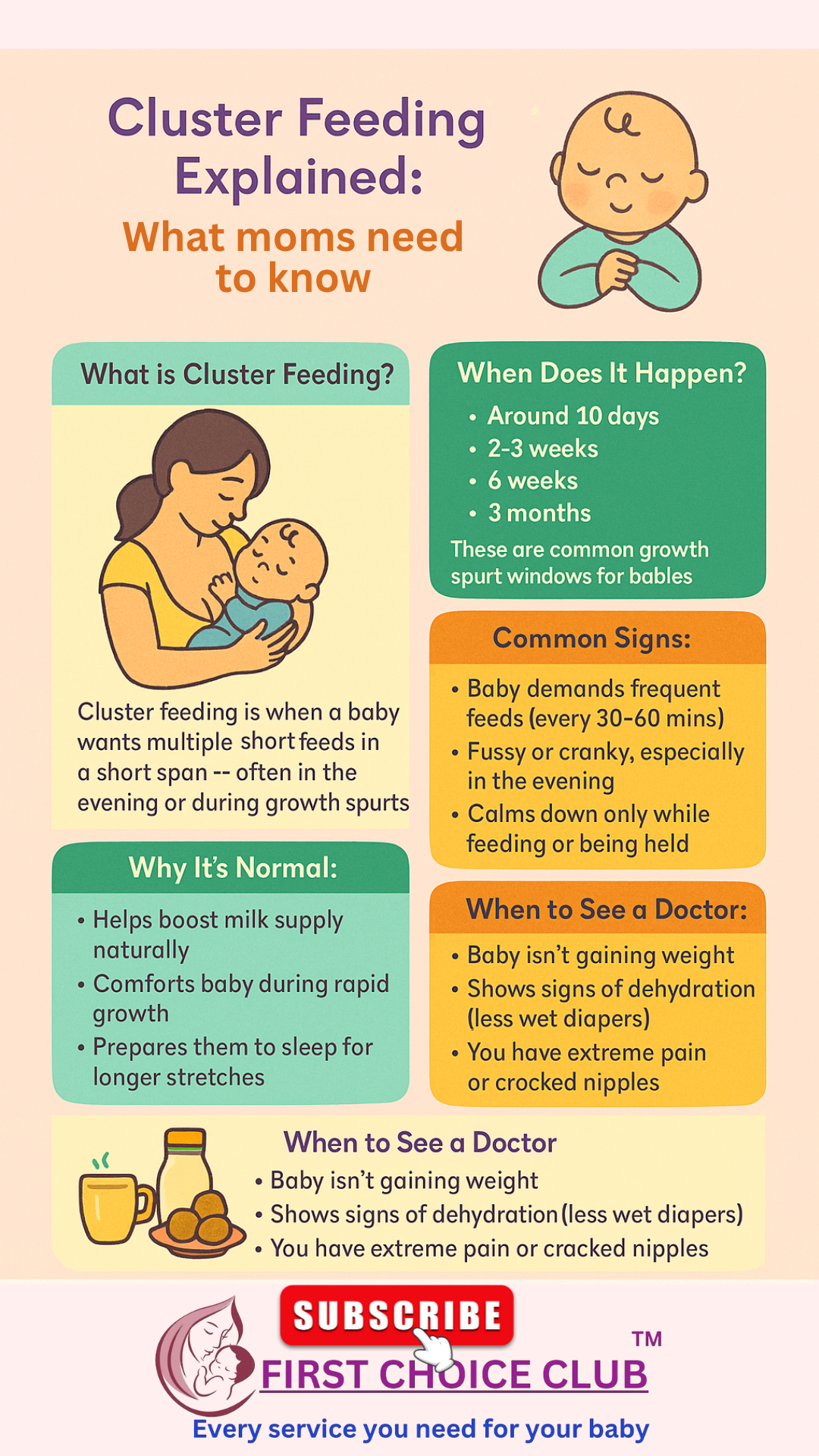
🍼 Cluster Feeding Explained: What Moms Need to KnowIs your newborn feeding every 30–60 minutes all of a sudden? Don’t panic — it might just be cluster feeding!⸻👶 What is Cluster Feeding?Cluster feeding is when a baby wants multiple short feeds in a short span — often in the evening or during growth spurts.⸻🕐 When Does It Happen?Usually seen: • Around 10 days • 2–3 weeks • 6 weeks • 3 monthsThese are common growth spurt windows for babies.⸻🌙 Common Signs: • Baby demands frequent feeds (every 30–60 mins) • Fussy or cranky, especially in the evening • Calms down only while feeding or being held⸻🧘 Why It’s Normal: • Helps boost milk supply naturally • Comforts baby during rapid growth • Prepares them to sleep for longer stretches⸻🇮🇳 Indian Mom Tips: • Drink warm fluids like ajwain water, jeera water, suva seeds • Eat protein-rich foods and traditional lactation boosters (like gond ke ladoo, methi) • Use nursing pillows or lie down while feeding to avoid back strain⸻⚠️ When to See a Doctor: • Baby isn’t gaining weight • Shows signs of dehydration (less wet diapers) • You have extreme pain or cracked nipples
13 Jul
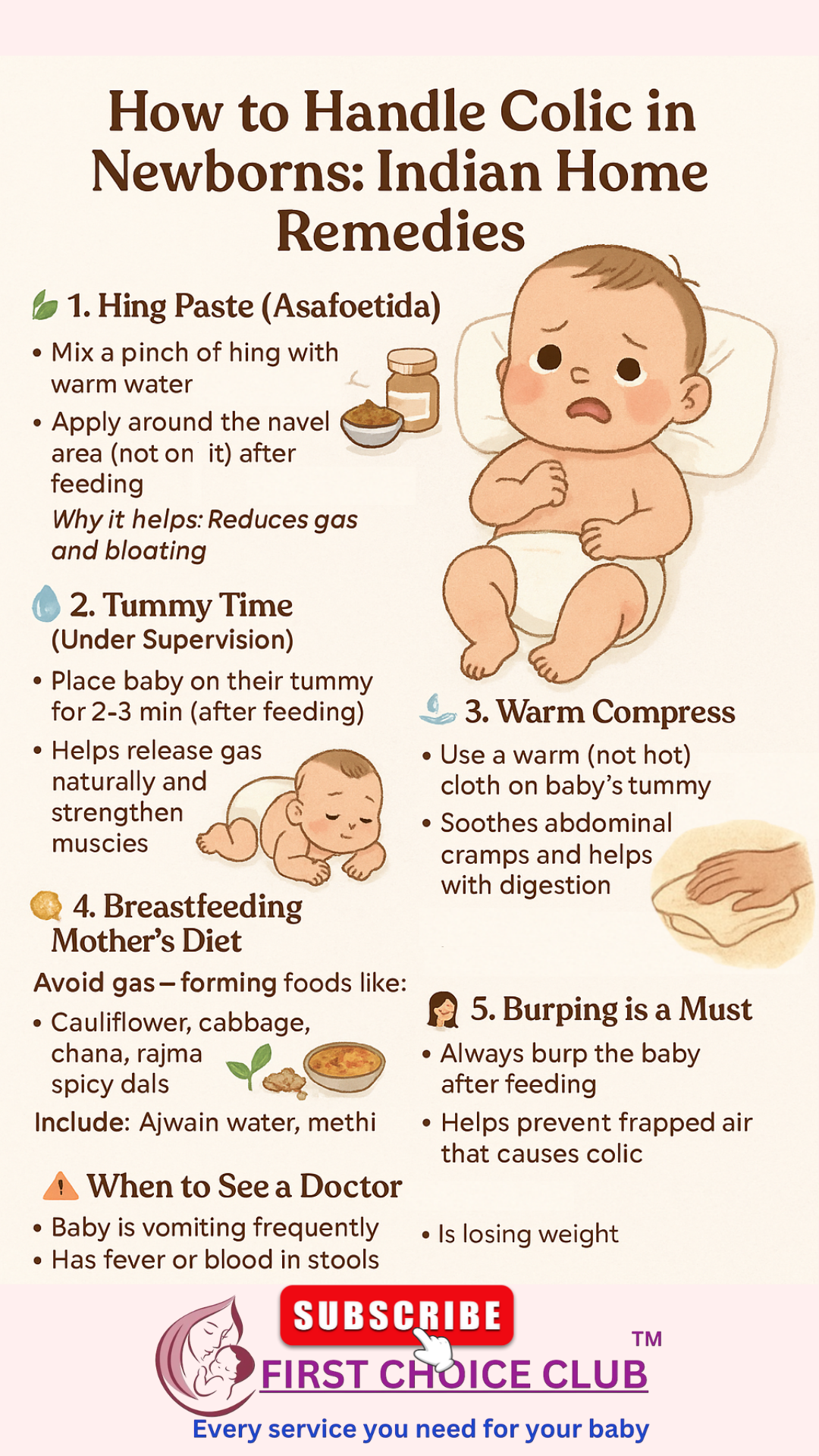
How to Handle Colic in Newborns: Indian Home RemediesColic can be stressful, especially when your newborn cries uncontrollably for hours. Here’s how you can naturally soothe your baby using safe, gentle Indian home remedies:⸻🌿 1. Hing Paste (Asafoetida)How to Use:• Mix a pinch of hing with warm water• Apply around the navel area (not on it) after feedingWhy it helps: Reduces gas and bloating⸻🧘 2. Tummy Time (Under Supervision)• Place baby on their tummy for 2–3 mins (after feeding gap)• Helps release gas naturally and strengthen muscles⸻💧 3. Warm Compress• Use a warm (not hot) cloth on baby’s tummy• Soothes abdominal cramps and helps with digestion⸻🍃 4. Breastfeeding Mother’s DietAvoid gas-forming foods like:• Cauliflower, cabbage, chana, rajma, spicy dalsInclude:• Ajwain water, jeera water, methi in moderation⸻👩⚕️ 5. Burping is a Must• Always burp the baby after feeding• Helps prevent trapped air that causes colic⸻🛁 6. Warm Bath with Gentle Massage• Use coconut oil or baby-safe massage oils• Gentle strokes on tummy, legs, and back help relax baby⸻⚠️ When to See a Doctor• Baby is vomiting frequently• Has fever or blood in stools• Is losing weight or not feeding
14 Jul
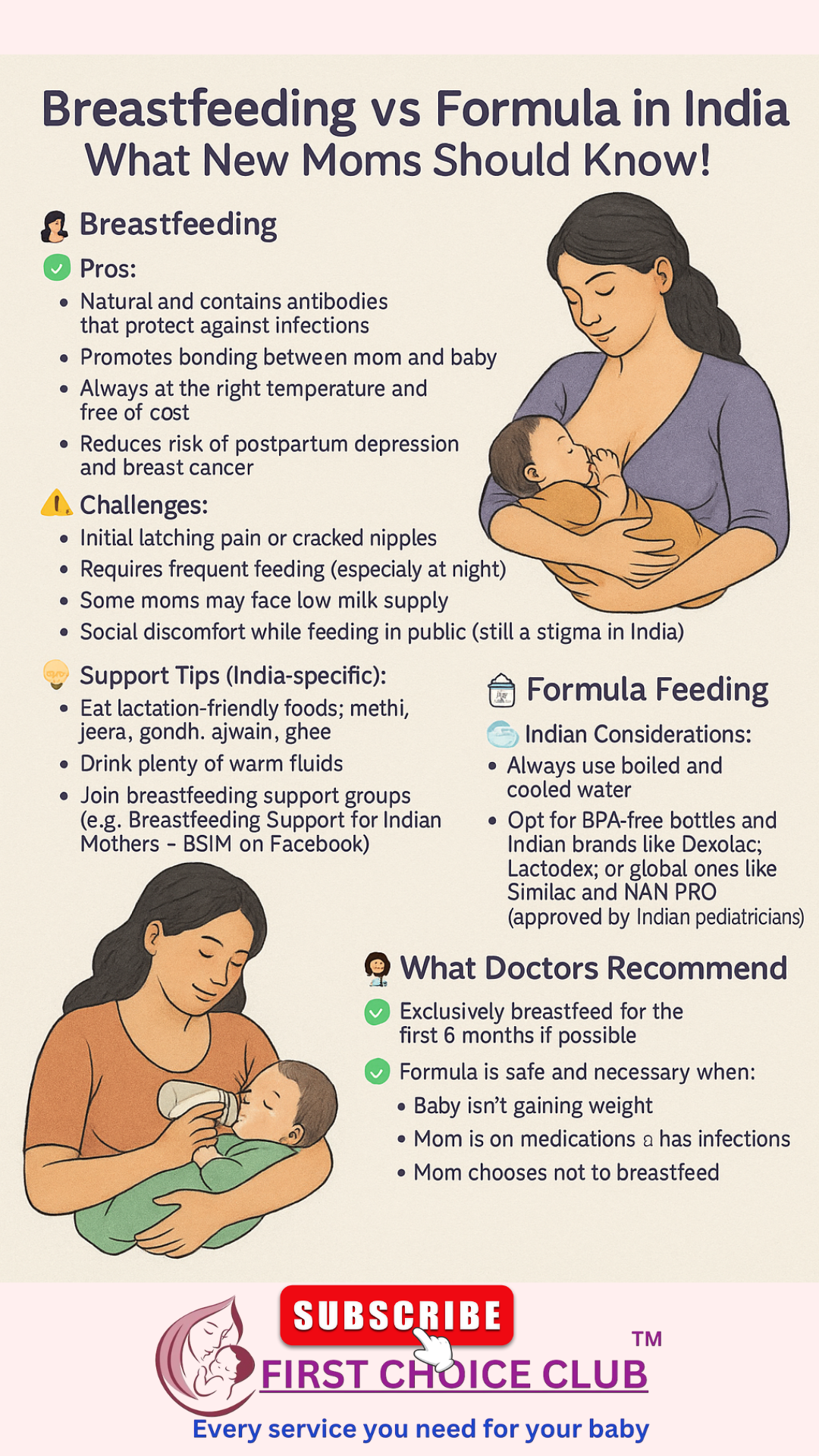
🍼 Breastfeeding vs Formula in India: What New Moms Should Know!Choosing between breastfeeding and formula feeding is a personal decision. Here’s a balanced comparison to help Indian moms make informed choices.⸻🤱 Breastfeeding✅ Pros: • Natural and contains antibodies that protect against infections • Promotes bonding between mom and baby • Always at the right temperature and free of cost • Reduces risk of postpartum depression and breast cancer⚠️ Challenges: • Initial latching pain or cracked nipples • Requires frequent feeding (especially at night) • Some moms may face low milk supply • Social discomfort while feeding in public (still a stigma in India)💡 Support Tips (India-specific): • Eat lactation-friendly foods: methi, jeera, gondh, ajwain, ghee • Drink plenty of warm fluids • Join breastfeeding support groups (e.g., Breastfeeding Support for Indian Mothers – BSIM on Facebook)⸻🍼 Formula Feeding✅ Pros: • Anyone can feed the baby (dad, grandparents, etc.) • Predictable feed amounts and timing • Helps moms with low supply or medical issues⚠️ Challenges: • Expensive (average ₹300–₹800 per tin/month) • Needs sterilization of bottles, clean water, and strict hygiene • No natural antibodies, may lead to more infections early on🧼 Indian Considerations: • Always use boiled and cooled water • Opt for BPA-free bottles and Indian brands like Dexolac, Lactodex, or global ones like Similac and NAN PRO (approved by Indian pediatricians)⸻👩⚕️ What Doctors Recommend: • Exclusively breastfeed for the first 6 months if possible • Formula is safe and necessary when: • Baby isn’t gaining weight • Mom is on medications or has infections • Mom chooses not to breastfeed
15 Jul
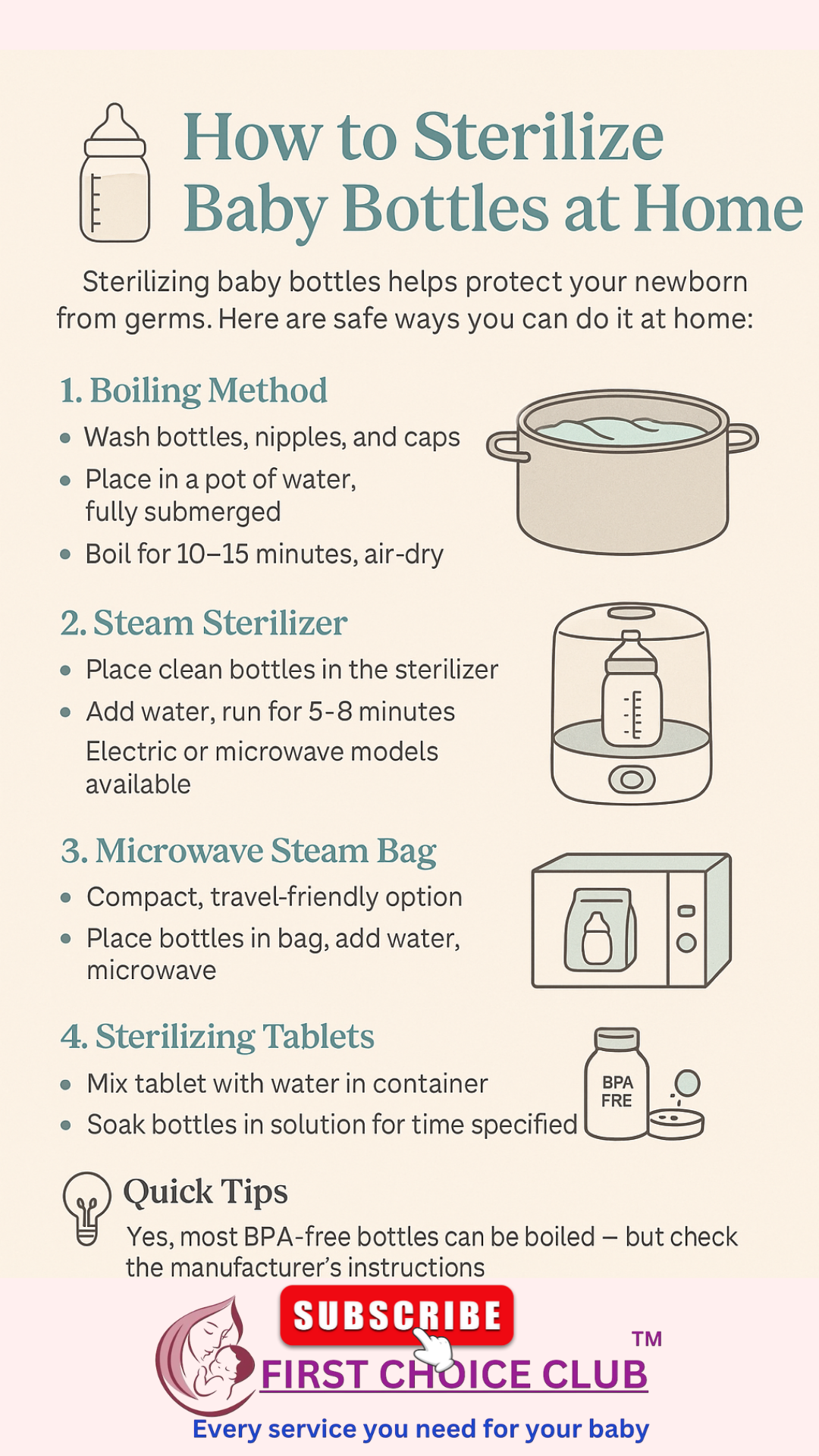
How to Sterilize Baby Bottles at Home (Moms’ Guide)Sterilizing baby bottles is crucial to protect your newborn from germs, infections, and tummy troubles. Here’s how you can do it safely at home:⸻🪔 1. Boiling Method (Traditional & Effective)Steps: • Wash bottles, nipples, caps with bottle brush & mild detergent • Place them in a large vessel filled with water (fully submerged) • Boil for 10–15 minutes • Remove with clean tongs, air-dry on a clean cloth or sterilized tray✅ Best for Indian homes without electric sterilizers⚠️ Don’t boil bottles with printed designs too often — may fade⸻💨 2. Steam Sterilizer (Electric or Microwave) • Place clean bottles in the sterilizer • Add required amount of water • Run for 5–8 minutes (as per device instructions)✅ Fast and effective⚠️ Needs electricity and may not be travel-friendly⸻🍳 3. Pressure Cooker Method (Indian Hack) • Add water in the base (no whistle) • Place bottles upright without touching sides • Steam for 5–7 minutes on low heat✅ Works in most Indian kitchens⚠️ Avoid using high flame; always monitor carefully⸻💧 4. Sterilizing Liquid/Tablets (Travel Option) • Mix sterilizing liquid (like Chicco or Milton) in water as instructed • Soak bottles/nipples for specified time (usually 30 mins) • Rinse with boiled cooled water before use✅ Great for travel or power cuts⚠️ Always follow product instructions⸻🧴 Tips to Remember: • Always wash hands before handling sterilized bottles • Use bottle tongs — don’t touch inside with fingers • Air-dry — avoid wiping with towels (can transfer germs)🔍 Can BPA-Free Plastic Bottles Be Boiled?Yes — most BPA-free plastic baby bottles can be boiled, but you need to check a few things first:⸻✅ Things to Check Before Boiling: 1. Label:Look for “Boil-safe” or “Sterilizer-safe” on the bottle packaging. 2. Material:BPA-free doesn’t always mean heat-resistant. Bottles made of polypropylene (PP) or silicone usually tolerate boiling. 3. Brand’s Instructions:Always follow the manufacturer’s sterilization guidelines.(e.g., Philips Avent, Chicco, and Pigeon bottles often allow boiling.)⸻⚠️ Risks of Repeated Boiling: • Fading of prints or measurements on bottles • Discoloration or deformation over time • Can lead to micro-cracks if boiled too long or on high flame⸻✅ Safer Alternative:If you use plastic bottles regularly: • Alternate between boiling and steam sterilizing • Or invest in glass bottles (very safe for boiling and long-term)✅ Steam sterilization can be travel-friendly — especially: • When using microwave steam sterilizer bags (e.g., Philips Avent, Medela) • If you carry a compact electric steam sterilizer and have access to power⸻✈️ Travel-Friendly Steam Options: • Microwave bags: Just need a microwave and water — light and reusable • Small electric sterilizers: Handy for hotels, Airbnbs, or relatives’ homesOnly catch: you need electricity or microwave access, which isn’t always available in rural areas or during travel in India — that’s why we sometimes call boiling or tablets more universally “travel-friendly.”
16 Jul

💸 “Cheapest vs Best Maternity Insurance!”🍼 Which one actually helps?📍 India Edition⸻💸 Cheapest doesn’t always mean best — especially when it comes to maternity insurance!Here’s how to spot the difference between a budget-friendly plan and one that actually helps you during delivery:⸻✅ What to Look For in the BEST Maternity Insurance (India): 1. Covers both Normal & C-Section deliveries 2. Includes pre & post-natal checkups 3. Covers baby NICU or complications 4. Cashless claim options in top hospitals 5. No long waiting period (some have 9 months+)⸻🚫 What “Cheap” Plans Often Miss:• Long waiting period (2–4 years!)• Very low claim limits (₹25K–₹50K max)• Excludes baby expenses• No support for emergency NICU⸻💡 Pro Tip:Look for plans from trusted insurers with cashless network hospitals near your home.And always check the waiting period before signing up!⸻🩺 Popular Maternity Insurance Providers in India: • Niva Bupa (with add-on maternity cover) • Care Health (Joy Plan) • Star Health – Star Wedding Gift Insurance • HDFC Ergo (Health Suraksha with maternity) • ICICI Lombard with maternity rider
28 Jun

📝 Top Questions to Ask a Maternity Hospital (Delivery Packages)💰 Cost & Package Clarity 1. What is the total package cost for: • Normal delivery? • C-section? 2. What’s included in the package? • Room charges (how many days)? • Doctor fees (Gynaec + Paediatrician)? • Medicines and injections? • Baby NICU (if needed)? • Lab tests, scans, IV, anesthesia? 3. What’s not included in the package? • Blood tests? • Baby vaccinations? • Extra stay? • Emergency care? 4. Are there any hidden or additional charges? • Night doctor visits, scans, ICU shift, special diet, etc. 5. Can you share a full cost breakup in writing or WhatsApp?⸻🧾 Insurance-Related 6. Do you support cashless insurance? • Which TPAs and providers? 7. Do I need to pay upfront and claim later? 8. How much of the delivery cost is typically covered by insurance? 9. Is the baby’s care (like NICU) covered under my policy or billed separately?⸻🛏️ Room & Stay 10. What type of rooms are available? • General, semi-private, private, suite? 11. Can I book in advance? 12. How many days stay is included in the package? • (2 days for normal, 3–4 days for C-section) 13. Is there an attached washroom, visitor bed, AC?⸻👩⚕️ Doctor, Delivery & Support 14. Will my doctor be available for delivery? 15. Are midwives or doulas part of delivery care? 16. Do you support normal delivery or prefer C-section? 17. Is water-birth or epidural available? 18. Is there 24x7 OB-GYN, anesthetist, pediatrician, and NICU on-site?⸻👶 Baby Support 19. Is there a neonatal ICU or pediatric support? 20. Are baby vaccinations and initial checkups included? 21. How is baby monitoring handled after birth?⸻📦 Extras to Check 22. Do you provide antenatal classes or breastfeeding support? 23. Do you have a lactation consultant or postnatal counselor? 24. Is there a diet plan or food service for moms post-delivery? 25. Do you offer a hospital bag checklist or prep guidance?⸻💡 Bonus: Ask for This • A WhatsApp brochure or PDF with all package details • Any discounts if booking early or on weekdays • Testimonials or doctor reviews (many hospitals will show you)printable pdf of all questions (Here)
28 Jun

🏥 Here are some of Hyderabad’s top maternity hospitals—a mix of premium private, specialist, and trusted government options.Ranked based on quality of care, facilities, and community feedback: Highlights & Feedback1. Fernandez Hospital • A legacy institution for 70+ years, NABH‑accredited, with ~9,000 deliveries/year  . • From Reddit: “Fernandez is good. My aunt got her delivery there… They try doing normal delivery” . • Package range: ₹35k–₹75k for various delivery options .2. Apollo Cradle • Full-fledged maternity center with advanced NICU, antenatal classes, and modern labor suites . • Cost: ₹55k–₹110k depending on room and delivery type .3. Rainbow Hospitals • Specialises In women and children care with fetal medicine and NICU support . • Reddit says recommended for normal deliveries .4. KIMS Cuddles • Known for comfort and personalised service, good for high‑risk and normal deliveries.5. Yashoda Hospitals • Multi‑specialty chain with advanced maternal ICU, fetal imaging, postnatal rehab. • Note: Some Reddit users report ICU and room charges can be high (₹55–1 L/day ICU); care quality can vary .6. Ankura Hospitals • Specialist women & children hospital, strong for high‑risk pregnancy and NICU care • delivery cost: approx ₹1.5L for normal delivery with extras like suites .✅ Choosing Tips • For specialist maternity care & normal delivery focus → Fernandez or Rainbow • For high-end amenities, NICU, comfort → Apollo Cradle or KIMS Cuddles • For high-risk pregnancies with full support → Ankura or Yashoda • If budget-sensitive, consider comparing rooms and insurance benefits—packages vary widely. 🏥 Maternity Package Cost Estimates Hospital Normal Delivery C‑Section Notes Fernandez ₹35k–50k (general/private) ₹60k–75k (AC private Premium care, water-birth suite; some branches (Banjara Hills) may charge ₹1.6L+ Apollo Cradle ₹55k onward Up to ₹1.1L+ High-end NICU, full maternity service Ankura ₹1L₹1.5L Level III NICU/PICU; hidden extras possible Rainbow ₹1L+ (normal/C‑Sec) ₹1.3L–1.7L typical Excellent normal delivery support; scans & tests may be costly KIMS / Care / Continental ₹40k–60k ₹1L Multi-specialty, good NICU support LifeSpring Private network for low-cost maternity care (typically much lower; 30–50% of market rates) — Ideal for budget-sensitive cases 💡 Insurance Insights • Many corporate policies cap at ₹75k (Normal) and ₹1L (C‑Section) . • At Fernandez/Rainbow, any excess package cost may be out-of-pocket (~₹25–30k) . • Ankura experience: used insurance but paid ~₹70k extra . • Hidden extras (tests, doctor visits, meds, baby admission) can add ₹10k–40k . • Best to ask hospitals for a full cost breakout (room, delivery, meds, extras, baby charges).⸻👍 Pros & Cons SummaryFernandez • Strong reputation, midwife-led suites, water-birth options  – Premium pricing; excess charges commonRainbow • Excellent normal delivery support – High test/scan bills; costly extras possibleApollo Cradle • Advanced NICU, comprehensive services– Higher package (~₹55k–1.1L+)Ankura • Strong high-risk support, NICU/PICU– Hidden extras; moderate insurance acceptanceKIMS / Care / Continental • Lower mid-range pricing, stable qualityLifeSpring • Low-cost model for essential care⸻✅ Recommendations for You 1. List Your Priorities • Normal delivery vs. C‑section? • Budget vs. experience level? • Insurance caps? 2. Shortlist 2–3 Hospitals • Ask them to breakdown total estimated cost, line by line (delivery, room, doctor, scans, baby admission, meds). • Check which ones accept cashless insurance and if they have MoUs with insurers. 3. Visit or Call • See facilities, attend ante-natal class, assess staff response. 4. Plan for Extras • Keep ₹20–50k buffer for hidden charges. 5. Trust the Doctor • Many users recommend choosing a freelance OB‑GYN who practices at the hospital (e.g. at Rainbow or Fernandez) for better personalized care.📝 Top Questions to Ask a Maternity Hospital (Delivery Packages)💰 Cost & Package Clarity 1. What is the total package cost for: • Normal delivery? • C-section? 2. What’s included in the package? • Room charges (how many days)? • Doctor fees (Gynaec + Paediatrician)? • Medicines and injections? • Baby NICU (if needed)? • Lab tests, scans, IV, anesthesia? 3. What’s not included in the package? • Blood tests? • Baby vaccinations? • Extra stay? • Emergency care? 4. Are there any hidden or additional charges? • Night doctor visits, scans, ICU shift, special diet, etc. 5. Can you share a full cost breakup in writing or WhatsApp?⸻🧾 Insurance-Related 6. Do you support cashless insurance? • Which TPAs and providers? 7. Do I need to pay upfront and claim later? 8. How much of the delivery cost is typically covered by insurance? 9. Is the baby’s care (like NICU) covered under my policy or billed separately?⸻🛏️ Room & Stay 10. What type of rooms are available? • General, semi-private, private, suite? 11. Can I book in advance? 12. How many days stay is included in the package? • (2 days for normal, 3–4 days for C-section) 13. Is there an attached washroom, visitor bed, AC?⸻👩⚕️ Doctor, Delivery & Support 14. Will my doctor be available for delivery? 15. Are midwives or doulas part of delivery care? 16. Do you support normal delivery or prefer C-section? 17. Is water-birth or epidural available? 18. Is there 24x7 OB-GYN, anesthetist, pediatrician, and NICU on-site?⸻👶 Baby Support 19. Is there a neonatal ICU or pediatric support? 20. Are baby vaccinations and initial checkups included? 21. How is baby monitoring handled after birth?⸻📦 Extras to Check 22. Do you provide antenatal classes or breastfeeding support? 23. Do you have a lactation consultant or postnatal counselor? 24. Is there a diet plan or food service for moms post-delivery? 25. Do you offer a hospital bag checklist or prep guidance?⸻💡 Bonus: Ask for This • A WhatsApp brochure or PDF with all package details • Any discounts if booking early or on weekdays • Testimonials or doctor reviews (many hospitals will show you)Here’s your printable PDF (📝 Top Questions to Ask a Maternity Hospital (Delivery Packages)).
27 Jun

💆♀️ Newborn Baby Massage: Benefits & Oils Recommended in IndiaIn Indian culture, baby massage (tel malish) is a time-honored tradition that promotes health, bonding, and relaxation. When done gently and correctly, it can be one of the most rewarding routines for both mom and baby.⸻✨ Benefits of Newborn Massage: 1. Improves Blood Circulation 2. Promotes Better Sleep 3. Strengthens Bones & Muscles 4. Boosts Digestion & Weight Gain 5. Relieves Colic, Gas & Cramps 6. Deepens Bond Between Parent & Baby 7. Supports Healthy Skin & Flexibility 8. Enhances Brain Development Through Touch⸻🧴 Best Oils for Baby Massage in India (0–6 Months): Oil Benefits Suitable For 🥥 Coconut Oil (Cold-pressed) Cooling, antibacterial, light Ideal for summer 🌰 Almond Oil (Sweet Almond) Nourishing, rich in Vitamin E All seasons 🌾 Mustard Oil (Diluted) Warms body, boosts immunity Winters (must dilute) 🌿 Sesame Oil Traditional Ayurvedic choice Colder months 🪔 Ghee (Clarified Butter) Natural moisturizer Dry skin in winter 🌼 Ayurvedic Baby Oils (like Dabur Lal Tail, Himalaya Baby Oil, Mamaearth) Ready-mix blends with herbs Easy to use year-round ⚠️ Always do a patch test before full-body use. Choose cold-pressed, pure oils. Avoid mineral oil or heavily perfumed products.⸻🕐 When & How to Massage: • Best time: Morning or early evening, before bath • Frequency: Once daily or every alternate day • Duration: 10–15 minutes • Method: Use gentle, circular strokes with warm oil. Talk softly to baby while massaging.⸻💡 Tips: • Use warm oil (test on your wrist) • Ensure the room is warm and free from drafts • Avoid if the baby is sick, vaccinated that day, or crying a lot • Massage on a clean, soft surface like a mat or towel
26 Jun
👶 How to Take Care of a Newborn in the First 30 Days! The first month with your baby is all about bonding, learning, and nurturing. Here’s what really matters: ⸻ 🍼 1. Feeding • Breastfeed every 2–3 hours or feed formula as advised • Look for hunger cues (sucking hands, rooting) • Burp baby after every feed to avoid gas ⸻ 💤 2. Sleep • Newborns sleep 16–18 hours/day in short naps • Place baby on their back to sleep — it’s safest • Avoid pillows, loose blankets, and toys in the crib ⸻ 💧 3. Bathing & Hygiene • Sponge baths until the umbilical cord falls off • Use lukewarm water and mild baby products • Keep nails trimmed to prevent scratching ⸻ 🚼 4. Diapering • Change every 2–3 hours or after each poop • Use a barrier cream to prevent rashes • Watch for signs of infection or unusual poop ⸻ 🫶 5. Bonding • Skin-to-skin contact boosts comfort and immunity • Talk, sing, and smile to your baby • Respond to their cries — it’s how they communicate! ⸻ 🩺 6. Health Check • Schedule the first pediatrician visit within 72 hours • Monitor weight gain, jaundice, and body temperature • Keep your baby’s area clean and germ-free ⸻ 💡 Bonus Tips: • Accept help from family/friends • Sleep when the baby sleeps • Keep emergency numbers handy
24 Jun

🧴 Newborn Skincare Routine (0–6 Months)✅ Morning Routine: 1. Gentle Oil Massage (Before Bath) • Use: Coconut oil (cold-pressed) or Almond oil • Recommended Brands: Kama Ayurveda Baby Oil, Dabur Lal Tail (in moderation), Mamaearth Soothing Massage Oil • Tip: Warm the oil slightly before massaging. 2. Bath Time Cleanse • Use: Mild, soap-free baby cleanser • Recommended Brands: Himalaya Gentle Baby Wash, Sebamed Baby Wash, Mother Sparsh Ayurvedic Wash • Frequency: Daily or alternate days, depending on weather. 3. Hair Care (2–3 times/week) • Use: Mild baby shampoo • Recommended Brands: Mee Mee Mild Baby Shampoo, Sebamed Children’s Shampoo 4. Moisturizing After Bath • Use: Baby lotion or natural moisturizers • Recommended Brands: Himalaya Baby Lotion, Cetaphil Baby Daily Lotion, Mother Sparsh Plant-Powered Cream • Focus on dry areas like elbows, knees, and cheeks.⸻🌙 Night Routine: 1. Cleanse Face & Hands • Use: Soft cotton pad with plain water or rose water (diluted) 2. Moisturizing Touch • Apply a light layer of lotion to prevent overnight dryness 3. Diaper Care • Use: Barrier cream or rash cream • Recommended Brands: Sebamed Diaper Rash Cream, Himalaya Diaper Rash Cream, Desitin⸻💡 Extra Tips: • Avoid talcum powders (can irritate lungs) • Wash baby clothes in mild detergent (e.g., Mamaearth or Chicco Baby Laundry) • Use cotton fabrics and avoid synthetic ones • Monitor for any redness, rashes, or dry patches — consult your pediatrician if unsure
23 Jun

🛁 How to Bathe a Newborn Baby in India: Step-by-Step GuideBathing a newborn doesn’t need to be stressful. Follow this simple, safe routine rooted in Indian home practices — no professional experience needed!⸻✅ What You Need: • Soft cotton towel or baby hooded towel • Baby bathtub / flat surface with support • Gentle baby soap or cleanser (like Himalaya, Sebamed, Mother Sparsh) • Lukewarm water (test on inner wrist) • A mug or small jug for pouring water • Cotton balls for eyes & ears • Massage oil (optional, like coconut/almond oil) • A clean diaper and set of baby clothes⸻🪔 Optional Pre-Bath Oil Massage (Tel Malish) • Warm a bit of coconut, almond or mustard oil • Gently massage baby’s arms, legs, back, tummy • Improves circulation & bonding • Wait 10–15 minutes before bath⸻🚿 Bathing Steps:1. Prepare the AreaMake sure everything is within reach. Place baby bath mat or small tub on a flat surface (bathroom or bedroom floor works well in India).2. Test the WaterWater should be warm (not hot). Use your wrist or elbow to check.3. Undress Baby SlowlyRemove clothes gently; keep the baby wrapped in a towel until ready to bathe.4. Start with Face & Head (No Soap) • Dip cotton balls in warm water • Gently wipe eyes (inner to outer), forehead, cheeks • No need to use soap on face5. Shampoo (Optional, Once/Twice a Week) • Pour a little water over scalp • Use a pea-sized amount of baby shampoo • Rinse gently6. Wash the Body • Wet baby’s body using a mug • Apply mild soap to arms, chest, tummy, legs • Clean underarms, neck folds, thighs and diaper area • Rinse thoroughly7. Dry Immediately • Wrap in a clean towel • Pat dry – don’t rub • Focus on drying folds and scalp8. Moisturize & Dress • Apply baby lotion or coconut oil if needed • Put on a clean diaper and fresh clothes⸻⚠️ Safety Tips: • Never leave baby alone, even for a second • Avoid bathing right after feeding • No full baths daily; sponge bath on alternate days is okay • Bathe in warm room; avoid cold breeze • Clean bath items after every use
22 Jun
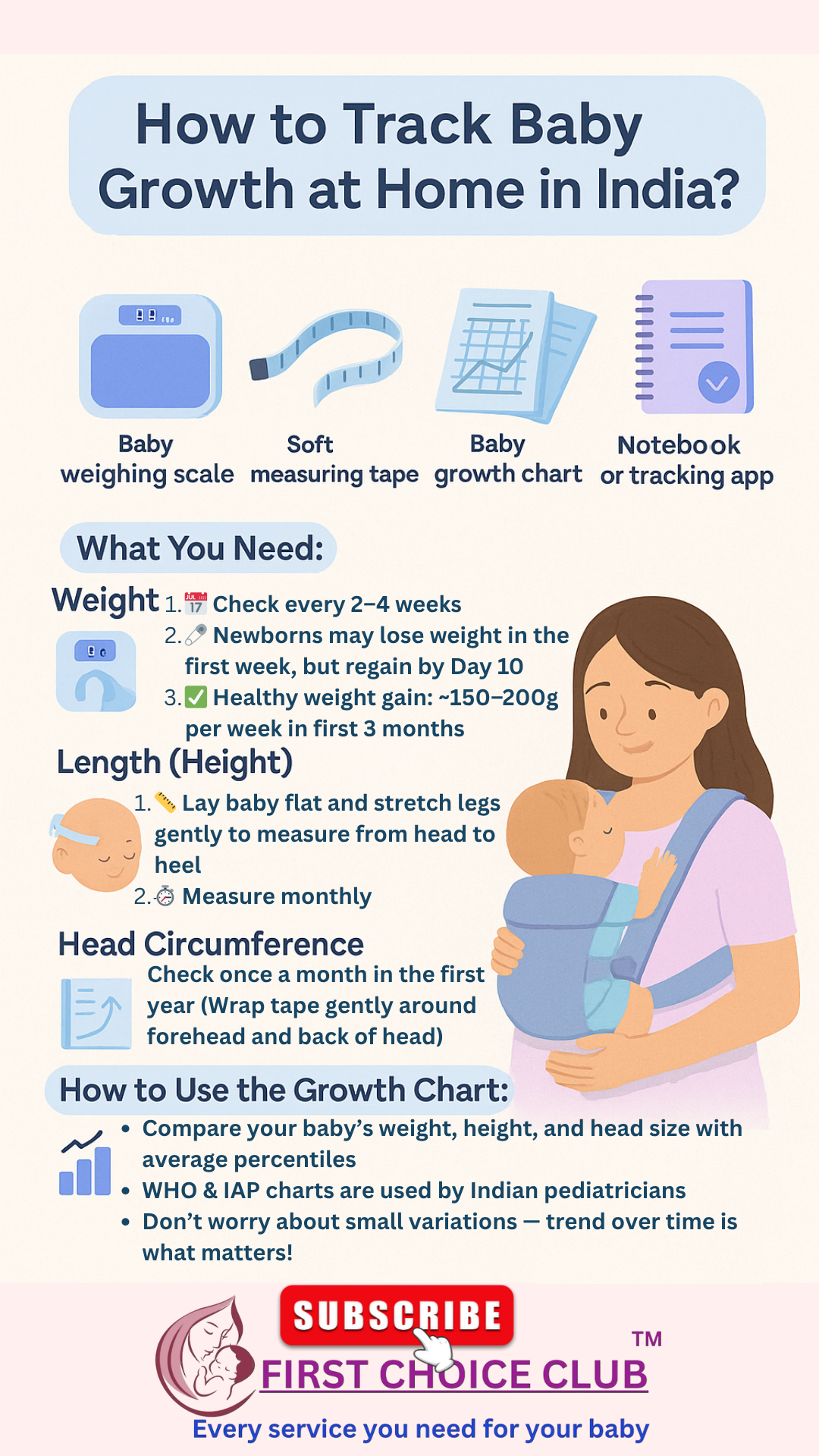
📏 How to Track Baby Growth at Home in India?Tracking your baby’s growth helps ensure they’re developing well — and you don’t need fancy tools to do it! With a few basics and regular checks, you can confidently monitor your baby’s physical development from the comfort of home.⸻✅ What You Need: • A baby weighing scale (digital preferred) • A soft measuring tape (in cm) • A baby growth chart (downloadable from WHO or IAP*) • A notebook or tracking app (like BabyCenter, GrowthBook)⸻📊 What to Measure: 1. Weight📅 Check every 2–4 weeks🧷 Newborns may lose weight in the first week, but regain by Day 10✅ Healthy weight gain: ~150–200g per week in first 3 months 2. Length (Height)📏 Lay baby flat and stretch legs gently to measure from head to heel⏱ Measure monthly 3. Head Circumference🧢 Wrap tape gently around forehead and back of head📅 Check once a month in the first year⸻📈 How to Use the Growth Chart: • Compare your baby’s weight, height, and head size with average percentiles • WHO & IAP charts are used by Indian pediatricians • Don’t worry about small variations — trend over time is what matters!⸻📱 Recommended Tools: • GrowthBook app – Made in India for easy tracking • WHO Child Growth Standards (PDF) • Indian Academy of Pediatrics (IAP) charts – available online
21 Jun
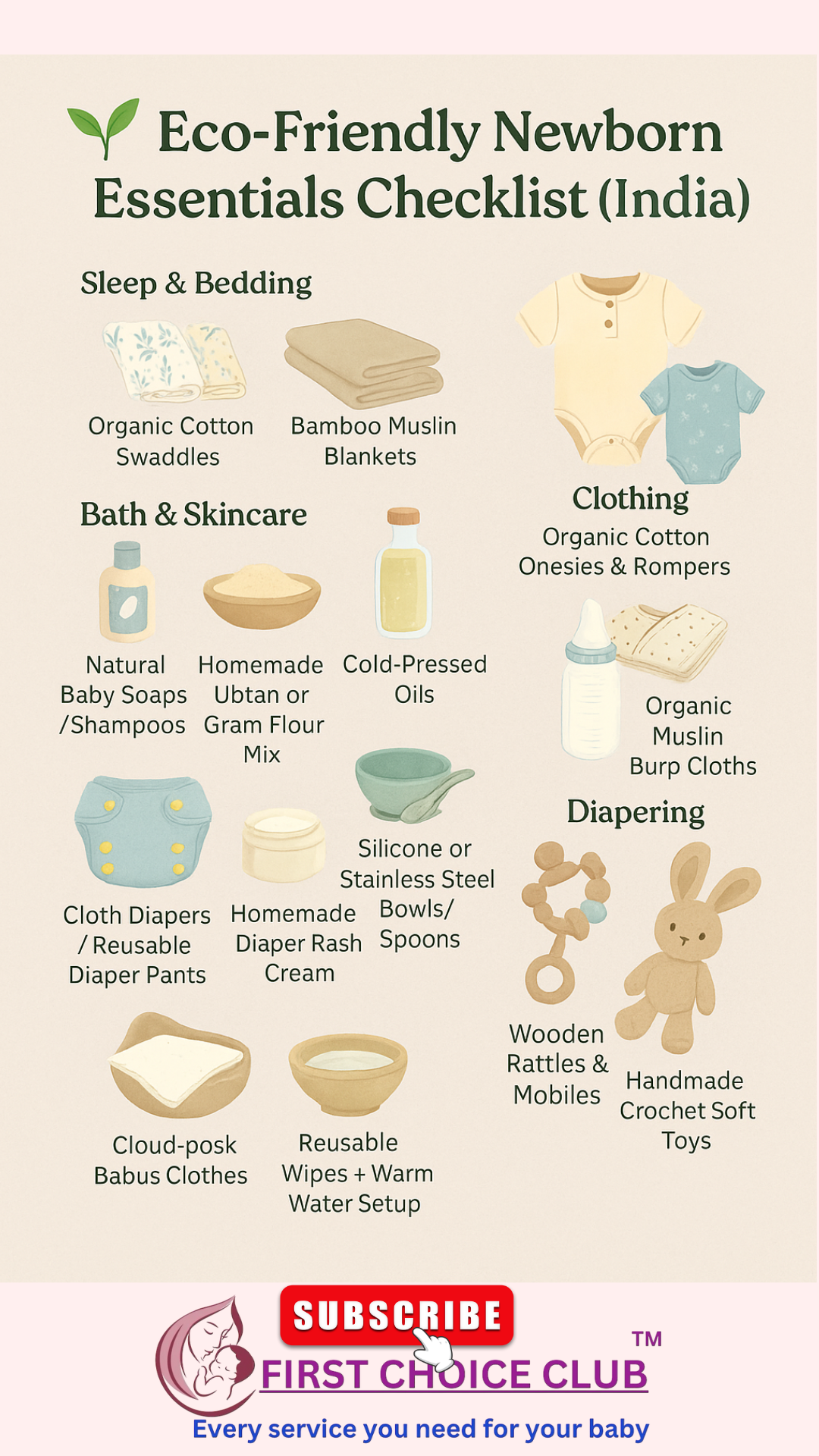
🌿 Eco-Friendly Newborn Essentials Checklist (India – 2025 Guide)As more Indian parents become conscious of sustainability, eco-friendly baby products are gaining popularity — not just for environmental reasons, but for baby’s health and comfort too. Choosing gentle, non-toxic, reusable, and biodegradable newborn essentials ensures you’re giving your child a safe start while supporting the planet.Here’s a complete Eco-Friendly Newborn Checklist for Indian families, including product types, tips, and Indian brands where possible.⸻🍼 Feeding Essentials1. Glass or Stainless Steel Feeding BottlesAvoid plastic bottles, even BPA-free ones. Go for: • Glass bottles – Easy to sterilize, non-toxic. • Stainless steel bottles – Durable and great for travel.Popular Indian brands: LuvLap Glass Bottles, Philips Avent (glass), Vaya Baby Bottles.2. Organic Cotton Burp Cloths • Soft, chemical-free, and reusable. • Avoid synthetic blends which can irritate newborn skin.Brands: Kaarpas, SuperBottoms, Bumpadum.3. Reusable Nursing Pads • Made from bamboo or cotton, these pads are washable and reduce landfill waste from disposables.Try: Mommy Milk Pads (India), SuperBottoms Nursing Pads.⸻🧷 Diapering Essentials4. Cloth DiapersModern cloth diapers (MCNs) are leak-proof, breathable, and come in adorable prints.Types: Pocket, AIO (All-In-One), pre-folds with covers.Top eco-friendly Indian brands: • SuperBottoms • Bumpadum • Snugkins • Tushions5. Coconut Oil for Diaper RashSkip petroleum-based creams. Virgin coconut oil works well as a natural rash guard.6. Reusable WipesUse soft muslin or flannel squares dipped in warm water or aloe vera solution. Replaces disposable wet wipes, which take 100+ years to break down.DIY Tip: Use old cotton sarees or towels to create reusable wipes.⸻🛁 Bath & Body Care7. Cold-Pressed Oils for MassageChoose oils free from parabens and artificial fragrance: • Coconut oil (summer) • Mustard or sesame oil (winter)Organic options: Conscious Chemist, Little Rituals, Kama Ayurveda.8. Natural Baby Soap/ShampooAvoid sulphates, parabens, and artificial fragrance.Brands: • Mother Sparsh • The Moms Co. • Rustic Art baby range • Kama Ayurveda Baby Cleanser9. Hooded Towels & Washcloths (Organic Cotton) • Gentle on baby’s skin. • Look for GOTS-certified organic cotton.⸻👶 Clothing & Bedding10. Organic Cotton Onesies and JhablasAvoid synthetic fibers that don’t breathe well and cause overheating. Stick to: • Undyed or naturally dyed clothes • GOTS-certified organic brandsIndian brands: Tiber Taber (organic line), Kaarpas, Greendigo, Love the World Today (LTWT), Aagghhoo.11. Muslin Swaddles • Light, breathable, multipurpose (swaddling, burping, nursing cover, stroller shade). • Natural dyes and soft texture are perfect for baby’s skin.12. Eco-Friendly Baby BlanketsUse layered organic cotton or handwoven baby quilts made without polyester fill.⸻🧼 Laundry & Cleaning13. Plant-Based Baby Laundry DetergentStandard detergents may contain harsh chemicals. Choose: • Phosphate-free • Fragrance-free • BiodegradableBrands: Mamaearth, Rustic Art, The Better Home, BabyOrgano.14. Wool Dryer Balls • Replace disposable dryer sheets. • Speeds up drying time and softens clothes naturally.⸻🎒 Travel & Outdoor15. Eco Diaper Bags • Made from recycled cotton, jute, or sustainable canvas. • Avoid PU leather or plastic-based bags.16. Wooden Teethers & ToysAvoid plastic or gel-filled toys. Go for: • Neem wood teethers (naturally anti-bacterial) • Painted with edible colorsIndian Brands: Shumee, Ariro, Bhoomi Toys.17. Reusable Wet BagsStore soiled diapers or clothes while traveling. Replace single-use plastic covers.⸻🏠 Home & Nursery18. Sustainable Baby FurnitureLook for: • Cribs or cots made of natural wood with non-toxic polish • Avoid MDF/particle board (emits formaldehyde)Indian sources: Boingg!, Little Birdie, Mothercare India (wood line).19. Organic Mosquito NetInstead of chemical sprays or coils, opt for breathable nets around sleeping areas.20. Natural Room Fresheners • Use camphor, essential oils, or potpourri. • Avoid sprays with phthalates or synthetic fragrance.⸻🌍 Waste-Free Tips for New Parents • Skip disposable bibs, breast pads, and changing sheets — opt for washable ones. • Upcycle old cotton sarees/tees into cleaning cloths, diapers, or baby wipes. • Buy second-hand baby gear (strollers, carriers) from trusted sources like Facebook groups or OLX. • Limit toys to a few natural items — rotate them instead of buying more.⸻🛒 Where to Buy Eco-Friendly Newborn Products in India Platform Highlights SuperBottoms India’s top cloth diaper and eco babywear brand Brown Living India’s largest zero-waste product platform Greendigo GOTS-certified organic cotton baby clothes Shumee Eco-conscious wooden toys Amazon India Good range of natural & organic baby brands FirstCry Filter by ‘organic’ & ‘sustainable’ categories 💡 Final Tips for Going Green with Your Newborn • Don’t try to be 100% eco-perfect — even a few sustainable choices matter. • Educate family and caregivers about cloth diapers, natural oils, and eco-toys. • Prioritize quality over quantity — less clutter, more mindfulness. • Look for certifications: GOTS (organic cotton), ECOCERT, BPA-free, cruelty-free, and vegan where applicable.⸻By making thoughtful, earth-friendly choices, you’re not only protecting your baby’s delicate skin and health but also shaping a better future for them. Small switches — like cloth wipes instead of disposable ones — go a long way when practiced daily.Every eco step you take today is a gift to your child’s tomorrow. 💚Here is your printable PDF:📄 Download Eco-Friendly Newborn Essentials Checklist (India)
21 Jun
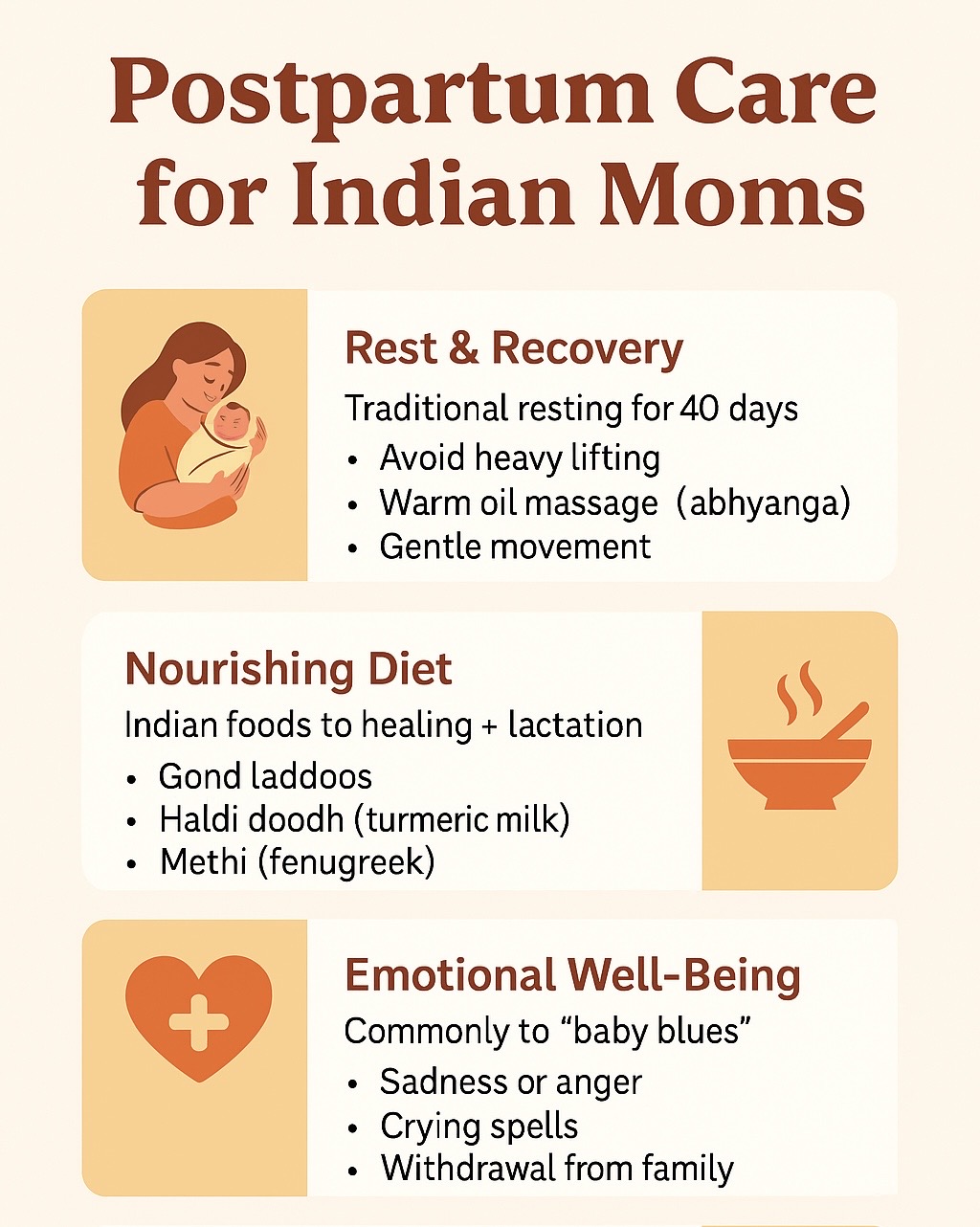
🧡 Postpartum Care for Indian Moms – Complete Recovery GuideBringing a baby into the world is one of the most life-changing events a woman can experience. But while everyone celebrates the newborn, the mother’s healing journey often gets overlooked.In Indian culture, postpartum care is deeply rooted in tradition—yet it’s also essential to blend it with modern knowledge for safe, holistic recovery. Here’s your complete guide to taking care of yourself in the crucial 6 weeks after childbirth.⸻🌼 Why Postpartum Care MattersThe postpartum period (also called the 4th trimester) is a time of physical healing, emotional shifts, hormonal changes, and intense sleep deprivation.Without proper care, Indian moms may face: • Weakness or fatigue • Postpartum depression • Back pain or joint stiffness • Breastfeeding issues • Nutritional deficiencies⸻🛏️ 1. Traditional Indian Rest Practices (Sutika Kala)In many Indian households, the new mom is encouraged to rest for 40 days. This period is known as: • Sutika kala in Ayurveda • Jaapa in North India • Seemantham aftercare in South IndiaKey principles: • No heavy lifting • Warm foods and baths • Staying indoors (to protect from infections) • Daily oil massagesModern take: While full rest may not be practical for everyone, at least 2–3 weeks of supported recovery can help immensely.⸻🧘♀️ 2. Ayurvedic Postnatal MassageIndian tradition recommends abhyanga (warm oil massage) to: • Improve blood circulation • Rebuild muscle tone • Relieve back and shoulder pain • Reduce postpartum swellingBest oils: • Sesame oil (South India) • Coconut oil (coastal areas) • Castor oil (for joint stiffness)Tip: Hire a trained postnatal massage therapist if available in your area. If not, ask a trusted female family member to help.⸻🥘 3. Nutrition: Indian Postpartum DietThe right food speeds up healing, supports lactation, and prevents constipation and weakness.Common Indian postpartum foods: Food Benefits Gond ke laddoo / Dry fruit laddoos Boost energy, warm the body Jeera ajwain water Aids digestion, increases milk supply Moong dal khichdi Easy on stomach, protein-rich Haldi doodh (turmeric milk) Anti-inflammatory, good for joints Methi (fenugreek) dishes Galactagogue (milk-boosting) Avoid: Cold foods, deep-fried items, processed snacks, and caffeine in the first 2–3 weeks.⸻🍼 4. Breastfeeding SupportBreastfeeding can be difficult initially. Many Indian moms give up due to: • Low milk supply anxiety • Cracked nipples • Latching issuesEssentials to help you: • Nursing pillow (for support) • Nipple cream (lanolin-based) • Breast pump (manual or electric) • Lactation consultant (can be found online too)Tip: Drink ajwain + jeera water 2x a day and continue iron + calcium supplements.⸻🧘♀️ 5. Mental Health & Baby BluesUp to 70% of Indian moms experience baby blues—mood swings, crying spells, anxiety—within the first two weeks. A smaller percentage develop postpartum depression (PPD), which can last months.Watch for: • Prolonged sadness or guilt • Irritability, anger, or crying often • Difficulty bonding with baby • Withdrawing from familyGet help: It’s okay to talk to a therapist or counselor. Urban Indian cities have many online platforms for maternal mental health.⸻🧼 6. Vaginal & C-Section RecoveryWhether you had a vaginal birth or C-section, wound healing is key.Vaginal Birth Tips: • Use warm water spray instead of toilet paper • Sitz baths (warm water + antiseptic) • Change pads frequentlyC-Section Tips: • Avoid bending or heavy lifting for 4–6 weeks • Keep the incision dry • Watch for signs of infection (redness, discharge)⸻🧺 7. Hygiene Tips for New MomsWith reduced immunity, you need to maintain hygiene: • Wash hands before breastfeeding • Change undergarments daily • Wash maternity pads with warm water if reusable • Wear cotton clothes that allow airflow⸻🧾 8. Indian Superfoods for Recovery Superfood Benefit Ajwain Aids digestion, relieves gas Haldi Reduces inflammation Gond Strengthens joints and spine Dry ginger (saunth) Warms body, helps lactation Coconut Hydration and healthy fats 🧘♀️ 9. Gentle Postnatal ExerciseStart pelvic floor exercises (Kegels) 2–3 weeks after delivery with doctor’s approval.After 6 weeks: • Gentle walks • Postnatal yoga (under guidance) • Avoid crunches or high-impact workoutsTip: Use a postpartum belly binder for back support if advised by doctor.⸻📥 Free PDF Download: Indian Postpartum Recovery ChecklistGet your free printable PDF with: • Foods to eat • Things to avoid • Essential recovery tips • 40-day daily checklist👉 Click here to download⸻🔗 Related Posts (Interlink These!) • 👉 Newborn Shopping Checklist India • 👉 Hospital Bag Checklist for Indian Moms • 👉 Best Breast Pumps in India⸻🧡 Final ThoughtsPostpartum care is not a luxury—it’s a necessity.Dear new mom, remember: • Rest is recovery • Your emotions are valid • You are healing just as much as your baby is growingSurround yourself with help, nourishment, love, and patience. You’ve done something extraordinary. Let FirstChoiceClub.in walk with you in this next chapter. 🌼
21 Jun

🌿 Eco‑Friendly Newborn Essentials in India – Complete ChecklistWelcoming a newborn into your family is a beautiful experience. But in the middle of excitement and joy, there’s also an opportunity to choose consciously—especially when it comes to baby products. From reusable diapers to toxin-free feeding bottles, eco-friendly newborn essentials are not only safer for your baby but also kinder to the planet.Here’s your complete guide to building a sustainable baby starter kit in India—without compromising on comfort, hygiene, or affordability.⸻💚 Why Choose Eco-Friendly Baby Products?Babies have delicate skin and developing immune systems. Many mainstream products contain harmful chemicals, plastic derivatives, or synthetic fragrances that can irritate or harm a baby over time.Going eco-friendly means: • 🌱 Reducing your baby’s exposure to toxins • 🌍 Lowering your household’s environmental footprint • 💸 Saving money in the long run through reusables⸻🍼 1. Reusable Cloth DiapersWhy They’re Better: • Disposable diapers take 500+ years to decompose • Cloth diapers are breathable and reduce diaper rash • You can reuse each diaper up to 200–300 times Best Indian Brands: Brand Type Price Range SuperBottoms Organic cotton + dry-feel pad ₹700–₹850 Bumpadum All-in-one, quick-dry ₹700–₹1000 Snugkins Indian prints, certified fabric ₹500–₹700 Tip: Start with 8–10 cloth diapers for rotation. Use coconut oil as a natural diaper rash barrier.⸻🧼 2. Natural Baby Skincare ProductsMainstream baby lotions and soaps often contain parabens, sulfates, and synthetic scents.What to Look For: • Paraben-free • No artificial fragrances • Plant-based oils like almond, olive, coconutEco-Friendly Brands in India: Brand Products Key Features Mamaearth Lotion, shampoo, diaper rash cream MadeSafe certified The Moms Co Natural body wash, baby butter Australian Certified Toxin-Free Rustic Art Organic soaps Cold-pressed oils, biodegradable 🍼 3. BPA-Free Feeding Bottles & UtensilsFeeding gear touches your baby’s mouth daily, so safe materials are crucial.Go For: • BPA-free silicone nipples • Borosilicate glass or stainless steel bottles • Bamboo-based bowls/spoonsRecommended Picks: Product Brand Eco-Benefit Glass feeding bottle Philips Avent or Chicco Reusable, BPA-free Bamboo dinner set Bumberry or DailyObjects Compostable Silicone bibs LuvLap, BuddsBuddy Easy to clean, reusable 🛏️ 4. Organic Cotton ClothingRegular baby clothes are often made with synthetic blends and dyed with chemicals. These can irritate sensitive skin or cause allergies.Choose: • GOTS-certified organic cotton • Unbleached, undyed onesies • Muslin swaddles and jablasTop Indian Options: Brand What They Offer Highlights Tula + Tumbler Organic onesies, muslin sets Minimalist & gender-neutral Kicks & Crawl Newborn sets Gentle prints, soft elastics Little West Street Sleepsuits, blankets Premium, gifting-ready 🛁 5. Eco-Safe Bathing EssentialsMust-Haves: • Baby bath tub (BPA-free) • Bamboo or organic cotton towels • Neem wood hair brushNeem is naturally antimicrobial and biodegradable—ideal for brushes, rattles, and combs.🪑 6. Sustainable Baby GearBaby gear can be reused by siblings or passed on—but investing in safer materials from the start matters.Eco-Friendly Gear to Consider: Product Brand Why It’s Green Baby carrier Soul Slings (India-based) Linen & handwoven cotton Wooden cradle Baby Jalebi No plastic, handcrafted Bouncer seat LuvLap Eco Fewer plastic parts 🌬️ 7. Air Quality & Baby-Friendly CleanersBabies breathe more rapidly than adults. Indoor air quality affects their development and immunity.Do: • Use indoor plants like areca palm, peace lily • Avoid room fresheners with artificial fragrance • Use baby-safe laundry detergent (e.g., Mamaearth, Rustic Art)⸻📦 8. Recyclable Packaging + Conscious BuyingEvery item you buy adds packaging waste. Support brands that offer: • Minimal plastic packaging • Recyclable paper wraps • Cloth bags or refillable jarsBuy in bulk when possible to reduce shipping frequency and packaging.⸻📥 Free Download: Eco-Friendly Newborn Checklist (PDF)🎁 We’ve created a downloadable checklist of: • Must-have eco products • Indian brands to trust • Shopping and prepping tips👉 Click here to download the PDF⸻🤱 New Mom Tip: You Don’t Need EverythingStart small. You don’t need: • 20 onesies • 10 bottles • Dozens of plastic toysInstead, focus on multi-use, reusable, and baby-safe products that last longer and don’t harm the environment.⸻🔗 Related Blog Posts • 👉 Hospital Bag Checklist – Indian Moms PDF • 👉 Newborn Baby Shopping Checklist India • 👉 Postpartum Care for Indian Moms⸻🌟 Final ThoughtsEco-parenting is not about perfection. It’s about making conscious, consistent choices—one reusable diaper, one safe bottle, one organic cotton outfit at a time.With Indian brands catching up in this space, you can now go green without going broke. Every sustainable choice you make is a gift not only to your baby—but to the planet they’ll grow up on. 🌎💚
20 Jun
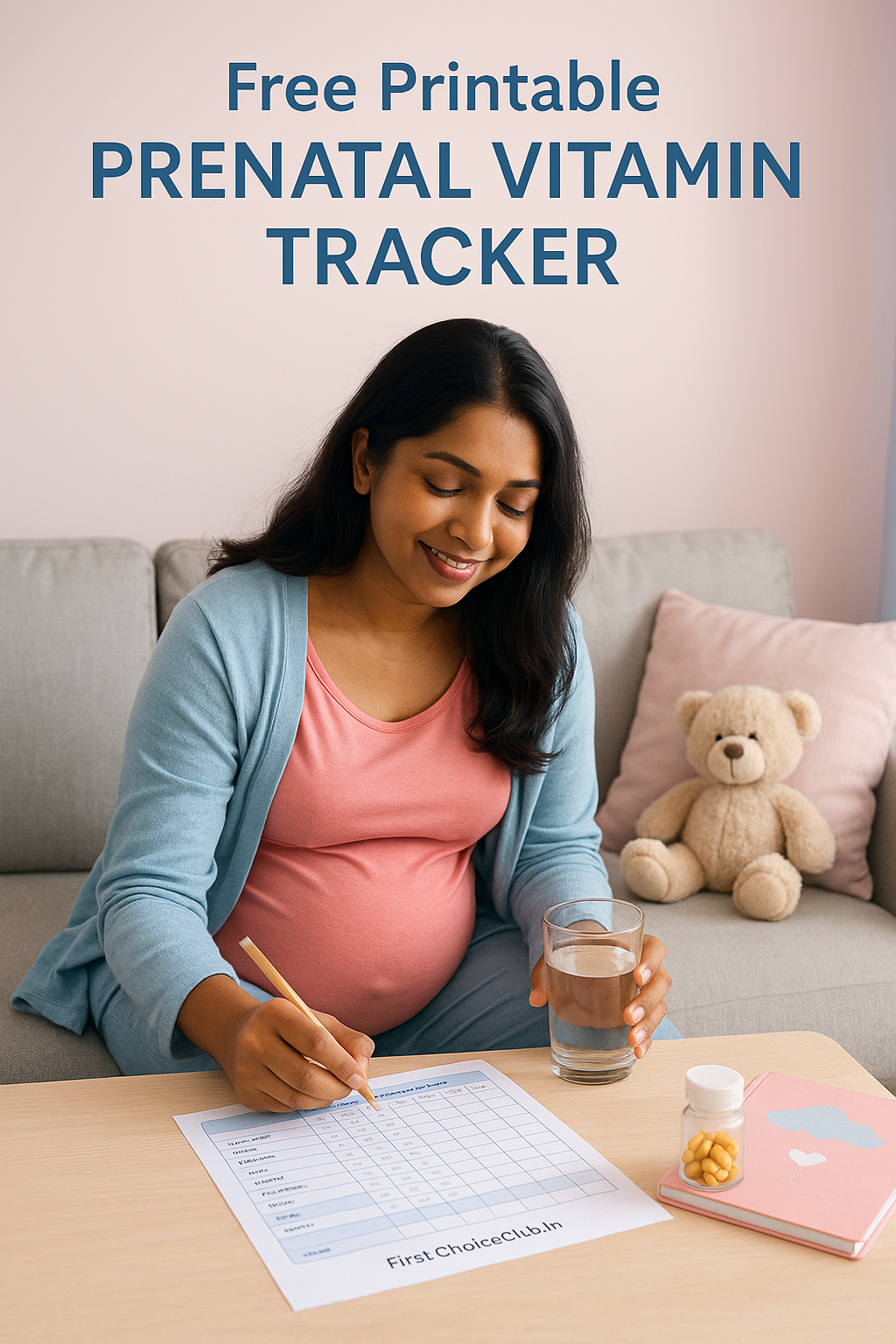
🍼 Comprehensive Prenatal Vitamins Guide for Indian MomsPregnancy is a beautiful journey—and to make it smoother and healthier, prenatal vitamins play a vital role. Especially for Indian moms, nutritional needs can vary due to unique diets, traditions, and regional food habits. In this guide, we’ll break down everything you need to know about prenatal vitamins, when to start them, and how to make sure you and your baby stay nourished at every step.🌟 What Are Prenatal Vitamins?Prenatal vitamins are specially formulated multivitamins designed to meet the increased nutritional needs of a pregnant woman. They support:Fetal brain and spine developmentHealthy birth weightReduced risk of birth defectsBalanced maternal health🕒 When Should You Start Taking Prenatal Vitamins?Doctors recommend starting at least 1–3 months before conception if you’re planning a baby. If you’re already pregnant, begin as early as possible—especially during the first trimester when the baby’s brain and spinal cord are developing.💊 Key Nutrients in a Prenatal Vitamin (And Why They Matter)1. Folic Acid (400–800 mcg)Prevents neural tube defectsFound in: Spinach, toor dal, black-eyed peas2. Iron (27–30 mg)Helps make extra blood for you and babyPrevents anemia (very common in Indian women)Found in: Ragi, beetroot, jaggery, green leafy veggies3. Calcium (1000 mg)Needed for baby’s bones, teeth, heartFound in: Milk, curd, paneer, sesame seeds4. Vitamin D (600 IU)Boosts calcium absorptionPrevents bone pain and weaknessFound in: Sunlight ☀️, fortified milk, mushrooms5. Vitamin B12Supports nerve development and DNA formationEspecially important for vegetarian momsFound in: Milk, eggs, fortified cereals6. Omega-3 Fatty Acids (DHA)Crucial for brain and eye developmentFound in: Fish oil supplements, walnuts, flax seeds.🇮🇳 Indian Diet and Prenatal Nutrition ChallengesCommon gaps among Indian moms:Low B12 and Vitamin D (especially vegetarians)Iron deficiency anemia is widespreadHeavy use of tea/coffee can block iron absorptionTip:Avoid tea/coffee within 1 hour of taking iron supplements.👩⚕️ Do Indian Moms Really Need All These Supplements?Yes—because modern diets may lack the right balance, especially for:Working moms skipping mealsStrict vegetarians or vegansHigh-risk pregnanciesMultiple pregnancies (twins/triplets)Natural Indian Foods That Boost Prenatal HealthNutrientNatural SourceFolic AcidSpinach, lentils, black chanaIronDates, jaggery, rajma, ragiCalciumSesame seeds (til), almonds, milkDHAWalnuts, flax seeds, chiaVitamin DSunlight, fortified milk, mushrooms🚫 Prenatal Vitamin Mistakes to Avoid❌ Skipping doses when you “feel fine”❌ Taking iron and calcium at the same time❌ Overdosing on multivitamins (can harm liver)❌ Not drinking enough water with supplements🔗 Related Posts👉 Indian Pregnancy Month-by-Month Guide👉 First Trimester Diet Plan for Indian Moms👉 Hospital Bag Checklist + Free PDF👉 Postpartum Nutrition Tips📥 Download: Free Printable Prenatal Vitamin TrackerStay organized with our FREE printable tracker:✅ Weekly checkboxes✅ Supplement schedule✅ Water reminder✅ Notes section👉 Click here to download your tracker PDF🏁 Final ThoughtsPrenatal vitamins are not optional—they’re a non-negotiable investment in your baby’s future health. Whether you’re pregnant, trying to conceive, or in your second trimester, talk to your doctor and find the right supplement combo that fits your body, your lifestyle, and your Indian diet.
18 Jun

Best Baby Carriers for Indian MomsChoosing the right baby carrier can make a world of difference in your daily routine! Here are some of the best baby carriers for Indian moms, offering comfort, safety, and ease for both you and your little one.👶 Why Choose a Baby Carrier? • Keeps your baby close and secure while allowing you to go about your day • Ideal for multitasking while ensuring your baby gets the comfort they need • Helps with bonding, reducing fussiness by having the baby close to you • Perfect for navigating crowded spaces, markets, or crowded transport✨ Top Picks: 1. Ergobaby Omni 360🍼 Versatile and ergonomic with 4 carry positions🌱 Breathable and soft fabric for comfort💪 Supports up to 20 kg, ideal for long-term useBuy at Amazon:(Ergobaby Omni 360) 2. Luvlap Comfort Baby Carrier👶 Affordable yet practical🌼 Extra padded shoulder straps and waist belt🔒 Adjustable to accommodate newborns to toddlersBuy at Amazon(Luvlap Comfort Baby Carrier) 3. Chicco Ultrasoft Carrier🍼 Soft fabric for baby’s comfort🌿 Lightweight and breathable💪 Easy-to-adjust straps for a secure fitBuy at Amazon(Chicco Ultrasoft Carrier) 4. Buttbaby 6-in-1 Baby Carrier👶 Multiple carrying positions (front, back, hip)🌱 Comfortable for both baby and mom with extra support💡 Adjustable to grow with your baby from newborn to toddlerBuy at Amazon(Buttbaby 6-in-1 Baby Carrier) 5. Mee Mee Baby Carrier🍼 Budget-friendly and stylish💪 Supportive design with padded straps🌼 Perfect for short trips or outingsBuy at Amazon (Mee Mee Baby Carrier)🌟 What to Look For in a Baby Carrier • Comfort: Look for soft padding in shoulder straps and waist belt • Adjustability: Ensure it fits both you and your baby securely • Breathability: Choose fabrics that are breathable for both you and your baby, especially in warm weather • Safety Features: Ensure your carrier has proper safety mechanisms such as buckles, straps, and infant head supportChoosing the right carrier can provide a perfect balance of comfort and freedom for both mom and baby. Always ensure to select one that fits your lifestyle and baby’s needs!
17 Jun

🌿 Home Remedies for Pregnancy Symptoms (Indian Style)Relieve common pregnancy discomforts naturally using safe, traditional Indian remedies! Always check with your doctor before trying anything new.⸻🤢 Morning Sickness (1st Trimester) • 🧉 Jeera (Cumin) Water: Boil 1 tsp cumin in water, sip warm • 🫚 Ginger Tulsi Tea: Small piece of ginger + 3 tulsi leaves + honey • 🍋 Nimbu & Honey: Mix lemon juice with warm water & a pinch of rock salt • 🍭 Suck on Amla or Elaichi Candy: Soothes nausea⸻🔥 Heartburn / Acidity • 🥛 Cold Milk or Buttermilk (Chaas): Neutralizes acid • 🪔 Ajwain (Carom Seeds) with Black Salt: Chew slowly after meals • 🍌 Ripe Banana or Sabudana: Soothing and light on the stomach⸻💨 Gas / Bloating • 💧 Ajwain + Kala Namak + Warm Water: Relieves trapped gas • 🍵 Heeng (Asafoetida) water: Just a pinch in warm water • 🌿 Mint-Coriander Tea: Aids digestion⸻😴 Insomnia or Restlessness • 🥛 Warm Milk with a pinch of Jaiphal (Nutmeg) at bedtime • 🛀 Warm Bath with Lavender Oil or light coconut oil massage • 🧘♀️ Deep Breathing & Left-side Lying: Improves sleep⸻🦵 Leg Cramps / Body Pain • 🧂 Epsom Salt or Rock Salt Foot Soak • 🧴 Warm Sesame Oil Massage on legs • 🥬 Include calcium-rich foods: Ragi, sesame seeds, paneer, almonds⸻😓 Constipation • 🍌 Eat soaked raisins or prunes in the morning • 🥥 Drink coconut water regularly • 🥗 Add fiber: sabja seeds, fruits, bran rotis, oats⸻😞 Mood Swings or Anxiety • 🎧 Listen to calming mantras or bhajans • 🧘♀️ Try gentle yoga, deep breathing, gratitude journaling • 🍵 Chamomile or Tulsi Tea (limited use)
15 Jun

🏥 How to Choose a Maternity Hospital in India (Step-by-Step for Indian Moms)Whether you’re planning a normal delivery or C-section, choosing the right hospital matters for your comfort, safety, and budget. Here’s a complete guide to help you make a confident decision:⸻✅ Step 1: Check Hospital Reputation & Reviews • Ask friends, family, and local moms’ groups for recommendations • Check Google Reviews, Practo, or BabyCenter India • Look for high delivery success rates and a good OB-GYN team⸻✅ Step 2: Verify Gynaecologist Availability • Choose a hospital where your preferred OB-GYN is available • Confirm if they will be personally present during delivery • Ask if there’s a team of backup doctors for emergencies⸻✅ Step 3: Tour the Maternity Ward • Check for cleanliness, staff behaviour, and privacy • See if they allow birthing partners inside the labour room • Ask about visitor policies, especially post-COVID⸻✅ Step 4: Understand Delivery Packages • Ask for a printed quote: normal delivery vs C-section • Compare what’s included: room charges, tests, baby vaccines, stay • Inquire about hidden charges (NICU, baby doctor, night duty)💸 Average delivery cost in India: ₹35,000 – ₹2,50,000 depending on city & hospital type⸻✅ Step 5: Emergency & NICU Facilities • Confirm 24/7 emergency care and anesthetist availability • Must have a NICU (Neonatal Intensive Care Unit) on-site or nearby • Ask how they handle high-risk pregnancies⸻✅ Step 6: Check Proximity & Accessibility • Choose a hospital within 30 minutes travel time • Test the route for traffic, night access, and parking • Keep a Plan B hospital in case of urgent delivery⸻✅ Step 7: Ask About Postnatal Support • Do they offer lactation consultants, dieticians, or newborn care classes? • Are nurses trained in baby handling and breastfeeding assistance? • Any post-delivery counseling or pelvic floor therapy?⸻✅ Step 8: Understand Insurance & Cashless Claims • Confirm if your insurance is accepted (Star Health, Niva Bupa, etc.) • Ask for TPA contact details for pre-approval • Check if baby’s expenses are covered in your policy⸻✅ Step 9: Comfort & Room Options • Tour available rooms: general, semi-private, deluxe • Ask about A/C, meals for mom, attached bathroom, TV, etc. • Check if rooming-in is allowed (baby stays with you)⸻✅ Step 10: Vibe & Staff Behaviour • Choose a place where you feel respected and heard • Observe how nurses, receptionists, and doctors interact • Trust your instincts — you deserve a warm, caring space 💕
15 Jun

🌼 Third Trimester Checklist for Indian Moms (Weeks 28–40)🩺 Medical & Health Essentials • Regular antenatal visits (every 2–3 weeks, then weekly from week 36) • Get your Growth Scan and Doppler (as advised by doctor) • Monitor baby’s movements daily (start kick counting by week 28) • Track BP, gestational diabetes, and swelling (PIH warning signs) • Continue Iron, Calcium, DHA supplements⸻🥗 Indian Diet Tips • Include protein-rich foods: dal, paneer, eggs, sprouts • Add iron & calcium-rich foods: ragi, dates, sesame seeds, leafy greens • Stay hydrated with coconut water, jeera water, buttermilk • Eat small, frequent meals to ease digestion • Avoid too much salt, spicy food, raw papaya, or excess ghee • Limit refined sugar and caffeine intake⸻🧘♀️ Body Care & Movement • Do gentle walks or prenatal yoga (if approved) • Practice squats or butterfly pose for easier labor (only if cleared) • Use pregnancy pillow, support belts for back & belly support • Moisturize belly, thighs to reduce itching/stretch marks • Get enough sleep — try left-side sleeping • Wear soft, loose cotton clothes and supportive maternity bras⸻👜 Hospital Bag & Birth Prep • Pack hospital bag by Week 35 (mom + baby essentials) • Keep ID cards, insurance documents, scan reports ready • Choose your birthing partner (husband/mom/sister) • Decide between normal/C-section based on doctor’s advice • Learn about labor signs and false contractions (Braxton Hicks) • Attend antenatal classes if possible (online/offline)⸻👶 Baby-Ready at Home • Wash baby clothes, bedding in gentle detergent • Set up diaper changing area & newborn sleeping space • Stock up: diapers, wipes, feeding bottles, baby care basics • Finalize baby name and plan baby announcement • Check vehicle for safe hospital travel plan⸻❤️ Mental Wellness & Bonding • Talk and sing to your baby – they recognize your voice • Journal your birth affirmations or pregnancy feelings • Practice breathing techniques or meditation • Accept help from family – it’s okay to slow down • Plan postpartum support system – help at home, food, baby care • Celebrate with a small godh bharai / baby shower if you wish!
14 Jun
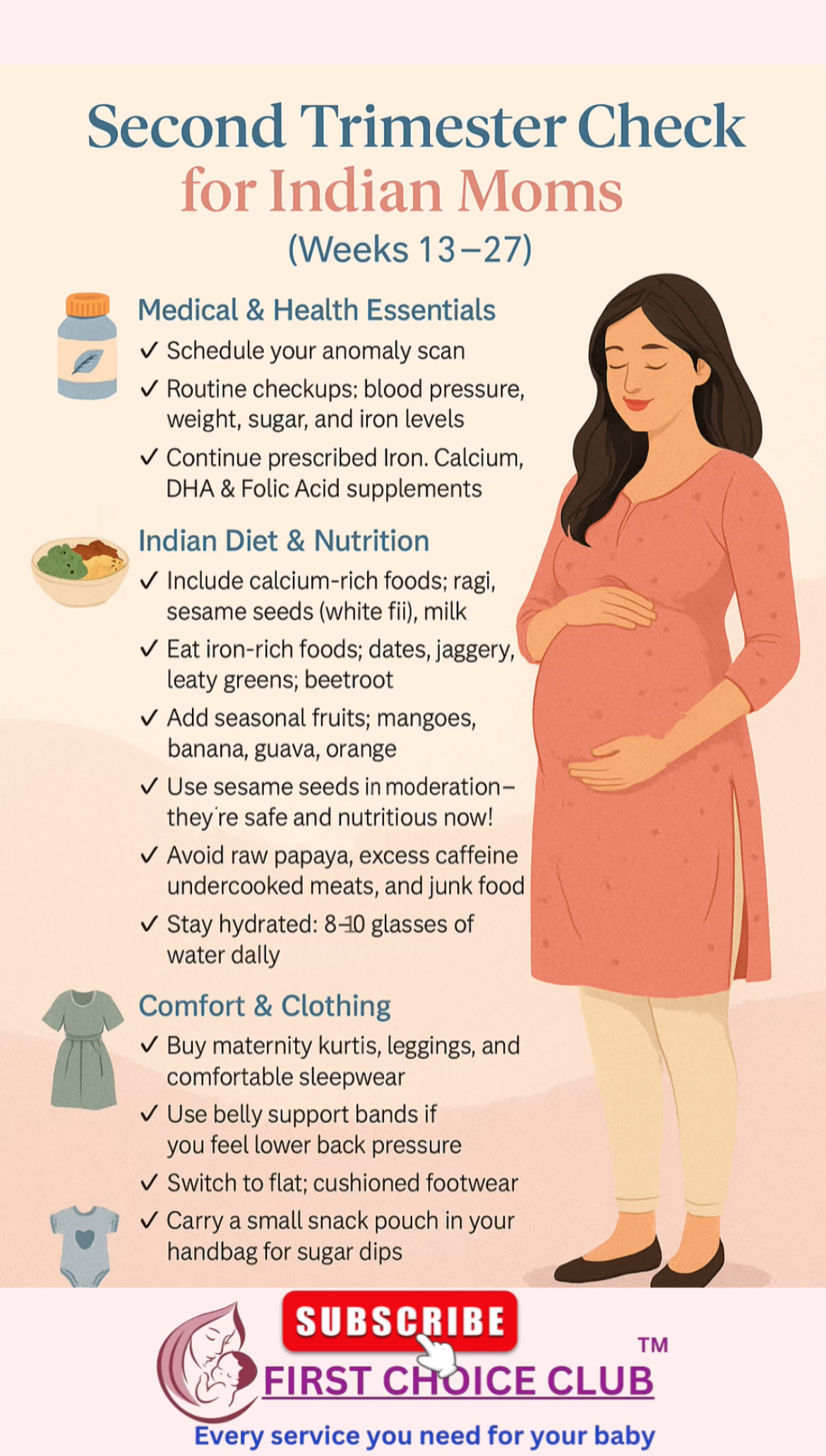
🌸 Second Trimester Checklist for Indian Moms (Weeks 13–27)Welcome to the most comfortable phase of your pregnancy — where your baby bump starts to show, energy levels rise, and bonding truly begins. Here’s your easy-to-follow checklist, tailored for Indian moms!⸻🩺 Medical & Health Essentials • Schedule your anomaly scan (usually between weeks 18–22) • Routine checkups: blood pressure, weight, sugar, and iron levels • Continue prescribed Iron, Calcium, DHA & Folic Acid supplements • Track baby movements from around Week 18 onwards • Dental care checkup (pregnancy hormones can cause gum issues)⸻🥗 Indian Diet & Nutrition • Include calcium-rich foods: ragi, sesame seeds (white til), milk, paneer • Eat iron-rich foods: dates, jaggery, leafy greens, beetroot • Add seasonal fruits: mangoes, banana, guava, orange • Use sesame seeds in moderation — they’re safe and nutritious now! • Avoid raw papaya, excess caffeine, undercooked meats, and junk food • Stay hydrated: 8–10 glasses of water daily✅ Myth-buster: Sesame seeds do NOT cause miscarriage when eaten in regular food amounts!⸻🧘♀️ Body Care & Movement • Try gentle prenatal yoga or walking (only if your doctor approves) • Use a pregnancy pillow for side sleeping support • Moisturize daily to reduce stretch marks (coconut or almond oil works well) • Wear comfortable cotton innerwear and maternity bras • Avoid lifting heavy items or sudden movements • Elevate your legs if you experience swelling⸻👗 Comfort & Clothing • Buy maternity kurtis, leggings, and comfortable sleepwear • Use belly support bands if you feel lower back pressure • Switch to flat, cushioned footwear • Carry a small snack pouch in your handbag for sugar dips⸻🧸 Early Baby Planning • Start browsing baby products (swaddles, bottles, diapers, etc.) • Make a list or start a baby registry • Discuss nursery setup or sleeping arrangements • Shortlist baby names — traditional, modern, or Vedic-inspired • Plan your maternity leave and backup support at home⸻❤️ Emotional & Bonding Activities • Talk, sing, or read to your baby — sound starts reaching baby by Week 18! • Start journaling your pregnancy journey or taking weekly bump photos • Practice mindfulness, garbh sanskar music, or deep breathing • Spend quality time with your partner and family • Read Indian pregnancy books or trusted parenting blogs⸻✨ This is your time to feel empowered and connected.
14 Jun

🌸 First Trimester Checklist for Indian Moms! 🇮🇳Just found out you’re pregnant? Congratulations! 🎉The first trimester can be exciting and overwhelming — but don’t worry, we’ve got you covered! From doctor visits and prenatal supplements to Indian diet tips and emotional self-care, this checklist is specially made for desi moms-to-be! 🧡Whether you’re in a metro city or a small town, this guide will help you:✅ Book your first OB-GYN appointment✅ Start folic acid and iron supplements✅ Understand key pregnancy scans✅ Plan your first-trimester Indian diet✅ Manage nausea & tiredness naturally✅ Track your baby’s weekly growth✅ Say no to harmful foods & habits✅ Start building your pregnancy support system
13 Jun

Best Baby Products in India (2025 Edition) — categorized and tailored for Indian parents, with top picks that are doctor-approved, widely available (Amazon, FirstCry, etc.), and perfect for Indian weather and routines:⸻🍼 Best Baby Products in India (2025 Edition)👶 Newborn Essentials 1. Baby Diapers – Pampers Premium Care / Mamaearth Plant-Based Diapers 2. Baby Wipes – WaterWipes / Mother Sparsh 99% Water Wipes 3. Cotton Nappies – SuperBottoms Dry Feel Langot (washable, eco-friendly) 4. Swaddle Wraps – Kaarpas Muslin Swaddles (soft & breathable)⸻🛁 Bath & Skin Care 5. Baby Body Wash – Cetaphil Baby / Sebamed Baby Wash 6. Baby Shampoo – Himalaya Gentle Baby Shampoo / Moms Co Natural Shampoo 7. Moisturizer – Aveeno Baby Lotion / Sebamed Baby Cream 8. Massage Oil – Dabur Lal Tail (traditional) / Mamaearth Soothing Baby Oil⸻🍽 Feeding Essentials 9. Feeding Bottles – Philips Avent / Chicco Natural Feeling 10. Breast Pump – Lansinoh Manual / LuvLap Electric Breast Pump 11. Sterilizer – Philips Avent Steam Sterilizer / R for Rabbit UV Sterilizer 12. Nursing Pillow – Mylo Essentials / Baybee Feeding Pillow⸻🛏 Sleep & Comfort 13. Baby Cot/Bassinet – LuvLap C-50 Cot / R for Rabbit Hide & Seek Cradle 14. Bedding Set – Mee Mee Newborn Set / Masilo Organic Cot Bedding 15. Night Light – VTech Soothing Light & Music / Chickoo Soft LED Lamp 16. White Noise Machine – Hatch Baby Rest / White Noise India App (Free)⸻🚼 Travel & Safety 17. Stroller – R for Rabbit Chocolate Ride / LuvLap Sunshine Stroller 18. Car Seat – Joie Tilt Convertible / R for Rabbit Jack n Jill 19. Baby Carrier – Anmol Wrap / Infantino Flip Advanced 20. Diaper Bag – Motherly Smart Diaper Bag / Mee Mee Multipurpose⸻🎁 Extra Must-Haves 21. Nasal Aspirator – NoseFrida by Fridababy 22. Digital Thermometer – Dr. Odin Infrared Thermometer 23. Baby Nail Trimmer – Chicco Electric Nail File 24. Teethers & Toys – Fisher-Price Rattle Set / Little’s Soft Teether 25. Laundry Detergent – Mamaearth Baby Detergent / Pigeon Liquid CleanserComplete list PDF(Here)
12 Jun

🗓 Indian Pregnancy Diet Month by MonthMonth 1 (Weeks 1–4) • Focus: Implantation support & folic acid • Eat: • Folic acid-rich foods: spinach, lentils, citrus fruits • Hydrating fruits: coconut water, pomegranate, banana • Avoid caffeine, papaya, pineappleMonth 2 (Weeks 5–8) • Focus: Managing nausea & supporting organ development • Eat: • Small frequent meals: poha, idli, khichdi, curd rice • Ginger tea, dry toast, lemon water for nausea • Folic acid, B6, and iron supplements (as advised)Month 3 (Weeks 9–12) • Focus: Bone and muscle formation • Eat: • Dairy (milk, paneer), ragi, almonds for calcium • Eggs, dals, sprouts, fish for protein • Oranges, amla, guava for vitamin C⸻Month 4 (Weeks 13–16) • Focus: Appetite improves, baby growth speeds up • Eat: • Fresh homemade meals with whole grains (millets, brown rice) • Protein-rich: rajma, chana, tofu, eggs • Dry fruits, soaked almonds, walnutsMonth 5 (Weeks 17–20) • Focus: Iron, calcium & energy boost • Eat: • Palak paneer, methi thepla, beetroot salad • Ghee in small amounts for digestion • Dates, raisins, jaggery, cooked leafy greensMonth 6 (Weeks 21–24) • Focus: Managing weight & baby movements • Eat: • Frequent, balanced meals • Coconut water, lassi, chaas for hydration • Avoid fried snacks & too much sugar⸻Month 7 (Weeks 25–28) • Focus: Fetal brain development & reducing constipation • Eat: • Omega-3: flaxseeds, walnuts, fish (if non-veg) • Fiber-rich: oats, fruits with peel, sabudana • Hydrate well + warm soupsMonth 8 (Weeks 29–32) • Focus: Fat stores, fetal immunity • Eat: • Ghee-roti, dry fruits, protein shakes • Moong dal chilla, daliya, green smoothies • Avoid gas-causing foods (chole, rajma at night)Month 9 (Weeks 33–40) • Focus: Preparing for labour • Eat: • Easily digestible khichdi, fruit, sabudana kheer • Ajwain water or jeera water for digestion • Dates (if doctor-approved) to prep for deliveryDownload free printable PDF(Here)
10 Jun
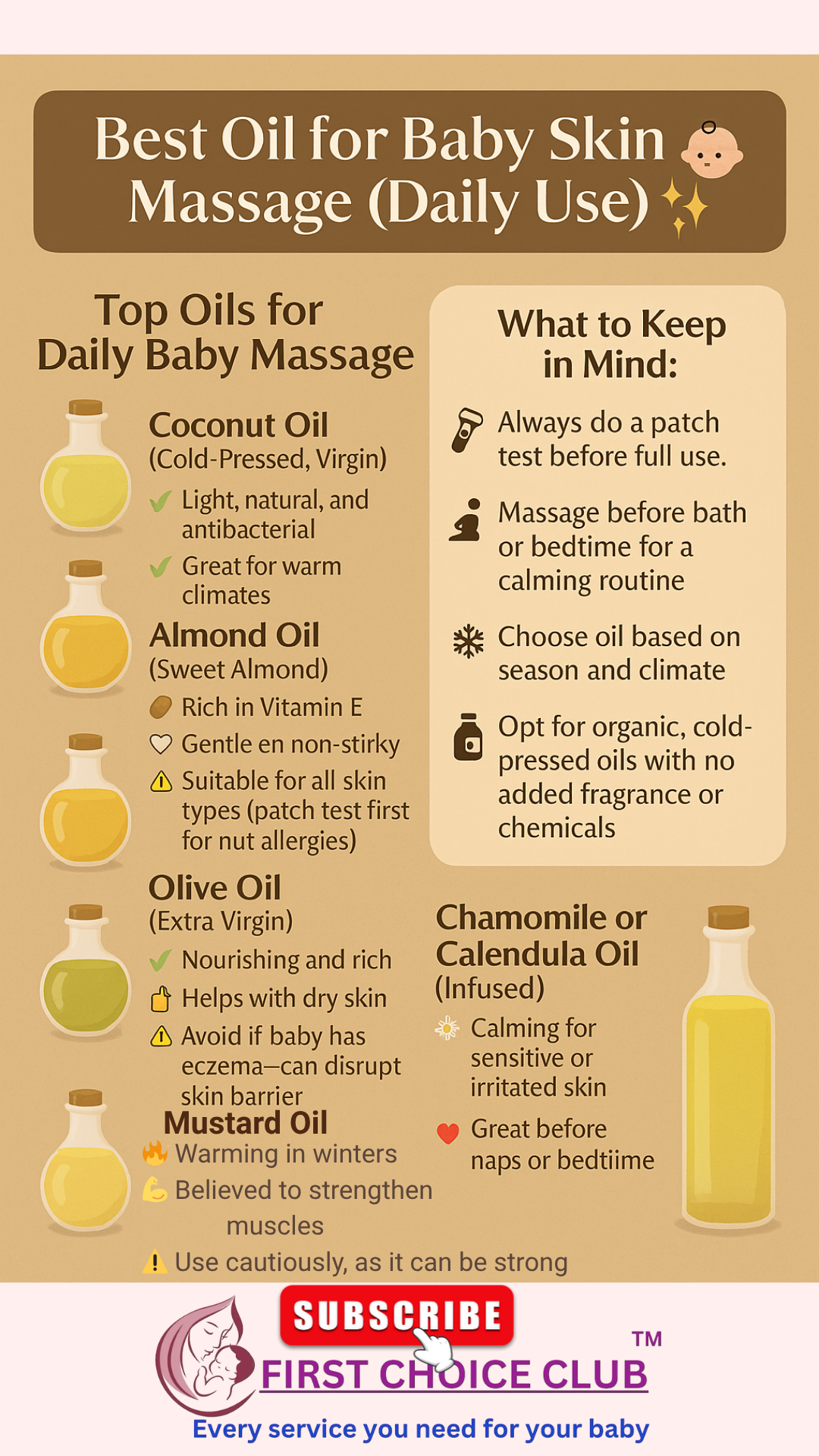
Best Oil for Baby Skin Massage (Daily Use) 👶✨Daily baby massage is not just soothing—it’s also a beautiful bonding ritual and supports your baby’s skin health, sleep, and development. Here’s how to choose the best oils for regular use:⸻🥇 Top Oils for Daily Baby Massage1. Coconut Oil (Cold-Pressed, Virgin) • 🌴 Light, natural, and antibacterial • 🌡️ Great for warm climates • 🌿 Moisturizes without clogging pores2. Almond Oil (Sweet Almond) • 🌰 Rich in Vitamin E • 🤍 Gentle and non-sticky • 💡 Suitable for all skin types (patch test first for nut allergies)3. Mustard Oil (Diluted, Mild Form) • 🔥 Warming in winters • 💪 Believed to strengthen muscles • ⚠️ Use cautiously, as it can be strong4. Olive Oil (Extra Virgin) • 🌿 Nourishing and rich • 👍 Helps with dry skin • ⚠️ Avoid if baby has eczema—can disrupt skin barrier5. Chamomile or Calendula Oil (Infused) • 🌼 Calming for sensitive or irritated skin • 💖 Great before naps or bedtime⸻🌟 What to Keep in Mind: • 🧪 Always do a patch test before full use. • 🛀 Massage before bath or bedtime for a calming routine. • ❄️ Choose oil based on season and climate. • 🧴 Opt for organic, cold-pressed oils with no added fragrance or chemicals. • 🧸 Warm oil slightly before applying for a soothing touch.
09 Jun

👶 Must-Have Newborn Products in India: 2025 Guide!Welcoming a newborn into your life is magical—but also overwhelming when it comes to deciding what you truly need. With countless baby brands in India, it’s easy to get lost between essentials and extras. This 2025 guide helps you confidently choose must-have newborn products, curated for Indian parenting styles, climate, and budgets.⸻🍼 1. Feeding EssentialsWhether you’re breastfeeding, formula-feeding, or doing both, having the right feeding products will make the process smoother.✔ Must-Have Products: • Nursing Pillow: Supports your baby and reduces strain on your arms and back.Top Picks: Mylo Essentials, Luvlap, Mothercare. • Breast Pump: Helps working moms or those with latching issues.Affordable Brands: Luvlap Manual, Mee Mee, Philips Avent Electric. • Feeding Bottles (BPA-free): Choose anti-colic options for better digestion.Best Brands: Philips Avent, Pigeon Glass Bottles, Chicco. • Burp Cloths: Soft, absorbent cloths for post-feeding cleanups. • Bottle Sterilizer: Optional but convenient, especially in the early months.💡 Tip: If you’re formula feeding, have a bottle warmer, formula dispenser, and thermos for night feeds.⸻🛏️ 2. Sleeping & BeddingNewborns sleep up to 16 hours a day. A calm and safe sleep environment is crucial.✔ Must-Have Products: • Baby Cradle or Bassinet: Choose ones with mosquito nets for Indian households.Trusted Brands: R for Rabbit, Fisher-Price, LuvLap. • Organic Cotton Bedsheets: Soft and breathable; avoid synthetic fabrics. • Swaddles or Wraps: For secure sleeping and to reduce startle reflex. • Night Light: Helps with late-night feedings and diaper changes. • Baby Blanket: Lightweight and suitable for Indian temperatures.💡 Avoid pillows or heavy bedding for the first 6 months to reduce SIDS risk.⸻🛁 3. Bathing & SkincareBath time is a bonding moment, and using safe, gentle products protects your baby’s sensitive skin.✔ Must-Have Products: • Baby Bathtub or Bath Support Mat • Mild Baby Soap/Shampoo: Prefer herbal or chemical-free options.Indian Brands: Himalaya, Sebamed, Mother Sparsh. • Cotton Towels with Hood: Quick drying and gentle on skin. • Baby Massage Oil: Coconut oil, almond oil or Ayurveda-based blends. • Nail Clippers or Scissors: Safe grooming is essential to prevent scratches.🌿 Many Indian families still follow traditional “tel malish” (oil massage) before bath—continue this with modern safety in mind.⸻👚 4. Clothing & LaundryNewborns need soft, breathable clothes that are easy to change.✔ Must-Have Products: • 6–8 Onesies/Rompers: Prefer side-buttoned or front-open for ease. • Cotton Caps, Mittens & Booties: Keep the baby warm and prevent self-scratching. • Newborn Diapers (Cloth or Disposable):Cloth Brands: SuperBottoms, Snugkins.Disposable Brands: Pampers NB, Huggies Nature Care. • Laundry Detergent for Babies: Gentle on skin, fragrance-free.Brands: Mamaearth, Chicco Baby Laundry.👕 Wash all clothes before first use. Stick to natural fabrics like cotton.⸻🧼 5. Diapering EssentialsDiaper changes are frequent! A well-stocked setup avoids stress.✔ Must-Have Products: • Newborn Diapers (0–5 kg): Stock up based on baby’s birth weight. • Diaper Changing Mat: Waterproof and portable. • Diaper Rash Cream: Prevents rashes in hot and humid climates.Best Picks: Sebamed, Desitin, Himalaya. • Wet Wipes (Fragrance-Free): Water-based wipes are gentler.Recommended: Mother Sparsh 99% Water Wipes. • Dustbin with Lid / Diaper Bin: For odor control and hygiene.⸻🚼 6. Health & SafetyHealth essentials give parents peace of mind and help in emergencies.✔ Must-Have Products: • Digital Thermometer (ear or forehead) • Nasal Aspirator or Suction Bulb • Baby Nail Cutter • First Aid Kit with basic medicines (ask your pediatrician) • Baby Monitor (optional but useful)🏥 Have your pediatrician’s number handy and create a medicine log book.⸻🎒 7. On-the-Go GearEven short trips with a newborn need some preparation.✔ Must-Have Products: • Diaper Bag with compartments • Baby Carrier (Ergonomic)Top Picks: LuvLap, Ergobaby, Chicco Ultrasoft. • Stroller/Pram: If you’re planning outdoor walks or mall visits. • Portable Changing Pad • Swaddle or Cover for Breastfeeding👜 Pack extra clothes, diapers, wipes, and hand sanitizer in your diaper bag.⸻🎀 8. Toys & StimulationEven newborns benefit from sensory toys that aid early development.✔ Must-Have Products: • Soft Rattles or Hanging Mobiles • Black & White Contrast Books or Cards • Tummy Time Mat • Crib Toys or Musical Mobiles🎶 Talk, sing, and play gentle music—it stimulates brain development early on.⸻✅ Final Checklist: Newborn Must-Haves Category Essentials Feeding Bottles, pump, burp cloths, sterilizer Sleeping Bassinet, swaddles, bedsheets, night lamp Bath & Skincare Bathtub, towels, baby wash, oil, nail clipper Clothing Onesies, mittens, diapers, baby detergent Diapering Diapers, mat, wipes, rash cream, bin Health & Safety Thermometer, aspirator, nail cutter, first-aid kit Travel Diaper bag, carrier, stroller, changing pad Toys Rattles, contrast cards, musical mobile Don’t buy everything in bulk before birth. Wait for baby’s size, skin type, and preferences. Many Indian parents also combine modern baby products with traditional care practices—that’s the best of both worlds!
08 Jun

1. Niva Bupa Health Companion – Maternity & Newborn Add-on• ✅ Waiting Period: 2 years• 🍼 Covers maternity + newborn + vaccinations• 💰 Sum insured: ₹3L – ₹25L2. Care Joy Maternity Insurance• ✅ Dedicated maternity plan• 🍼 Covers delivery, C-section, newborn complications• 💰 Waiting period: 9 months – 2 years3. HDFC ERGO – My:Health Suraksha• 🍼 Covers delivery, prenatal/postnatal• ✅ Newborn covered for 90 days• ⏳ Waiting Period: 3–4 years4. Aditya Birla Activ Health Platinum Enhanced• ✅ Maternity + wellness programs + chronic care• 🍼 Covers delivery, newborn care, vaccinations• ⏳ Waiting: 2 years5. Star Comprehensive Insurance• 🍼 Covers maternity + newborn + vaccination• 💡 No cap on room rent• ⏳ Waiting Period: 3 years6. SBI Arogya Premier• 🍼 Covers maternity, newborn hospitalization• ✅ Up to 2 deliveries covered• ⏳ Waiting: 9 months – 1 year7. ManipalCigna ProHealth Premier• ✅ Covers up to ₹1L formaternity• 🍼 Newborn automatically covered• ⏳ Waiting Period: 4 years8. ICICI Lombard Complete Health Insurance• 🍼 Maternity + newborn + vaccinations• 💡 Good for family floater policies• ⏳ Waiting: 2 years9. Reliance Health Infinity• 🍼 Maternity + assisted reproductive treatments• ✅ Option to add maternityrider• ⏳ Waiting: 3 years10. Tata AIG MediCare Premier• ✅ Maternity with up to ₹50K cover• 🍼 Covers up to 2 deliveries + newborn care• ⏳ Waiting: 2 years📝 Important Tips:Always read the waiting period clause.Most plans don’t cover pre-existing pregnancy.Opt for cashless network hospitals for easy claims.Choose policies with newborn vaccination and OPD cover.
07 Jun
.png)
Newborn Baby Essentials Checklist for Indian Moms (2025 Updated) Introduction:Becoming a mom is a beautiful journey—but the early days can feel overwhelming. Whether you’re preparing for your first baby or want to stay organized, this ultimate newborn baby essentials checklist for Indian moms will make sure you’re ready!From diapers to feeding bottles and from clothes to skincare, we’ve got everything covered—with options you can buy online or find in your local baby shop. Categories of Essentials: 1. Baby Clothing:6–8 Cotton Onesies3–4 Swaddle Cloths (muslin or cotton)4 Pairs of Socks & MittensSoft Cap (especially for newborn)Pro tip: Choose breathable, organic cotton for summer babies. 2. Sleeping & Bedding:Baby Mattress with waterproof sheet2–3 Soft baby blanketsMosquito net for cribBuy Online: [Amazon India Top Cribs & Beds →] 3. Feeding Items:2–3 Feeding bottles (BPA-free, anti-colic recommended)Bottle sterilizer or hot water methodBibs and burp clothsBreast pump (manual or electric)Nursing cover Check trusted feeding bottles list →[Here] 4. Diapering & Hygiene:Newborn diapers (Pampers, Huggies, or reusable cloth)Diaper rash creamBaby wipes (fragrance-free)Baby bathtub & mild shampooNail cutter & baby comb 5. Skincare & Health:Baby massage oil (coconut or almond based)Baby lotion & powder (dermatologically tested)Digital thermometerNasal aspiratorCotton swabs & sterilizer 6. For Mom:Maternity padsNipple creamComfortable feeding nightwearReusable hot/cold gel packs FREE Download: Download the Full Printable Baby Checklist (PDF) →Includes: hospital bag, mom care, and week 1 newborn tracker! Conclusion:Start with the essentials, and build as you go. Every baby is different, and you’ll discover what your little one truly needs in the first few weeks. Bookmark this page or share with a fellow mom who’s preparing for her newborn!Check out the youtube videoFree Printable for Newborn Baby Essentials Checklist for Indian Moms (Here)
06 Jun
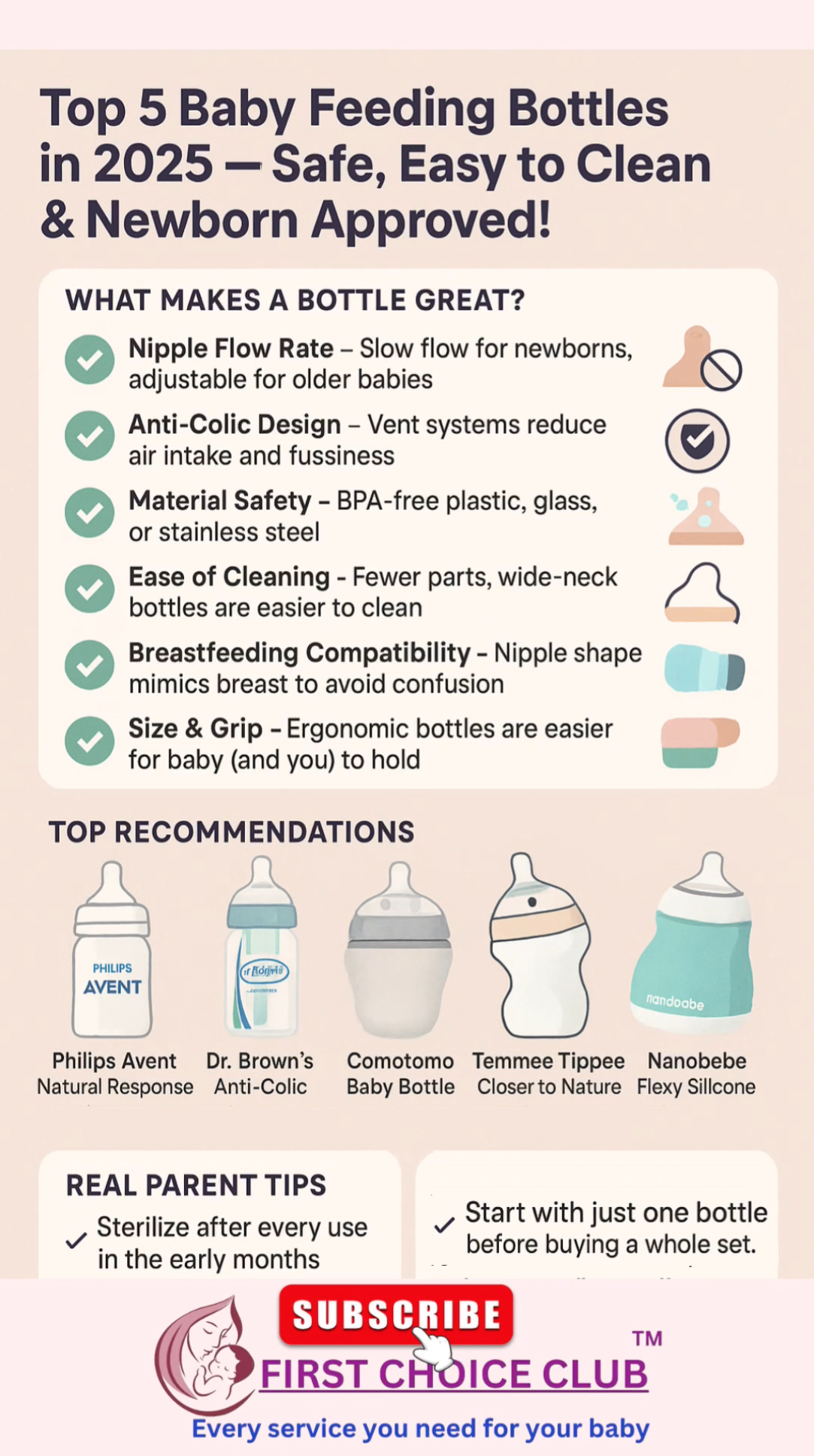
Best Baby Bottles in India (2025) – A Complete Guide for New MomsBecoming a new mom is exciting—but choosing the right feeding bottle? That can be confusing! With so many options out there, how do you know what’s safe, leak-proof, and perfect for your baby?Here’s your ultimate guide to baby bottles in India (2025)—handpicked for Indian moms. What to Look for in a Baby BottleBefore we dive into the list, here are the top factors to consider: BPA-Free Material – Safe for baby Anti-Colic Design – Reduces gas and fussiness Nipple Shape – Close to natural breastfeeding Size & Flow – Start with 120ml/slow flow for newborns Easy to Clean – Wide-neck and dishwasher-safe Top 5 Best Baby Bottles in India (2025) Philips Avent Natural Baby Bottle Best overall bottle for newbornsBPA-free, anti-colic valveNatural nipple shape for breastfed babiesAvailable in 125ml, 260ml, 330ml Buy on Amazon: [Link] Mom Tip: Great for mixed feeding (breast + bottle) Dr. Brown’s Anti-Colic Options+ Bottle Best for babies with gas or colicInternal vent system reduces spit-upNarrow or wide-neck optionsPrevents air bubbles Buy on Amazon: [Link] Mom Tip: A bit harder to clean but very effective Pigeon Peristaltic Nursing Bottle Budget-friendly & widely trustedSoft silicone nippleAffordable and easy to findGreat for Indian feeding schedules Buy on Amazon: [Link] Mee Mee Premium Glass Bottle Best glass baby bottle in IndiaEco-friendly, durableBPA-free and toxin-freeHeat-resistant borosilicate glass Buy on Amazon: [Link] Mom Tip: Heavier, but safe and long-lasting Comotomo Baby Bottle High-end and soft like momSilicone body mimics breastfeedingUltra-soft, squeezableGreat for fussy babies Buy on Amazon: [Link] Mom Tip: Expensive but worth it for picky feeders Firstchoiceclub RecommendationIf you’re confused, start with: Philips Avent for ease + safety Pigeon for affordability Dr. Brown’s for colic issuesSwitch brands as your baby grows—every baby is different! FAQs – Baby Bottles for Newborns in IndiaQ: Are plastic bottles safe for babies?A: Yes, if they are BPA-free and from a reputed brand. Avoid old or scratched bottles.Q: How many bottles do I need?A: Start with 2–3 bottles and observe your baby’s preference.Q: How often should bottles be replaced?A: Every 2–3 months, or if cracked/discolored. Want a full Baby Feeding Tracker + Bottle Hygiene Checklist? [Click here to download FREE] Final Thoughts Every baby is unique. What works for one may not for another. The best bottle is the one that keeps your baby happy and feeds smoothly—without fuss or tears (yours or baby’s ).You’re doing amazing, mommy! Related Reads:Hospital Bag Checklist for Indian Moms (coming soon!)Monthly Baby Growth Tracker (printable)Best Diapers in India (2025)
05 Jun
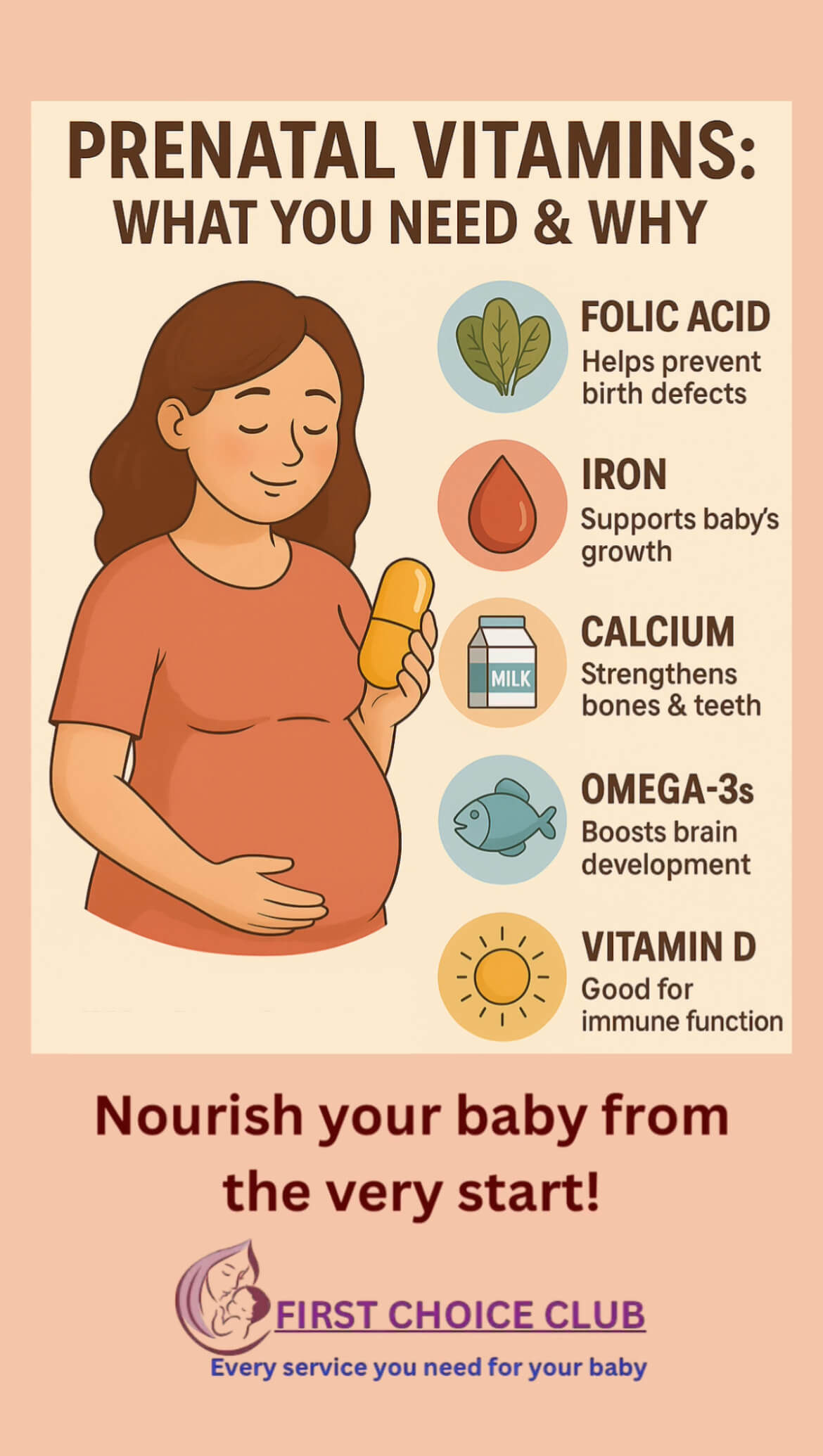
Your baby’s development begins even before you realize you’re pregnant! That’s why prenatal vitamins are so important from Day 1. Here’s what every expecting mom needs: ✔️ Folic Acid – Prevents neural tube defects ✔️ Iron – Supports oxygen supply to baby ✔️ Calcium & Vitamin D – For strong bones ✔️ DHA – For baby’s brain and eyes ✔️ Iodine – For thyroid health and brain development Ask your doctor which prenatal vitamin is right for you. Start early. Stay nourished. Support your baby’s journey from the very start! https://youtube.com/shorts/vtGsrQzhoIs?si=kLL6wPFJ6PlapaQr #PrenatalVitamins #FirstChoiceClub #PregnancyTips #HealthyPregnancy #BabyDevelopment #PregnancyNutrition #FolicAcid #IronForPregnancy #PregnancyCare
11 Apr

Struggling to sleep during early pregnancy?Here’s everything you need to know about the best sleeping positions in your first trimester!From side sleeping benefits to pillow hacks, we’ve got you covered.Sleep safe. Sleep smart. Sleep comfy!Share it to a mom-to-be who needs this!https://www.instagram.com/share/BAK3KMCzYMhttps://youtube.com/shorts/mJNCzUS4P4M?si=eDSU_cyR4q2Ma0k0Follow @firstchoiceclub for more pregnancy tips & baby care content.—#EarlyPregnancyTips #SleepingDuringPregnancy #PregnancyCare #PregnancySleep #MomToBeIndia #PregnancyJourney #FirstTrimesterCare #MotherhoodIndia #FirstChoiceClub #PregnancyTipsDaily #PregnancyHealth #IndianMomCommunity #PregnancySupport #pregnancyawareness
09 Apr
Welcoming a newborn is a joyous occasion, and choosing eco-friendly products ensures a healthier start for your baby and a better future for the planet. Here are some top eco-friendly newborn essentials: 1. Organic Cotton Swaddle Blankets Soft, breathable, and gentle on sensitive skin, organic cotton swaddles are perfect for wrapping your baby securely. Product: MOM'S HOME Baby Organic Cotton Soft Muslin Cloth Swaddle 2. Bamboo Muslin Washcloths Naturally antibacterial and highly absorbent, bamboo washcloths are ideal for delicate skin. Product: FDSHIP Baby Square Cotton Organic Bamboo Absorbent Reusable Face Towels 3. Reusable Cloth Diapers An eco-friendly alternative to disposables, cloth diapers reduce waste and are gentle on the environment. Product: SuperBottoms Newborn Essentials Combo4. Wooden Baby Hairbrush Crafted from natural materials, a wooden hairbrush with soft bristles is perfect for your baby’s sensitive scalp. Product: Organic B Baby Hair Brush 5. Organic Cotton Baby Clothing Free from harmful chemicals, organic cotton clothing ensures comfort and safety for your newborn. Product: MOM'S HOME Baby's Organic Cotton Soft Full Sleeve Onesie/Bodysuit 6. Neem Wood Teether Naturally antibacterial, neem wood teethers provide a safe and eco-friendly solution for teething discomfort. Product: Ariro Wooden Infant Teethers Gift 7. Biodegradable Baby Wipes Made from natural materials, biodegradable wipes are gentle on the skin and the environment. Product:Mother Sparsh Natural Care Baby Wipes 8. Organic Baby Skincare Products Ensure your baby’s skin stays soft and healthy with organic lotions and shampoos free from harmful chemicals. Product: Blue Nectar Ayurvedic Baby Oil with Organic Ghee, 100% Natural Baby Massage Oil With Coconut Oil & Olive Oil 9. Bamboo Baby Blanket Soft, hypoallergenic, and thermoregulating, bamboo blankets provide comfort in all seasons. Product: TinyLane Curated for You! All in one Bamboo : Cotton Newborn Baby Essentials Gift Set 10. Eco-Friendly Baby Gift Sets Comprehensive sets that include multiple eco-friendly products make for perfect gifts or starter kits. Product: Z-KIDS™ Premium Newborn Gift Set - Flower of Life™ Note: The above links are affiliate links. We may earn a small commission at no extra cost to you if you make a purchase through these links.
08 Apr

Introduction:Welcoming a baby into your world is magical—but let’s be honest, it also comes with a shopping list that can feel endless. Don’t worry! We’ve rounded up 10 absolute must-have newborn products that every new mom swears by.Whether you’re preparing for your baby’s arrival or just delivered—this guide helps you get the best products at the best prices, with direct links from Amazon & FirstCry.1. Soft Cotton Swaddles Swaddling helps newborns feel safe—just like in the womb.Why it’s essential: Promotes better sleep, reduces startle reflexRecommended Brands: Mee Mee, LuvLap, MothercareBuy Now:Amazon India – Best Swaddle Combo PackFirstCry – Organic Cotton Swaddles2. Newborn Diapers (Sensitive Skin Friendly) Trust us, you’ll go through plenty of these!Tip: Choose newborn size with wetness indicators.Top Picks: Pampers, Huggies Nature CareBuy Now:Amazon – Pampers Newborn 72 PackFirstCry – Huggies Nature Care Pack3. Baby Wipes (Alcohol-Free) For diaper changes and quick clean-ups.Go For: Aloe vera & Vitamin E-based wipesBuy Now:Amazon – Mamaearth Baby Wipes (72 count)FirstCry – Chicco Wipes Combo4. Feeding Bottles (BPA-Free) Whether you’re breastfeeding or not, these come in handy!Suggested Brands: Philips Avent, Dr. Brown’sBuy Now:Amazon – Philips Avent Starter KitFirstCry – Dr. Brown’s Anti-Colic Bottles5. Diaper Changing Mat You’ll thank yourself later for this.Reusable + Waterproof + FoldableBuy Now:Amazon – Foldable Baby Changing MatFirstCry – Travel-Friendly Mats6. Baby Clothes (0–3 Months) Pick breathable cotton onesies with front buttons.Pro Tip: Avoid fancy clothes for daily useBuy Now:Amazon – Baby Bodysuit Pack of 5FirstCry – Soft Newborn Rompers7. Baby Nail Clipper or Scissors Newborn nails grow super fast! Keep them trimmed.Look For: Rounded tips, safety guardsBuy Now: Amazon – Chicco Nail Clippers SetFirstCry – Mee Mee Grooming Kit8. Baby Carrier or Wrap Helps calm the baby & keeps your hands free.Ergonomic & Breathable Mesh Options RecommendedBuy Now:Amazon – LuvLap Hip Seat CarrierFirstCry – R for Rabbit Carry Nest9. Gentle Baby Body Wash & Shampoo Tear-free, pH balanced products are a must.Buy Now:Amazon – Himalaya Gentle Baby WashFirstCry – Sebamed Baby Shampoo10. Digital Thermometer for Infants Must-have for fever monitoring, especially in early months.Buy Now:Amazon – Dr. Trust Infrared ThermometerFirstCry – Babyhug Flexi Digital Thermometer Note: The above links are affiliate links. We may earn a small commission at no extra cost to you if you make a purchase through these links.
07 Apr

We are your trusted newborn service directory, helping parents find the best hospitals, pediatricians, maternity care, baby products, and more—all in one place! 🍼💕Whether you’re preparing for your baby’s arrival or looking for expert newborn care services, First Choice Club makes parenting easier with reliable and convenient solutions. 🌿✨Follow us for expert recommendations, parenting tips, and a supportive community! 💙💗#FirstChoiceClub #NewbornServices #ParentingMadeEasy #MomAndBaby #PregnancyJourney #ParentingSupport #BabyCare #NewbornCare #MaternityCare #PregnancyGuide #MotherhoodUnplugged #ParentingTips #IndianMoms #MomToBe #NewMom #BabyEssentials #PregnancySupport #ParentingCommunity #BabyWellness #NewbornDirectory #MomLife #DadLife #BabyDevelopment #BabyLove #Parenthood #BabyPlanning #PregnancyAnnouncement #BabyOnTheWay #healthypregnancy
19 Jan
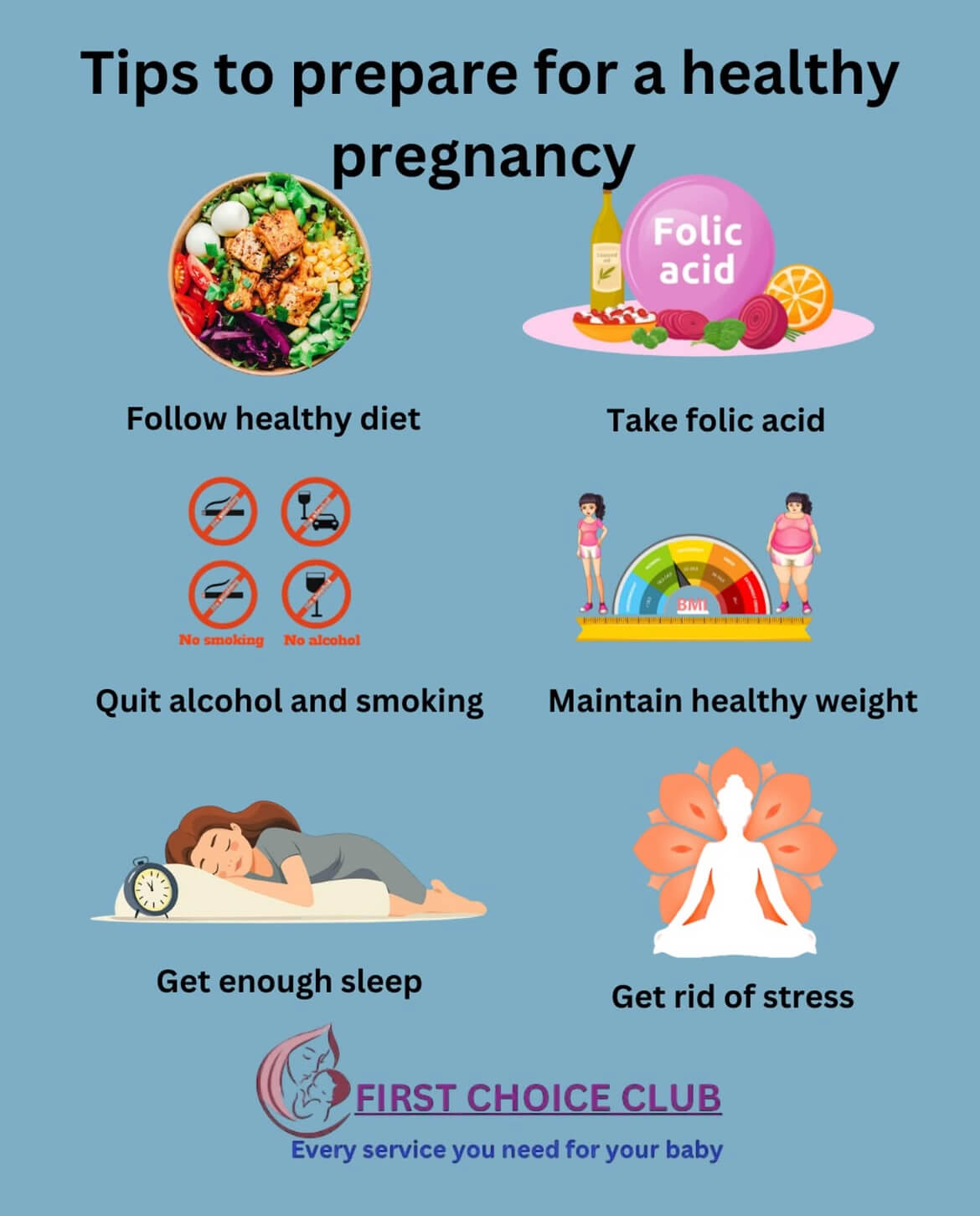
Preparing for a healthy pregnancy starts long before conception! Here are 6 essential tips to boost fertility and ensure a smooth journey into motherhood:🥗 Follow a healthy diet – A nutrient-rich diet supports fertility and a healthy pregnancy.💊 Take folic acid – Essential for fetal development and preventing birth defects.🚭 Quit smoking & alcohol – These can harm fertility and increase pregnancy risks.⚖️ Maintain a healthy weight – Being under or overweight can impact conception.😴 Get enough sleep – Quality rest helps regulate hormones and reduces stress.🧘♀️ Manage stress – High stress levels can affect fertility and pregnancy health.Start making these small changes today for a healthier pregnancy journey! ❤️Tag someone who needs to see this! 👇#FirstChoiceClub #HealthyPregnancy #PregnancyTips #FertilityHealth #MomToBe #PreconceptionCare #BabyPlanning #PregnancyJourney #WomenHealth #healthylifestyle
19 Feb

Mama, take a deep breath… 🌬️ Here are 5 simple relaxation tips to keep you calm and glowing during pregnancy! ✨Pregnancy is a beautiful journey, but it can also be overwhelming. In this video, we share 5 simple yet effective relaxation tips for expecting moms to help reduce stress, improve well-being, and create a calm environment for both mother and baby. From gentle exercises to mindfulness techniques, these self-care tips are designed to support you through every stage of pregnancy.✨ Stay relaxed, stay happy, and embrace motherhood with love!#FirstChoiceClub #PregnancySelfCare #RelaxationForMoms #SelfCareTips #ExpectingMoms #HealthyPregnancy #PrenatalCare #MotherhoodJourney #PregnancyWellness #CalmPregnancy #PregnancyTips #PregnancyRelaxation #MaternityCare #StressReliefForMoms #MindfulnessForMoms #MomToBe #PregnancyYoga #BreathingExercises #PregnancyMeditation #PregnancySupport #HealthyMomHealthyBaby #PositivePregnancy #NewMomJourney #SelfCareDuringPregnancy #PrenatalWellness #PregnancyLifestyle #HappyPregnancy #embracemotherhood
19 Feb

Here are the essential vitamins and minerals needed for a healthy pregnancy, along with their benefits and food sources:1. Folic Acid (Vitamin B9)✔ Why? Prevents neural tube defects in the baby.✔ Sources: Leafy greens, lentils, citrus fruits, fortified cereals.2. Iron✔ Why? Supports oxygen transport and prevents anemia.✔ Sources: Spinach, beans, red meat, poultry, fortified cereals.3. Calcium✔ Why? Essential for the baby’s bone and teeth development.✔ Sources: Dairy products, almonds, tofu, leafy greens.4. Vitamin D✔ Why? Helps the body absorb calcium for bone health.✔ Sources: Sunlight, fatty fish, fortified dairy products.5. Omega-3 Fatty Acids (DHA & EPA)✔ Why? Supports brain and eye development in the baby.✔ Sources: Salmon, walnuts, flaxseeds, chia seeds.6. Vitamin C✔ Why? Boosts immunity and helps iron absorption.✔ Sources: Oranges, strawberries, bell peppers, tomatoes.7. Iodine✔ Why? Supports brain development and thyroid function.✔ Sources: Iodized salt, dairy products, eggs, seafood.8. Zinc✔ Why? Aids in cell growth and immune function.✔ Sources: Meat, nuts, whole grains, legumes.#PregnancyNutrition #HealthyPregnancy #PrenatalCare #PregnancyTips #MomToBe #PregnancyJourney #BabyOnBoard #PrenatalVitamins #HealthyMomHealthyBaby #PregnancyEssentials #PregnancyHealth #FirstTrimester #SecondTrimester #ThirdTrimester #PregnancyDiet #MaternityCare #FolicAcid #IronDuringPregnancy #CalciumForBaby #HealthyEating #ExpectingMoms #MotherhoodJourney #PregnancySupport #NewMomLife #pregnancywellness
19 Mar
