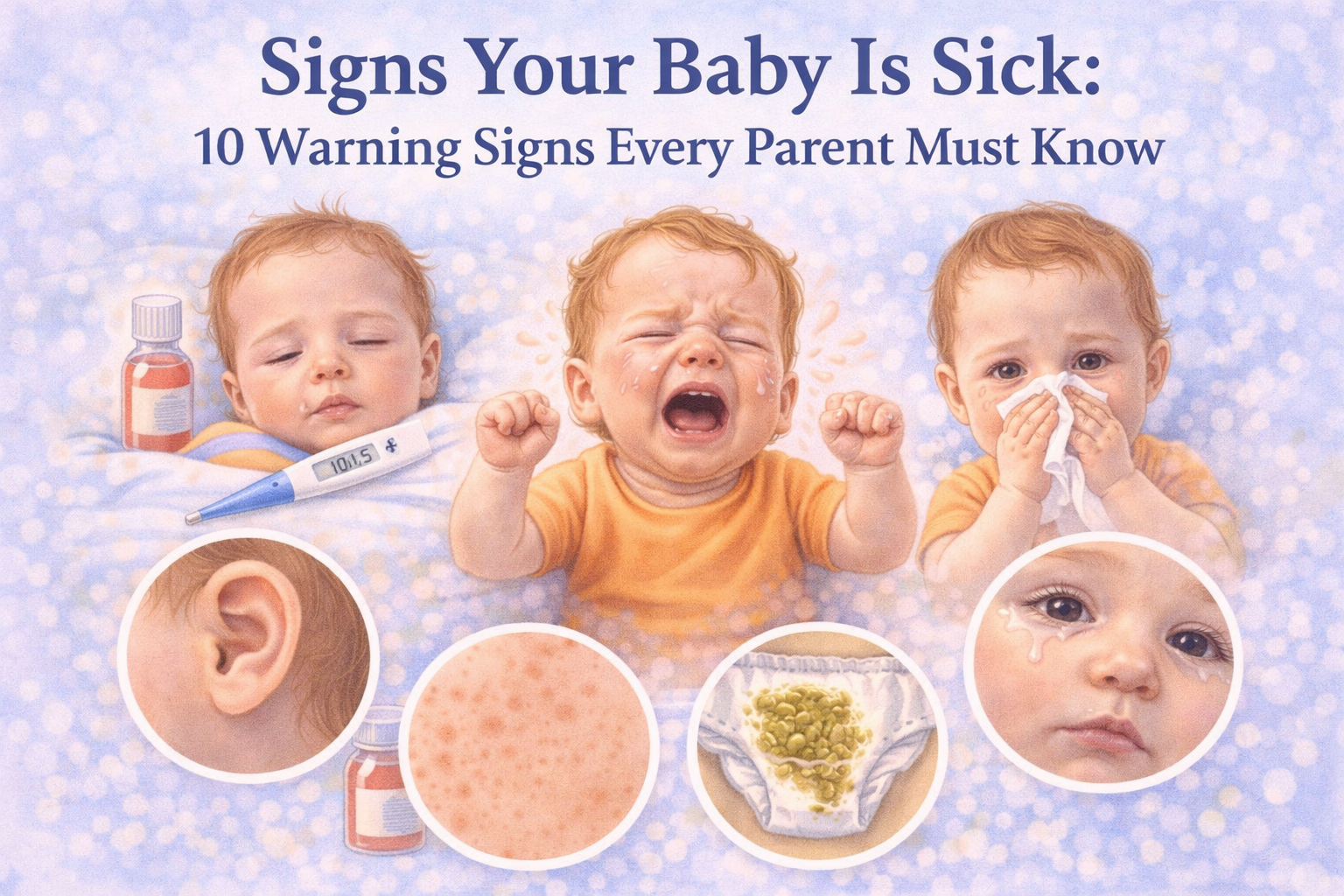
Signs Your Baby Is Sick: 10 Warning Signs Every Parent Must Know
As a new parent, one of the most frightening experiences is not knowing whether your baby is genuinely unwell or simply going through one of the many normal phases of infant development. Babies cannot tell you where it hurts or how they feel. They communicate through behaviour, and learning to read that behaviour is one of the most important skills you will develop in the first year of life.
This guide covers the ten most important warning signs that your baby may be sick, explains what each sign might mean, and tells you clearly when to seek same-day medical attention versus when to monitor at home.
Why Newborns Are Particularly Vulnerable
In the first three months of life, babies have an immature immune system. They have some protection from maternal antibodies passed through the placenta and breast milk, but this protection is incomplete and diminishing. A fever in a baby under three months is always a medical emergency — their bodies cannot mount the same immune response as older babies, and infections can become serious very quickly.
After three months, the immune system becomes progressively stronger, but babies remain vulnerable to a wide range of viral and bacterial infections throughout the first year. The ten signs below apply to babies of all ages, though the urgency varies depending on your baby's age.
Sign 1: Fever
A rectal temperature of 38°C or above in a baby under three months requires immediate emergency assessment — do not wait and see. In babies aged three to six months, a fever of 38°C or above warrants same-day medical attention. In babies over six months, a fever is less immediately alarming but should be assessed if it lasts more than two to three days, is above 39°C, or is accompanied by other concerning signs.
The most accurate way to take a baby's temperature is rectally, but an axillary (armpit) reading from a reliable digital thermometer is acceptable for home monitoring. Ear thermometers are not reliable in babies under six months because the ear canal is too small for an accurate reading.
🛒 RECOMMENDED PRODUCT Dr Trust Digital Thermometer Every parent should have a reliable digital thermometer at home before their baby is born. The Dr. Trust Digital Thermometer is accurate, fast and safe for newborns — paste your Amazon affiliate link here. 🔗 Amazon Link: Dr Trust Digital Thermometer |
Sign 2: Unusual Crying
All babies cry — it is their primary form of communication. But most parents quickly learn to distinguish their baby's different cries: the hungry cry, the tired cry, the uncomfortable cry. A cry that sounds different from your baby's usual cries — particularly a high-pitched, continuous, inconsolable cry — can be a sign of pain or serious illness.
If your baby cannot be soothed by feeding, holding, rocking or any of the usual techniques, and this is not their normal behaviour, contact your pediatrician.
Sign 3: Lethargy or Unusual Sleepiness
A baby who is much harder than usual to wake, who seems limp or floppy, who is not making eye contact, or who lacks their normal responsiveness is showing one of the most serious warning signs in infant illness. Lethargy in a baby is never normal. It can indicate serious infections including meningitis, sepsis, or severe dehydration.
This is different from a baby who is simply sleeping more during a growth spurt. A lethargic baby looks and feels different — they do not respond normally to stimulation, their muscle tone may be reduced, and they may not be interested in feeding.
Sign 4: Difficulty Breathing
Normal breathing in newborns is irregular — they may breathe quickly, then pause briefly, then breathe again. This is called periodic breathing and is normal. What is not normal is laboured breathing, where you can see the muscles between the ribs pulling in with each breath (called intercostal recession), rapid breathing sustained over several minutes (more than 60 breaths per minute in a newborn), or any breathing that sounds like grunting.
A bluish tinge around the lips or fingertips (cyanosis) is a sign that your baby is not getting enough oxygen and requires immediate emergency care.
Sign 5: Refusing to Feed
Babies are driven to feed — it is one of their strongest instincts. A baby who consistently refuses feeds over a six to eight hour period, who is taking significantly less than their usual amount, or who is too weak or uninterested to feed properly may be unwell. Refusal to feed combined with any other sign on this list significantly increases the concern.
Sign 6: Vomiting
Posseting — bringing up small amounts of milk after feeds — is entirely normal in young babies. Vomiting is different. It involves forceful expulsion of larger amounts and is often associated with distress. A single episode of vomiting is rarely concerning. Persistent vomiting, vomiting that contains blood or bile (green colour), or vomiting in a baby who is also lethargic or feverish requires prompt medical assessment.
Sign 7: Diarrhoea
Breastfed babies often have frequent, loose, mustard-yellow stools — this is normal. Formula-fed babies typically have firmer, less frequent stools. A significant change from your baby's normal stool pattern, particularly stools that are very watery, very frequent, or contain blood or mucus, warrants attention. Diarrhoea in young babies can cause dehydration very quickly.
Sign 8: Signs of Dehydration
Dehydration in babies can occur rapidly and become serious. Warning signs include a sunken fontanelle (the soft spot on top of the head), dry mouth and lips, no tears when crying, significantly fewer wet nappies than usual (less than four in 24 hours), and dark or strong-smelling urine. Any baby showing signs of dehydration needs same-day medical assessment.
Sign 9: Rash
Many baby rashes are harmless — heat rash, neonatal acne, and dry skin are all common and benign. A rash that does not fade when you press a clear glass firmly against it (the glass test) may be a sign of meningococcal disease and requires immediate emergency care. A widespread red rash accompanied by fever also requires same-day assessment.
Sign 10: Nasal Congestion Affecting Feeding
Newborns breathe predominantly through their nose, so even mild congestion can interfere significantly with feeding. If your baby is too congested to feed effectively and is becoming dehydrated or distressed, saline nasal drops and gentle suction before feeds can help.
🛒 RECOMMENDED PRODUCT NoseFrida Nasal Aspirator A nasal aspirator makes clearing a blocked newborn nose much easier before feeds. The NoseFrida is the most recommended nasal aspirator by Indian pediatricians — paste your Amazon affiliate link here. 🔗 Amazon Link: NoseFrida Nasal Aspirator |
When to Go to the Emergency Department Immediately
Take your baby to the emergency department without delay if they have: a temperature above 38°C and are under three months old, blue or grey colouring around the lips or fingertips, a rash that does not fade under pressure, breathing difficulty with visible effort, a bulging fontanelle, a seizure, or if you instinctively feel something is seriously wrong. Your instincts as a parent matter — if something feels wrong, get it assessed.
Finding a trusted pediatrician before your baby needs one makes all the difference. Visit firstchoiceclub.in to find verified pediatricians in your area.
🛒 RECOMMENDED PRODUCT Baby First Aid Kit A well-stocked baby first aid kit should be ready before your baby arrives. Search for a complete newborn first aid kit on Amazon — paste your affiliate link here. 🔗 Amazon Link: Baby First Aid Kit |
20 Mar