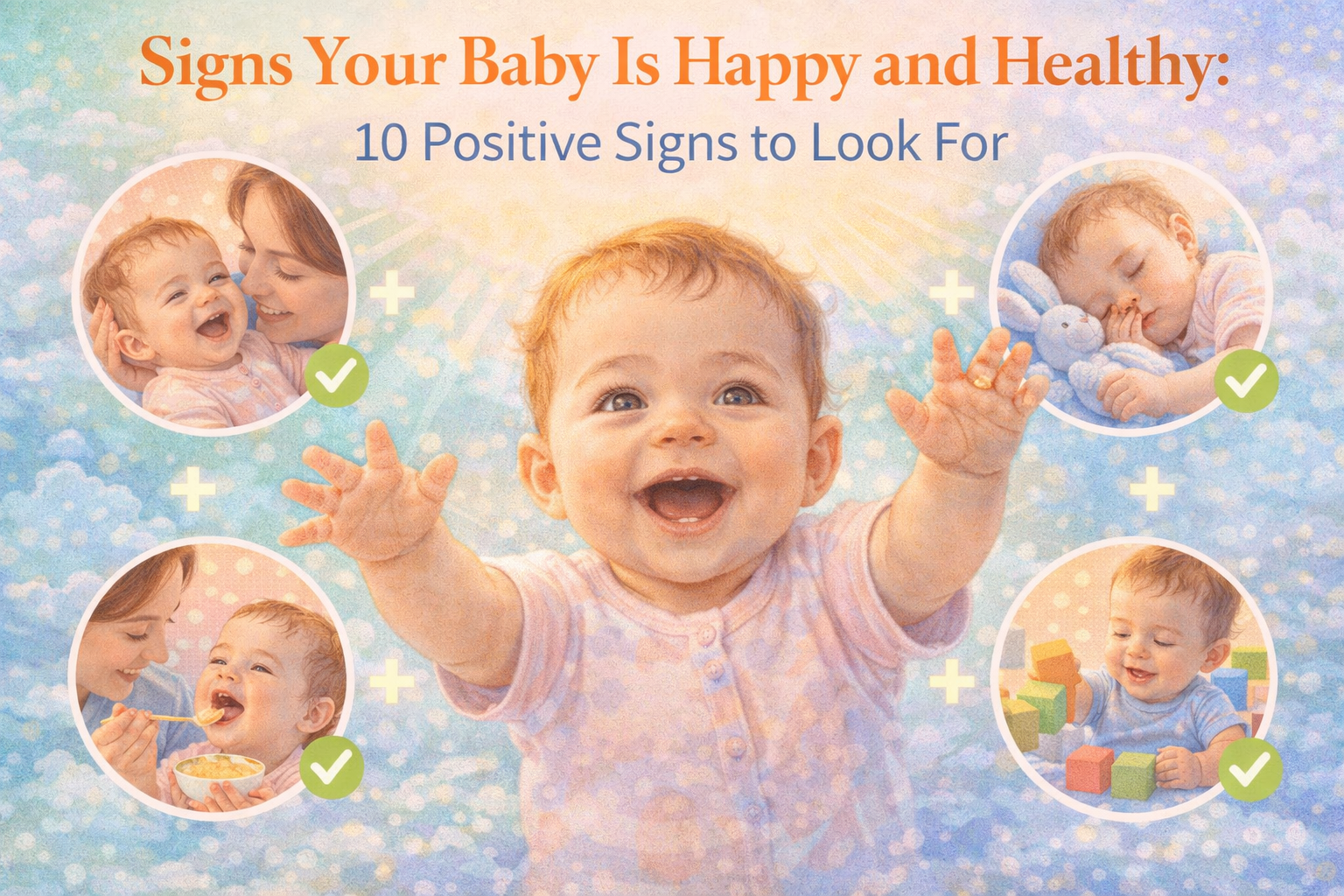
Signs Your Baby Is Happy and Healthy: 10 Positive Signs to Look For
New parents spend a lot of time worrying about what might be wrong with their baby. But what about recognising what is right? Learning to read the signs that your baby is genuinely happy, thriving and developing well is just as important as knowing the warning signs of illness — and considerably more reassuring.
Here are ten positive signs that your baby is doing exactly as they should.
Sign 1: Regular Feeding and Good Weight Gain
A baby who feeds regularly — whether breastfed or formula-fed — and is gaining weight along their expected growth curve is showing the most fundamental sign of good health. In the first few days of life, babies normally lose up to 10 percent of their birth weight, then regain it by approximately ten to fourteen days. After that, expect consistent weekly gains — your pediatrician will monitor this at check-ups.
Sign 2: Wet and Dirty Nappies
The number of wet and dirty nappies your baby produces is one of the best indicators of adequate feeding. In the first few days, expect one wet nappy per day of life (one wet nappy on day one, two on day two, and so on). By day five to seven, a well-fed baby should have at least six wet nappies in 24 hours. Breastfed babies typically have frequent, loose yellow stools, while formula-fed babies have firmer, less frequent stools.
Sign 3: Alertness and Eye Contact
When your baby is awake and content, they should be alert — making eye contact, responding to your voice and face, and showing interest in their environment. Newborns can focus best at a distance of about 20 to 30 centimetres, which is approximately the distance between your face and theirs during feeding. By six to eight weeks, most babies begin to smile in response to faces and voices.
Sign 4: The Social Smile
The first social smile — a genuine smile in response to a face or voice, as opposed to the reflexive smiles of the newborn period — is one of the most joyful moments in early parenting. It typically emerges between four and eight weeks of age. This smile signals that your baby is beginning to develop the social and emotional connections that are fundamental to healthy development.
Sign 5: Normal Periods of Sleep and Wakefulness
A healthy newborn typically sleeps between 14 and 17 hours in 24 hours, in periods of two to four hours. As babies grow, sleep periods lengthen and the proportion of nighttime sleep gradually increases. A baby who cycles through clear periods of sleep and alertness — rather than being either constantly sleepy or constantly irritable — is demonstrating a healthy developing nervous system.
🛒 RECOMMENDED PRODUCT Fisher Price Baby Activity Gym A baby activity gym provides visual and tactile stimulation for healthy development during alert periods. The Fisher-Price Kick and Play Piano Gym is one of the most popular options for Indian parents. Paste your Amazon affiliate link here. 🔗 Amazon Link: Fisher Price Baby Activity Gym |
Sign 6: Responding to Sounds
From birth, babies are sensitive to sound — they startle at loud noises and show preference for familiar voices, particularly their mother's. By three to four months, a baby should consistently turn toward the source of a familiar voice and show visible excitement at hearing it. If you have any concerns about your baby's hearing, visit firstchoiceclub.in to find hearing assessment services in your area.
Sign 7: Physical Milestones
Physical development in the first year follows a broadly predictable sequence. By two months, most babies can briefly lift their head during tummy time. By four months, they can hold their head steady and are beginning to reach for objects. By six months, most can sit with support. By nine months, many are crawling. By twelve months, most are pulling to stand. These are ranges, not deadlines — significant variation is normal.
Sign 8: Settling After Feeding
A baby who settles comfortably after feeds — without persistent crying, arching or obvious distress — is generally feeding well and digesting comfortably. Some degree of fussiness is normal, particularly in the late afternoon. But a baby who is consistently impossible to settle after feeds may be experiencing feeding difficulties or reflux worth discussing with your pediatrician.
Sign 9: Engagement During Play
As babies move through the first months, they become increasingly engaged during awake periods. They begin to bat at objects, track moving items with their eyes, vocalise in response to interaction, and show clear preferences. This engagement is a sign of healthy cognitive and sensory development.
🛒 RECOMMENDED PRODUCT Infant Sensory Toys 0 to 6 Months Age-appropriate sensory toys support cognitive and motor development. Search for infant sensory toys on Amazon and paste your affiliate link here. 🔗 Amazon Link:Infant Sensory Toys 0 to 6 Months |
Sign 10: A Calm, Content Temperament Between Feeds
Perhaps the most reassuring sign of all: a baby who, when their needs are met, shows periods of genuine contentment — gazing peacefully, vocalising softly, or simply resting comfortably. Not every baby has an easy temperament, and some are more sensitive or reactive than others. But a baby who can be reliably soothed and who shows regular periods of calm is demonstrating healthy self-regulation that will only improve with time.
21 Mar