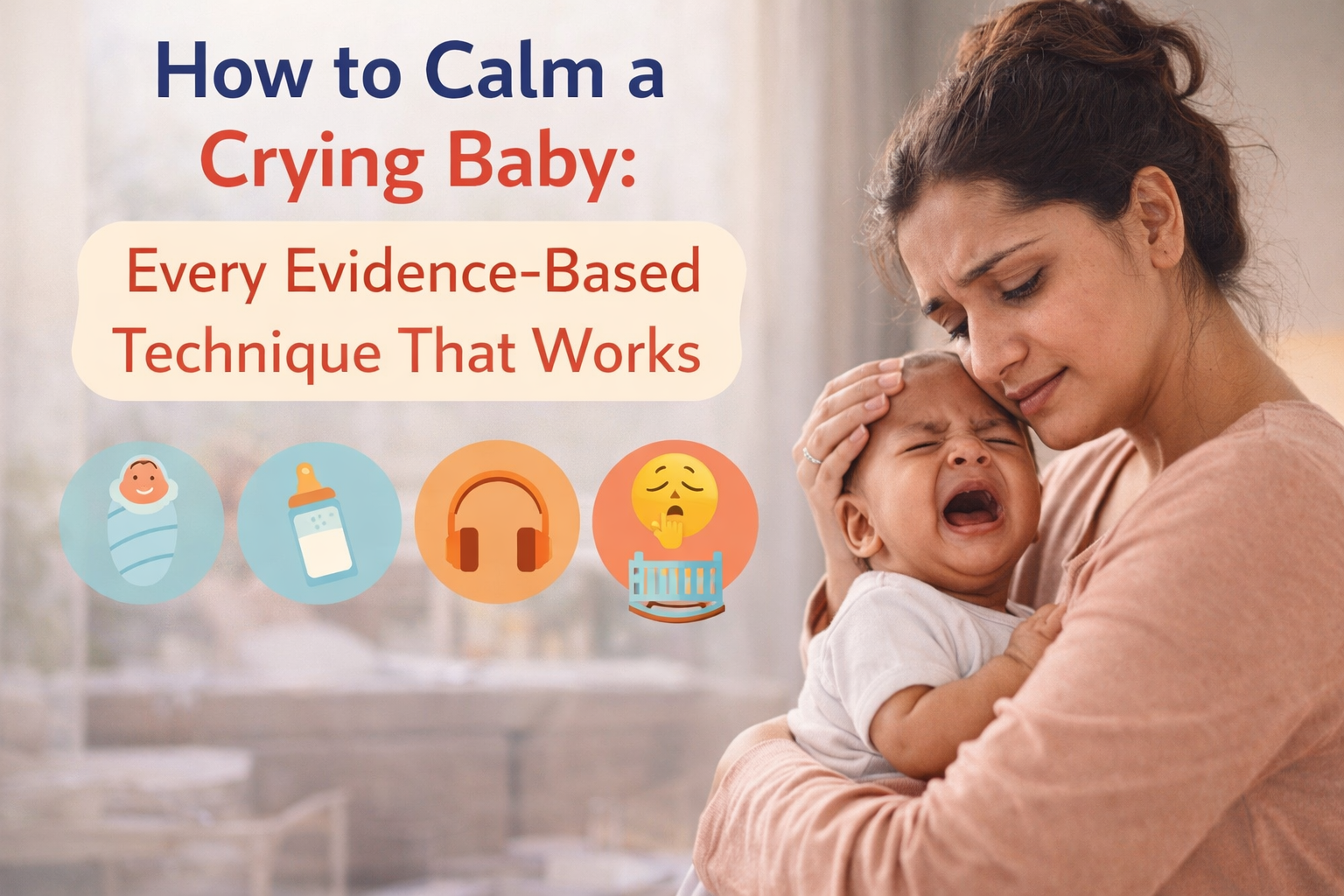
How to Calm a Crying Baby: Every Evidence-Based Technique That Works
A crying baby is one of the most stressful sounds a human being can hear — by evolutionary design. Your brain is literally wired to find that sound distressing, because historically, responding quickly to a baby's cry was a matter of survival. But when you are exhausted, have tried everything you can think of, and your baby is still screaming, that biological imperative quickly becomes overwhelming.
This guide gives you every evidence-based technique for calming a crying baby, explains the science behind each one, and helps you understand why your baby might be crying in the first place.
First: Understand Why Babies Cry
Crying is your baby's only means of communication. Before attempting any calming technique, run through a quick checklist: Is the baby hungry? (Most common cause in the first weeks) Is the nappy wet or dirty? Is the baby too hot or too cold? Is the baby overtired? Is the baby in pain (gas, reflux, illness)? Does the baby need closeness and stimulation?
Addressing the underlying cause is always more effective than any calming technique. If you cannot identify a cause and the crying persists, proceed to the techniques below.
The 5 S Method (Dr Harvey Karp)
Pediatrician Dr Harvey Karp identified five techniques that mimic the womb environment and trigger what he calls the calming reflex in newborns. Used together, they are highly effective for most babies in the first three to four months.
Swaddling
Snug wrapping in a muslin or cotton blanket recreates the snug containment of the womb and prevents the startle reflex (Moro reflex) from waking and distressing the baby. The arms should be wrapped firmly but not tightly, with the legs able to flex. If you find swaddling difficult to master consistently, a velcro swaddle makes it easier.
🛒 RECOMMENDED PRODUCT SwaddleMe Velcro Swaddle Baby The SwaddleMe Original Swaddle uses velcro fastening to create a secure swaddle even for sleep-deprived parents at 3am. Paste your Amazon affiliate link here. 🔗 Amazon Link: SwaddleMe Velcro Swaddle Baby |
Side or Stomach Position (While Held)
Holding a crying baby on their side or stomach (across your forearm, face down, with their head at your elbow) activates the calming reflex more effectively than holding them upright on your shoulder. Note: this position is only for calming while awake and held — babies must always sleep on their backs.
Shushing
A loud, sustained shushing sound made directly near the baby's ear — louder than most people feel comfortable with — mimics the sound of blood flow in the womb. It needs to be approximately as loud as the baby's crying to be effective. Alternatively, white noise played at appropriate volume achieves the same effect.
Swinging
Small, rapid, rhythmic movements — the head and neck always well supported — activate the calming reflex. This is different from the large, slow rocking movement most parents instinctively use. Think of the jiggling motion a parent uses when walking with a crying baby, not the gentle rocking of a traditional rocking chair.
🛒 RECOMMENDED PRODUCT Fisher Price Baby Swing For persistent crying, a baby swing can be genuinely life-changing in the early weeks. The Fisher-Price Snuga Swing provides the consistent rhythmic motion that activates the calming reflex in most newborns. Paste your Amazon affiliate link here. 🔗 Amazon Link: Fisher Price Baby Swing |
Sucking
Non-nutritive sucking — sucking for comfort rather than for food — is a powerful self-regulation tool for babies. The options are: breastfeeding for comfort, a clean finger, or a pacifier. Pacifiers are generally recommended after breastfeeding is well established (usually three to four weeks) to avoid nipple confusion.
🛒 RECOMMENDED PRODUCT Philips Avent Pacifier Orthodontic The Philips Avent Ultra Soft Orthodontic Pacifier is the most widely recommended option by Indian pediatricians. Paste your Amazon affiliate link here. 🔗 Amazon Link:Philips Avent Pacifier Orthodontic |
Other Proven Calming Techniques
Skin-to-Skin Contact
Placing your baby directly on your chest, skin to skin, regulates their temperature, heart rate and breathing, and releases oxytocin in both baby and parent. It is one of the most powerful calming techniques available, particularly for newborns.
Baby Wearing
Carrying your baby in a sling or carrier keeps them close to your heartbeat, body warmth and movement throughout the day, reducing the total amount of crying significantly. Studies show that babies who are carried for an extra three hours per day cry approximately 43 percent less.
Fresh Air and Change of Environment
A change of scene is often surprisingly effective for an inconsolable baby. Taking your baby outside, even briefly, provides novel sensory input that can interrupt a crying cycle.
When Crying May Indicate a Problem
Seek medical assessment if your baby: cries inconsolably for more than three hours despite your best efforts, has a cry that sounds different from their usual cry (especially high-pitched), has a fever, refuses feeds, or if you have any instinct that something is wrong. Trust your instincts. Visit firstchoiceclub.in to find trusted pediatricians in your area.
22 Mar